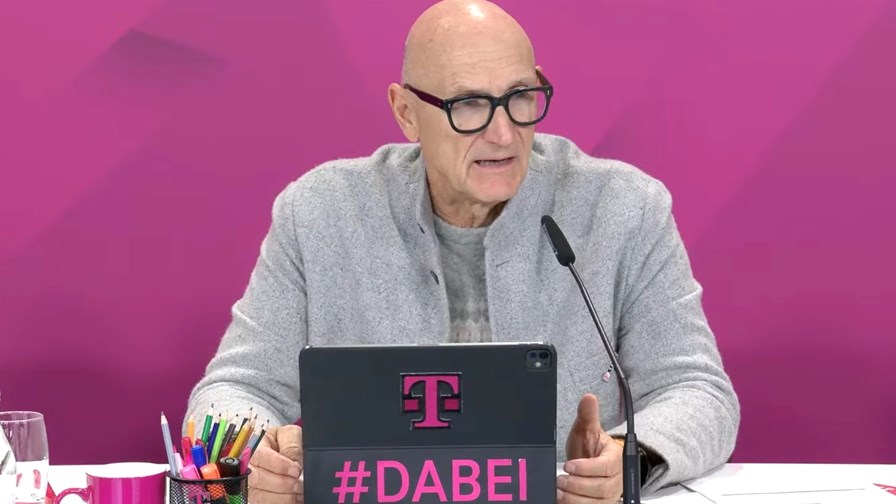
Deutsche Telekom’s CEO Tim Höttges shares his views on the SpaceX competitive challenge during DT's Q3 earnings call.
- SpaceX’s plan to build a Starlink Mobile terrestrial cellular network in the US is causing waves in the telecom sector
- Deutsche Telekom’s CEO, Tim Höttges, addressed the ‘fear’ head on during the German giant’s third-quarter earnings call
- He noted that just to build a greenfield mobile access network in the US would cost at least $200bn
- But Höttges also noted that Elon Musk’s company is developing a new ‘category’ of communications services built on vertical integration that needs to be addressed by the traditional telco sector
- ‘I take his attempt seriously’, noted Höttges
In preparing for his company’s third-quarter earnings conference call, Deutsche Telekom’s CEO, Tim Höttges, knew that financial analysts would ask him about the competitive threat from Elon Musk’s SpaceX in the US market during the Q&A segment of the session. So Höttges decided to address the topic head on by acknowledging the “fear” in the market, reiterating DT’s strong position, and coming armed with some analysis of how SpaceX’s plan to build a greenfield Starlink Mobile terrestrial cellular network in the US might play out and the likely costs involved.
But Höttges also made it clear he is taking Musk’s approach very seriously, noting that if the telco sector sits back and watches SpaceX develop a new kind of integrated AI-native communications company that leverages the various strengths of the trillionaire’s industrial empire, it could find itself in a similar position to the traditional auto sector – having to scramble to catch up in a new world shaped by AI and ubiquitous connectivity.
As a quick reminder, SpaceX has aspirations for Starlink Mobile – currently a provider of wholesale direct-to-device (D2D) connectivity from its low-earth orbit (LEO) satellite constellation – to become a “major mobile carrier in the US” by building a terrestrial network and acquiring spectrum licences – see Spectrum deal advances Starlink’s ‘major mobile carrier’ plan.
SpaceX is moving quickly: It is reportedly in talks to use Crown Castle’s towers across the US for part of its infrastructure rollout, is also reported to be mulling over whether it could buy or team up with Echostar’s Boost Mobile operation to give itself a foothold in the US mobile services sector, and has just selected Qualcomm’s Dragonwing Cellular Infrastructure platforms for its terrestrial 5G radio access network (RAN) rollout “with an opportunity to lay the foundation for AI-native 6G in the years ahead”.
So what did Hottges have to say?
Opening remarks
The CEO didn’t wait to be asked. He opened the earnings call by noting that DT is ensuring it has skin in the D2D game in North America and Europe, reminding investors and analysts that T-Mobile US (in which DT holds a majority stake) has teamed up with the other main telcos – AT&T and Verizon – to form a joint venture “for satellite rural coverage” and that in Europe “DT is exploring a joint bid with three other operators for European satellite spectrum, following the same logic as what we have laid out in the US.”
Then he addressed the elephant in the room.
“Clearly, there is a lot of fear in the market – fear that our industry could get disrupted by new forces, be it AI agents or satellite players. The big question for me here is – how can we give you confidence about our business model and about Deutsche Telekom? Let me start with three components on this,” he said.
“The first one is our track record, and we have always delivered over the last almost 20 years, or 15 years under my tenure here as CEO. Today, we show you another set of very strong results. It is not just that we are delivering. We are delivering in highly competitive market situations. We are outperforming the competition, as you have seen on our current numbers, for instance, in Germany, time and time and time again. The US market is getting even more competitive. Our European markets are already very competitive, and we know how to survive in this environment,” noted Höttges as he launched into a checklist of growth and network rollout statistics in Germany and across Europe.
Second, “in the US, we look at the forthcoming spectrum auctions as an opportunity to strengthen our leadership, not only on the spectrum side but even on the network side. We have a strong brand, the most valuable telco brand in the world, strong execution, technology leadership and a unique transatlantic presence. As we outlined at our recent [AI] investor day, we are aggressively leveraging AI for better customer experience, for growth and for significant efficiency gains within the entire workflow of this organisation. So, we are investing today, and we are reinvesting today’s success into our future strength.
Thirdly, “let me mention some of the challenges faced by our competition. Building [network infrastructure] is super expensive, and filling the networks takes even more time. Building a terrestrial network is costly and takes many years. It is much more complicated than it may look in the lab or on a spreadsheet. In the US, we have 380 megahertz of high-quality low- and mid-band spectrum. This will be hard, if not impossible, to match. Sometimes I am a bit irritated how quickly the market thinks that everything that has been built over centuries can get disrupted within a minute. I do not see this.”
But the CEO is looking past his irritation.
“We are not ignoring the potential challenge… my organisation is waking up and addressing these topics, but we should not panic. We have to put our blinkers on… we have to focus on delivering on our strategy. We have to deliver excellent, outstanding customer service, and then I am very confident that we will manage all the challenges that are laying in front of us.”
The MVNO angle
Then it was time to address analyst questions, starting with one from Goldman Sachs analyst Andrew Lee, who noted that while building networks is hard and expensive, new entrants have disrupted markets in Europe, such as France and Italy, where government support ensured mobile virtual network operators (MVNOs) access to the market to get started. “How confident are you that the US will be different to those examples?” asked Lee.
Höttges, as you might expect, took the same line as the one put forward by T-Mobile US CEO Srini Gopalan during his recent earnings call Q&A session.
DT’s CEO noted: “Our philosophy on MVNOs has been very clear and remains unchanged. It is about access to new customers, and it is an access to new channels. [This] is why we like MVNOs. We don’t like MVNOs just to fill pipes, create contribution to earnings and then, at the end of the day, lose control about our own retail prices because the MVNO is always offering a cheaper price. I am not a big fan of MVNOs because we are filling our pipes with our own customers, with our own brand, and we have a big pull on this one. Therefore, I do not want to see an arbitrage on our business going forward. Therefore, it is very difficult to see how an MVNO agreement with Starlink would fit into that framework going forward. Unlike [markets in Europe], we don’t see any kind of pressure from regulatory intervention to force an MVNO to be provided.”
Network deployment challenges and costs
Next, Höttges shared his views on just what it would take to develop a network that could rival the US telco incumbents.
JP Morgan analyst Akhil Dattani asked about the options that SpaceX has for entering the US market, by either building or buying a network, and the DT CEO launched into his answer.
“This is something we are looking into intensively. We have always said that satellite services will not substitute terrestrial service. It’s impossible from a bandwidth [perspective]. You cannot build so many satellites – it’s impossible. If you have an antenna 10 metres or 100 metres away from you, why should you go 400km up and down? 80% of all the calls are made indoors.
“So, how do you get indoors? Please don’t tell me that femtocells are the solution,” stated Höttges, referencing the plan shared by SpaceX in August that centred on the use of small cell radios. “This is a technology that we have tested 10 years ago” and which was found to be challenged by interference issues. “Therefore, we created indoor coverage with low-band spectrum to a big extent,” noted the CEO.
And what about the potential of using Wi-Fi for indoor connectivity? “Wi-Fi, by the way, is shrinking. It’s not on a growth [trend]. Therefore, this is not the alternative,” opined Höttges in what might be deemed as a contentious view.
If Musk wants to “play in the telecommunication business or in the connectivity business, he needs terrestrial service. No question. By the way, I take his attempt seriously. He has now bought 76 megahertz of spectrum.”
But T-Mobile US has 400 megahertz, he stated. “So if you now say he can buy the spectrum prospectively, do your math – triple-digit billions are needed to gain this spectrum position. Okay, if he has the money, go for it. Then he has to build a network. I can tell you, we have 85,000 towers. He can rent towers, no question. But this is another $20bn to $30bn.”
Then you need to install antennas on the towers, and maybe SpaceX could source the technology in a cost-effective way and build out the coverage in a new way, noted the CEO, “but you [still] need money for that. Therefore, my assessment is that SpaceX, if it wants to play in this industry, needs at least minimum $200bn, but even beyond that, to play in an industry which we have, let’s say, professionalised over the past 20 years. Okay, welcome to the party!”
But building a network isn’t the only option, of course.
“He can make a deal – build or buy, and he can choose whether he wants to spend the money or whether he’s acquiring a business... acquiring a business [offers] less control of the value chain, but… you immediately get cash flow as well and you’re not creating over-capacity. Therefore, I would always prefer the buy option.”
SpaceX is changing the industry
Höttges, though, is also aware that Musk’s approach with SpaceX will disrupt the telecom sector, which in the future will not be just a mobile proposition (or “mobile-and-mobile” as the CEO likes to call it).
“What we have to face is [that] SpaceX is creating a new category. I would compare it with, let’s say, inventing Tesla and bringing electromobility into a kind of legacy combustion engine industry. That is the same moment we have, and this moment is now here. We have a new kind of player coming to the ecosystem. He has chipsets, he has datacentres, he has AI, he has satellites, he wants to go for mobile services, and he goes for handsets. He will [probably also] integrate social media or at least agentic models into his service. So, he is creating a new way of communication services. It’s not that you can compare it with mobile-and-mobile. Therefore, we have now to find the right answer about this, maybe over the next five to 10 years, a new kind of business he’s going to create with a vertical integration.”
The CEO stated that this is why he is taking Musk’s efforts in the US mobile sector “super serious”, because this kind of disruption has already been seen in the car industry. That auto sector “were ignoring it for too long, and we have to face the situation. But it’s not a free lunch – you see that with Tesla as well in the car industry. Tesla is not a very successful car company – that's my assessment, at least, looking at the numbers and comparing that with Chinese cars, for instance.” That analysis might sting…
Having recognised the situation, DT/T-Mobile US and the other telcos “have possibilities to tackle this competition. You have to do it in a very intelligent and smart way. He’s here to stay. He needs tonnes of money to deploy this industry and to make it successful.”
Höttges reiterated that, if the choice was his, he would not opt to spend $200bn to $300bn to build a fourth national radio access network, and he noted that the recent effort by Charlie Ergen’s Echostar with Dish Mobile (now renamed Boost Mobile) to build an Open RAN-based network resulted in that competitive threat “coming to the market and then disappearing unsuccessfully”.
Instead, he stressed that Musk’s SpaceX move to create a new “category” in the comms services sector needs to be addressed seriously, but that any concerted effort will not lead to the eradication of the US mobile operators. “This is not something that I foresee at all, to be very clear.”
Of course, you wouldn’t expect Höttges to say anything else, just as you would expect him to stress how expensive and tough it is just to build a network let alone run it and attract and retain customers while trying to make money and please shareholders. That DT’s CEO also dismissed any ideas of using femtocells/small cells and/or Wi-Fi to provision terrestrial services is also not a shock – he has very clearly sowed seeds of doubt about whether SpaceX’s plans are in any way credible.
But it’s clear that Höttges knows that Musk’s plans need to be addressed and dealt with and that, indeed, providing cellular connectivity would only be one small part of what Starlink Mobile would be offering to prospective customers however it ends up developing its services strategy. The SpaceX plan might look counterintuitive and a potential distraction to many but, as DT’s CEO noted, the telco sector would be crazy to ignore it as the fanciful dreams of a deluded egotist.
- Ray Le Maistre, Editorial Director, TelecomTV
Email Newsletters
Sign up to receive TelecomTV's top news and videos, plus exclusive subscriber-only content direct to your inbox.