Telia’s path to building trust in multi-agent telecom networks

By James Pearce
Nov 5, 2026
To embed our video on your website copy and paste the code below:
<iframe src="https://www.youtube.com/embed/G4VvcqnGdlQ?modestbranding=1&rel=0" width="970" height="546" frameborder="0" scrolling="auto" allowfullscreen></iframe>
James Pearce, TelecomTV (00:05):
Hello and welcome to TelecomTV. I'm James Pearce, and I'm delighted to be joined today by Marton Sabli, who's from Telia. Thank you so much for joining us today. As we move from single-purpose machine learning models to multi-agent ecosystems, how is Telia structuring the orchestration plane to prevent conflicting actions between agents?
Marton Sabli, Telia (00:27):
Yeah, so first to be honest, we are at the beginning of this journey. So we have started first with simple agents with, you could say, one task or one skill so that we gain trust in how they operate. Just recently we have introduced for the first time an environment where we have, you could say, two agents, which are in a serial mode. So you could say an agent which is doing a root cause analysis and then feeds that input into some kind of an action recommendation agent. So the orchestration at this stage is still quite simple. Either it's just a single-purpose, single-task agent or they are, you could say, fed in a sequence. But this will become complex and more and more complex as we move on. Right now we try to keep this chain relatively straightforward and simple.
James Pearce, TelecomTV (01:24):
So agentic reasoning requires rich real-time context. How have you addressed the ontology latency, the graph updates and data quality issues across legacy stacks to feed agents accurately?
Marton Sabli, Telia (01:38):
Yeah, so this is a really good question first of all. So let me start breaking down into maybe two buckets. One is the knowledge itself, so the ontology, the understanding of the network. And here Telia did a fantastic job even before my time, consolidating the different data sources from the RAN, from the packet core, transport, even IT into a single coherent ontology so that instead of working with hundreds of legacy sources of data, now we have a modern interconnected data model in a central place. It's kind of a federation. And we realized that with AI coming now into the picture, this is a fantastic single source of truth because ontology is a structured data, AI understands the structure and then can reason with the data in there. And just checked recently, so we have 43 million components out of all the five countries in this data model. So that's a fantastic starting point. So that helped us also to accelerate the agentic introduction because we didn't have to do this data cleaning, data consolidation. It was already there. So that's one part of the challenge. And the other one is, as you say, how do we collect the network information in near real-time? So collect the telemetry, the events, the performance, the anomalies. And here we also have a relatively good situation, meaning that the data collection and, you could say, the analysis engine to find anomalies were already in place. So thanks to these, you could say, two good starting points, we could focus actually on automation and introduction of AI agents on top of that.
James Pearce, TelecomTV (03:48):
So what specific criteria or guardrails does Telia use to transition an agentic workflow from the recommendation mode with human approval required into a fully autonomous closed-loop execution?
Marton Sabli, Telia (04:04):
Yeah, so first of all, we try not to do yet fully closed-loop. So when we did these more complex agentic workflows, so one example was, you could say, the root cause analysis and then, you could say, the recommendation engine, what to do to resolve the original root cause. In that flow, we also have commands, that theoretically could be executed and sent to the network. But at this stage, we are running that through a human-in-the-loop. And we believe that through time, when our first-line, second-line get to trust that, okay, this is correct and this is correct and this is correct. So over time, the automation will be enabled because the automation is a choice. It's not a technical challenge. You could just throw those commands in an Ansible script and run them, but we want to get trust into the process. And if it doesn't work, of course we need to fine-tune it. So that's the stage we are at this stage.
James Pearce, TelecomTV (05:20):
So if we stick with that idea of trust, as we introduce more autonomy and redesign the OSS stack, how can you build operational trust within the engineering teams who have to implement it?
Marton Sabli, Telia (05:31):
Yeah, so this is a really good question. So just to step back, when we started this autonomous journey, first we did, you could say, baselining, like where do we need to improve automation? What are the manual tasks people are doing in different parts of the network? And then of course we focused on those types of autonomous network projects where we can do the most reducing manual work. So of course, now when we introduce these kind of automation capabilities, we need to see evidence that the people who are involved in these processes are actually freed up doing these manual tasks and potentially could do something more cognitively important instead of pressing buttons, looking at logs and following a graph and this kind of thing. So the proof will be when we deploy it to see that it actually results in what we hope to achieve with the automation in place.
James Pearce, TelecomTV (06:49):
Brilliant. Well, I look forward to seeing how that works out. Thank you for joining us today.
Marton Sabli, Telia (06:52):
Thank you.
Please note that video transcripts are provided for reference only – content may vary from the published video or contain inaccuracies.
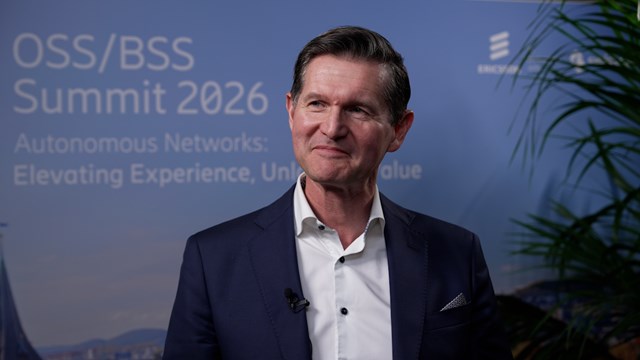
Marton Sabli, Head of Architecture & Roadmap, IT Production, Telia
At Ericsson’s OSS/BSS Summit 2026, Marton Sabli, head of architecture and roadmap for IT production at Telia, talks about how Telia is building trust in agentic AI by validating early results. He explains why Telia keeps humans in the loop for root-cause resolution and automated execution until engineering teams build operational trust.
Recorded October 2026
Email Newsletters
Sign up to receive TelecomTV's top news and videos, plus exclusive subscriber-only content direct to your inbox.