How Telstra and Ericsson turn data into knowledge

By James Pearce
Nov 6, 2026
To embed our video on your website copy and paste the code below:
<iframe src="https://www.youtube.com/embed/sy-c9RFH8tU?modestbranding=1&rel=0" width="970" height="546" frameborder="0" scrolling="auto" allowfullscreen></iframe>
James Pearce, TelecomTV (00:05):
Hello and welcome to TelecomTV. I'm James Pearce. I'm delighted to be joined today by Mark Sanders from Telstra. Thank you so much for joining us today, Mark. You attended and presented at the Ericsson OSS/BSS Summit last year. What are your main expectations from an event like this?
Mark Sanders, Telstra (00:20):
Just to hear how all the other operators are going and for them to share their experiences and for us to share ours and try to understand real-world progress and the challenges that they're facing and how they're looking to solve them. But there's been some great presenters and I've really thoroughly enjoyed listening to them and understanding where they're at on their pathway.
James Pearce, TelecomTV (00:40):
Telstra and Ericsson have announced further collaboration on knowledge taxonomy and composition. What can you tell us about this? What is it expected to contribute towards the TM Forum?
Mark Sanders, Telstra (00:51):
Yeah, so this builds upon a great piece of work we did with Ericsson last year. So last year we set out with the problem, how do we truly become autonomous? What does that mean? And how do we have trust in autonomy, particularly when we want it to act on the network? And that was a great piece of work and it resulted in contributing to many TM Forum initiatives and the concept of knowledge and ontology is a topic that's been discussed a lot actually at this event and it's been in many other speaker presentations. So it had that effect of advancing the industry. Now what we want to do is take that concept of knowledge even further. And the first part is knowledge classifications. What do we mean by knowledge? Everyone throws around terms of ontology and knowledge and semantics and semantic layer, what do we mean? Why do we care? And how do we trust in that knowledge and how are we going to use it and reason over it? The second point is, as you mentioned, knowledge composition. And it's really important because knowledge isn't centralized. Knowledge is all over an enterprise, all over the network. It's in various network domains, it's in business domains, and it's with our vendors, partners, and people we work with. So how do we bring that knowledge together and make the most of it? It's all valuable to us. So how are we going to share it and bring that knowledge together? And the third one is how do we make use of it? So we think of it, the best way of describing the third problem to solve is: what's a modern orchestrator? Is it the same thing or an autonomous system with AI agents trying to build the trust behind it? And with knowledge, is it something different? So that's what the third one's trying to advance as well.
James Pearce, TelecomTV (02:20):
You're also presenting at this year's summit. As you push into Horizon 2, what's the biggest technical challenge in shifting to dynamic intent-based orchestration where the network autonomously figures out how to achieve a business outcome?
Mark Sanders, Telstra (02:34):
Well, I think first of all, it needs those parts that we were just talking about behind it all. So I think we've got to really think about the world where we do have machines and people trying to act on knowledge. And what does it mean therefore to capture and formalize and life-cycle knowledge? So even though your question was about what it takes for the technology to mature, there's no doubt there's a technical part of it. What is the technology? How do we acquire it? How do we represent it? How do we store it? How do we reason over it? But I think the bigger challenge is how do we get our people who have all the knowledge and all the expertise and all that tribal knowledge of the network policies that we want to implement, engineering standards, along with the machines that are going to have to use and interpret and reason, how are we going to get better at those two coexisting? So I think it's more than a technical challenge that we need to resolve. And I think that's the basis on which I'm really trying to speak about Horizon 2 and challenge the thinking a little bit more. It has the higher-order goal of really thinking how do we differentiate ourselves in knowledge into the future? And these are hard, challenging questions to resolve. And so I'm sort of throwing it out there and seeing what the industry can do and what response we get from it.
James Pearce, TelecomTV (03:47):
Sounds fascinating. Thanks for joining us, Mark.
Mark Sanders, Telstra (03:49):
Thank you.
Please note that video transcripts are provided for reference only – content may vary from the published video or contain inaccuracies.
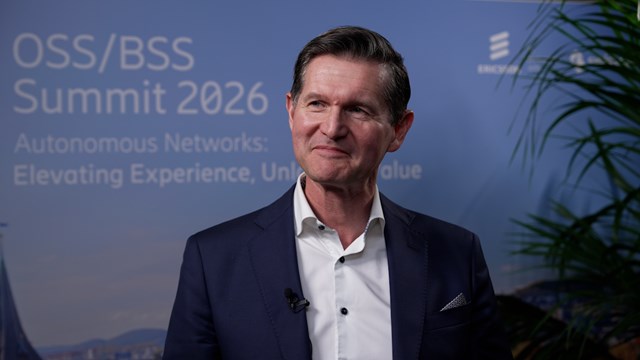
Mark Sanders, Chief Architect & Executive, Autonomous Networks Enablement, Telstra
At Ericsson OSS/BSS Summit 2026, Mark Sanders, chief architect and executive for autonomous networks enablement at Telstra, talks about how to become truly autonomous and trust autonomy. He believes it is now time to take these concepts forward with further focus on ontologies and semantics, knowledge composition and orchestration.
Recorded October 2026
Email Newsletters
Sign up to receive TelecomTV's top news and videos, plus exclusive subscriber-only content direct to your inbox.