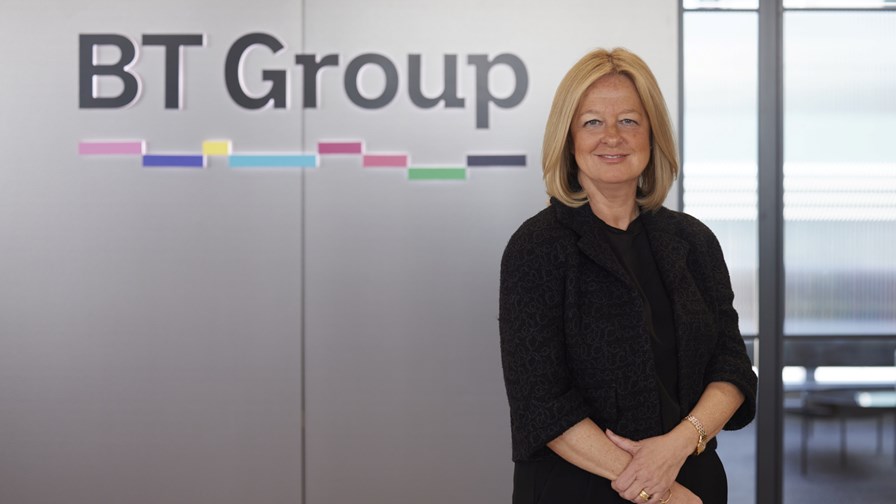
BT Group CEO Allison Kirkby © BT Group.
- BT’s CEO says telcos will be AI winners
- Qualcomm prepares to kick away its handset crutch
- GSMA predicts global GDP impact of 6G
In today’s industry news roundup: BT’s CEO talks up its AI game as its continues to shrink its workforce by tens of thousands; Qualcomm’s non handset product-related sales are growing fast, with more to come from its new datacentre products; the GSMA masks its latest spectrum allocation push with a 6G-related global GDP forecast; and much more!
BT Group has published its financial results and operating update for the first six months of its current financial year, and there was a lot to digest behind the headline revenue, earnings and network rollout numbers. During the operator’s H1 financial earnings call held on Thursday morning, the UK national telco’s CEO, Allison Kirkby, made it clear she believes BT can benefit in the agentic AI era. Responding to a question from Goldman Sachs analyst Andrew Lee, who asked whether the use of AI agents could prove to be negative for telco revenue trends and whether the savings from using AI would offset the impact of agentic AI-enabled pressures, Kirkby noted: “I still believe telcos, like BT in particular, will be AI winners, because AI has dramatic potential to improve how we serve our customers, how we run our operations, and how we just move faster in everything we do. What are we seeing? AI is one part of a multifaceted transformation, business transformation, both cultural and operational at BT. We are kind of embedding it everywhere.” She noted that while the use of AI was not yet making its mark on BT’s financial performance (in terms of direct lower costs), the benefits can already be seen in how call centre staff are “able to use it for call summarisation to get better insights and information on their customers so they can do better cross-sell and upsell. We are seeing real benefits in our B2B division, where we had a lot of legacy products and services and very poor visibility on end-to-end processes.” Kirkby noted that BT’s team “created an agent recently to improve the bids, the complex bids, for some of our more complex customers. That agent has already reduced the bid time from 14 man-weeks to three man-days. Just think about the scaling opportunity of that. We remain convinced that AI will have great operational and customer service improvement.” And in terms of the threat from agentic AI, she noted that “we need to start feeding the models and feeding the agents with all of the great knowledge, not just about price but the quality services and the benefits of convergence of all of our brands. The agents are this new channel. They understand the true value of buying a product and service from a BT brand versus others… Overall, AI will definitely be beneficiary to a business like BT as it continues on its transformation.”
Headcount reductions are front of mind in the UK telco sector right now, following Virgin Media O2’s announcement earlier this week that it is set to cut its staffing costs by 30% by shrinking its workforce. That process has been underway at BT for some time already and, as part of its (revised) plan to reduce its annual operating expenses by £3.7bn by the end of March 2030 (the end of its FY30), the telco had always targeted significant cuts to its total labour force (TLR), which comprises “direct labour” (salaried staff) and sub-contractors. In its H1 financial report, BT noted that it had reduced its TLR by 11% during the six months from April to September, from 102,000 to 90,000 people. It also noted that its TLR target for the end of March 2030 is now in the range of 65,000 to 70,000, lower than the 75,000 to 80,000 range it specified only six months ago, though this is mainly because the numbers exclude the BT International workforce (about 8,000), which is being offloaded into a joint venture with Verizon that was announced in June (more on that in a moment). If BT ends March 2030 with 65,000 TLR, it will have reduced its workforce by 55,000 (almost 46%) in the space of just six years as a result of redundancies, portfolio changes (divestments) and a reduced need for contractors once the fibre-to-the-premises (FTTP) rollout is concluded. Whatever the process, that is a massive drop in human resources, part of which will be related to the increased use of AI for process automation. Of course, BT could be adding additional staff if it gets the regulatory green light for its planned and somewhat contentious acquisition of broadband service provider TalkTalk, but Kirkby was not able to comment on that M&A deal today due to the ongoing review of the planned transaction.
As for the international deal announced with Verizon, BT noted that the 50/50 joint venture will be formed in the second half of 2027 with about 3,000 customers and annual revenues of some $4bn (as previously noted), and that BT will receive $625m from Verizon when the deal is completed. Key to that joint venture will be the Global Fabric data networking platform developed by BT in recent years, which now has 81 points of presence (PoPs) across 23 countries. BT noted in its H1 report that the international business, which is now treated as a discontinued operation, generated revenues of £923m and adjusted earnings before interest, taxes, depreciation and amortisation (EBITDA) of £60m during the six months to the end of September.
It’s been a big week for wireless chip giant Qualcomm, which is making a concerted effort to reduce its reliance on business from smartphone vendors and to boost the other parts of its business. Having already announced a headline-grabbing deal to supply SpaceX with radio access network (RAN) tech for Starlink Mobile’s national terrestrial network deployment across the US, Qualcomm reported its financial results for its fiscal fourth quarter and full financial year, which showed strong growth in its emerging business lines. Fourth-quarter revenues came in at $10.32bn, down by 8% year on year, as handset-related sales slumped by 26% to $5.14bn. But its automotive product line (for connected vehicles) reported an 89% ramp up in revenues to almost $2bn while revenues from the vendor’s internet of things (IoT) product line grew by 4% to $1.89bn. And there’s projected growth to come from the vendor’s datacentre product line following the recent announcement of its AI infrastructure collaboration with Amazon. Qualcomm’s president and CEO, Cristiano Amon, stated: “We are pleased to deliver fourth-quarter non-GAAP revenues at the high end of our guidance, along with 36% year-over-year growth in combined QCT automotive and IoT revenues. Fiscal 2027 marks the start of our non-handset revenue inflection, including the ramp of our datacentre business. Non-handset revenues are projected to grow by more than 60% year over year, and we are reiterating our fiscal 2027 datacentre revenue target of $5bn,” added the CEO. Amon might be excited about the future, but Qualcomm’s investors are less than enthused by the present, as the chip giant’s share price dipped by 12.3% in pre-market trading on the Nasdaq exchange on Thursday to $151.92.
We had been expecting the 6G noise to get louder following news this week of outdoor trials by Teli and Ericsson and talk of AI-native 6G developments by SpaceX and Qualcomm, but we didn’t expect the volume to be cranked to 11 (that’s one more than 10…) so quickly! The team at industry body the GSMA has rubbed its crystal balls furiously, peered into the future, and calculated that “6G mobile networks could contribute an additional $1.24tn to the global economy in 2040, equivalent to 0.7% of global GDP”. We love a big number as much as the next person, but… as the GSMA is, in part at least, a lobby group for the mobile network operator (MNO) community, there needs to be a strategic reason why it has made this calculation and shared it in a report – Vision 2040: The Economic Benefits of 6G. The reason appears to be that it wants to put pressure on government and regulators to release more spectrum to the mobile network operators (MNOs): While the world economy stands to get bigger to the tune of $1.24tn, as a result of the launch and use of 6G services, “insufficient spectrum availability could put as much as $520bn – or 42% – of that economic opportunity at risk,” according to the GSMA. Here’s John Giusti, chief regulatory officer at the GSMA, to hammer that message home: “6G represents a $1.24tn opportunity for the global economy. The next generation of mobile technology will help power AI, transform industries and unlock new levels of productivity across the economy. But these benefits are not guaranteed. More than $500bn of the economic value will depend on the spectrum decisions governments make today to fully realise the economic potential of 6G in the decades ahead.” Let’s reconvene in 14 years’ time to see what happened…
True Corp. is engineering and optimising its 5G network using AI with “the concept of Network Digital Twin, a technology that creates a virtual representation of the physical telecommunications network to simulate scenarios, assess potential impacts and identify opportunities for network improvement before physical deployment,” the Thailand telco noted in this press release. “This initiative lays the foundation for the future development of an autonomous network, with the aim of improving network efficiency and delivering better connectivity experiences to customers nationwide,” added the telco, which has 48.8 million mobile customers, of which 20.5 million are 5G users. True’s chief network officer, Khurrum Ashfaque, stated: “Our goal is not simply to expand 5G coverage but to develop a network that responds more effectively to how customers use connectivity and supports their constantly evolving lifestyles. Today, customers are consuming significantly more data, while different locations have different connectivity needs. True is, therefore, focused on enhancing network speed, capacity, reliability and management by combining advanced 5G technologies with data analytics and AI to deliver better connectivity experiences to customers across Thailand.
Deutsche Telekom, which counts numerous operations across Europe as well as T-Mobile US in its corporate portfolio, continues to grow in strength, reporting third-quarter revenues of €31.1bn, up by 5.5% year on year on an organic basis (excluding the impact of exchange rate changes or changes in corporate composition). Organic service revenues grew by 4.1% to €26bn, while organic EBITDA after leases increased by 8% to €12.2bn. CEO Tim Höttges noted: “Our strong figures are setting benchmarks in our industry. The consistently impressive results we have delivered for many years now bear testimony to the success of our strategy.” The operator noted it was seeing strong demand at its T-Systems enterprise services division (referred to in its financial reports as Systems Solutions) for its Industrial AI Cloud services: Last month DT noted during its first ever AI Investor Day that it expects to generate an additional €1bn-plus in revenues outside the US from AI-related services by 2030.
– The staff, TelecomTV
Email Newsletters
Sign up to receive TelecomTV's top news and videos, plus exclusive subscriber-only content direct to your inbox.