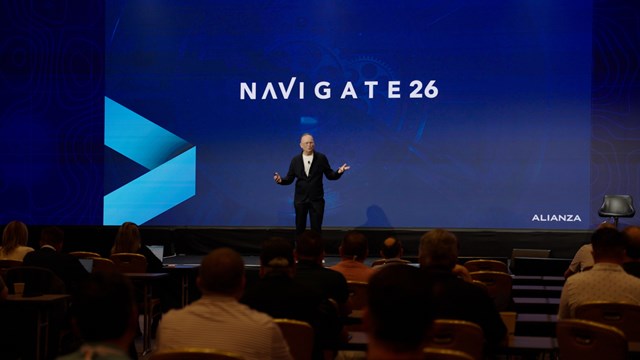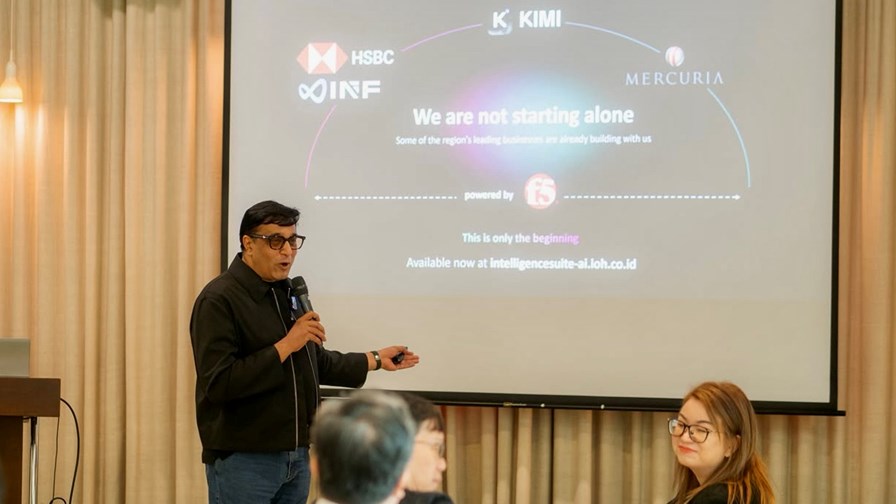
Indosat Ooredoo Hutchison (IOH) CEO Vikram Sinha presents the Indosat Intelligence Suite.
- Indosat and F5 unveil AI Intelligence Suite
- SK Telecom develops AI token gateway initiative
- Broadband Forum highlights automation issues
In today’s industry news roundup: Indonesia’s Indosat Ooredoo Hutchison (IOH) teams up with F5 to make it easier for enterprises to get the most out of AI; SK Telecom’s CEO updates the telco’s staff on the company’s strategy, which includes the development of a token gateway business; industry body the Broadband Forum identifies a number of challenges facing ISPs as they seek to deploy autonomous networks; and more!
Mindful that businesses need as much help as possible to get the greatest benefits from the use of AI, Indosat Ooredoo Hutchison (IOH), one of the largest telcos in Indonesia and home to one of the most ambitious AI-native telco strategies in the world, has teamed up with security tech specialist F5 to develop the Indosat Intelligence Suite, which provides enterprises with “a trusted and governed environment that simplifies how businesses access and deploy AI, without requiring them to build and manage complex infrastructure themselves.” The telco notes in this announcement that the platform “builds on Indosat’s full-stack AI ecosystem in Indonesia, spanning energy, datacentres, compute, connectivity and AI models” to bring “multiple AI models and infrastructure capabilities together through a single interface, giving businesses greater visibility and control over how they use AI. It is designed to help organisations select and deploy the intelligence suited to their specific workloads while maintaining the security and governance required for production environments,” added the operator. IOH’s president, director and CEO, Vikram Sinha (whose five-year contract extension has just been approved by the company’s shareholders) stated: “As AI moves from experimentation into everyday business, companies need more than access to models, they need a trusted way to put intelligence into production. With the full stack AI as the foundation, Indosat Intelligence Suite will become an intelligence factory for businesses, helping businesses access the right intelligence for their needs and scale it securely across the region.” IOH noted that the launch “marks the next step in Indosat’s AI journey: Building not only AI capacity for Indonesia and the region but the way to use it. By connecting infrastructure, models and enterprise demand, the Intelligence Suite can help businesses put growing AI capacity to work and support wider AI adoption and economic value across the region.” IOH recently helped to form Zankore, an AI infrastructure and services joint venture with Nvidia, Nokia and Ooredoo Group that recently secured $3.1bn in debt funding.
As with many telcos that are ahead of the pack with their AI-native telco plans, IOH is working very closely with Nvidia, which is very keen to see AI hardware and software integrated into communications network infrastructure around the world, and indeed IOH has featured in Nvidia’s latest blog about telco AI strategies. The AI tech giant is extolling the virtue of open models for telcos that want the “ability to trust, control and customise AI across their most critical workloads – from autonomous networks to customer care”. Nvidia highlights how the adoption of open models is helping Japan’s SoftBank Corp, US telco giant AT&T and IOH to get the most out of AI. As you would expect, the examples all point to how important a partner Nvidia is to these operators (as it is to an increasing number of telcos), but the blog is still instructive as to how and why certain approaches are paying off for the telcos. For example, Andy Markus, AT&T’s chief data and AI officer, notes: “At AT&T, we believe the future of AI is not about choosing a single model; it’s about intelligently matching every workload to the right combination of performance, cost and control. Open models are essential to that approach and, with Nvidia, we can bring that model-choice strategy into production with the scale, reliability and governance our business requires.”
Jeong Jae-heon, the CEO at South Korean telecom operator and self-styled ‘AI company’ SK Telecom (SKT), has presented the new SKT Growth Gear Strategy to the company’s workforce, stating that SKT’s key goal is to position itself as the “gateway to the token economy” by “organically connecting key businesses – telecommunications, AI services and AI infrastructure – with AI technology and AX (AI transformation) as common driving forces”. The CEO noted in this announcement (in Korean) that the “axis of AI competition is expanding beyond models and infrastructure to an ecosystem that stably generates, supplies and utilises tokens… this represents a new growth opportunity for SKT, which has consolidated its telecommunications and AI capabilities.” As part of the new plan, SKT is developing a new business called Token Gateway, which “acts as a control centre that manages AI usage patterns for companies and customers and connects them to optimal AI models and infrastructure.”
There’s most definitely a theme emerging here: These latest announcements from IOH and SKT suggest that telcos can and should play a key role in helping individuals, businesses and governments to securely interact with AI in an appropriate, secure, reliable, flexible and hassle-free way that gives the end user what they need while also providing a new business opportunity for service providers. The big question now is – can the telcos secure that role as the broker of AI interactions, do it well and make money as a result? The TelecomTV team, through the work we’re doing via the AI-Native Telco Accelerator (ANTA) initiative, and through all of our channels, will do its best to answer that question as the AI-native ecosystem evolves.
Broadband network operators are facing some familiar challenges as they seek to use AI to automate their operations, according to the findings of a new report from the Broadband Forum. The industry body’s research “highlights poor device compatibility and inconsistent data as key challenges that must be addressed before broadband networks can become autonomous,” it noted. “The report reveals strong commitment to autonomous networking, with 94% of service providers planning to use software-defined networking (SDN) as part of their autonomous networking journey and 92% describing AI/ML integration as critical or important to these strategies. However, poor and inconsistent data from multiple systems was identified by 83% of service providers as a major barrier to deploying AI successfully in their networks,” stated the forum.
Low-earth orbit (LEO) new entrant Amazon Leo (formerly known as Project Kuiper) says it has now built more than 1,000 satellites at its own production facilities and is busy securing more launch slots – it already has more than 100 lined up – so it can get them into orbit as soon as possible to support its planned launch of satellite broadband services later this year. In this lengthy update, Amazon Leo, which is among the increasing number of companies planning to compete with SpaceX’s Starlink, also noted that its team has “already begun work on future generations of its satellite system, including a second-generation system that will increase coverage, capacity and performance for customers, and a direct-to-device (D2D) network that will beam internet directly to iPhones and other mobile devices. These systems will leverage the same manufacturing muscle already in place for the first-generation system,” added Amazon.
– The staff, TelecomTV
Email Newsletters
Sign up to receive TelecomTV's top news and videos, plus exclusive subscriber-only content direct to your inbox.