Building a cloud-native core network with Deutsche Telekom and HPE

By James Pearce
Nov 19, 2026
To embed our video on your website copy and paste the code below:
<iframe src="https://www.youtube.com/embed/PZCbYt0qBkc?modestbranding=1&rel=0" width="970" height="546" frameborder="0" scrolling="auto" allowfullscreen></iframe>
James Pearce, TelecomTV (00:05):
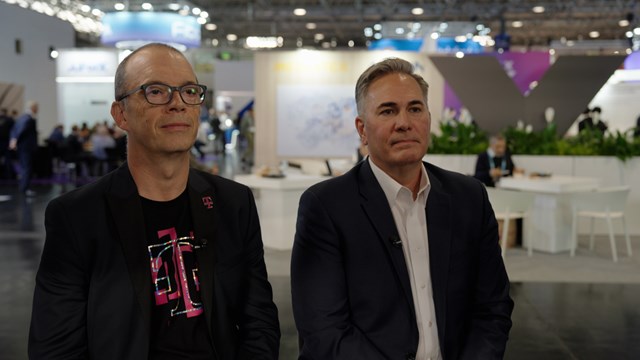
Hello and welcome to TelecomTV. I'm James Pearce and I'm delighted to be joined today by Franz Seiser from Deutsche Telekom and Steve Daigle from HPE. Thank you both for joining me. Franz, let's start with you. Deutsche Telekom's been working with HPE on its Horizontal Telco Cloud, but for reference, can you give a quick overview of what HTC actually is and why it's so important to you as a network?
Franz Seiser, Deutsche Telekom Technik (00:29):
Thanks for having me. Big pleasure to be here again. So yeah, our Horizontal Telco Cloud, that's our implementation, which we believe can also be used as a reference, how to implement and reap the benefits of a cloud-native core network. So we are talking about fixed and mobile core networks. What does it achieve? We get higher speed for both new features, but also, and that's super critical in days where we currently are, security updates. It's giving us higher reliability, less errors and all that on top. And that's of course super important as well, lower cost. Quickly, how did we do it? As the name implies, we have horizontalised, so we move away from vertical silos. We have one horizontal architecture, one private cloud, one automation layer, which then will also help us a lot in the area of AI and then all the network functions as cloud-native software running in that environment.
James Pearce, TelecomTV (01:25):
So Steve, why don't you tell us where HPE fits in the HTC story?
Steve Daigle, HPE (01:29):
Sure. So if you think of the overall solution that Franz and DT have created here as the layers of a cake, there's an infrastructure layer, an application layer, and then an automation layer on top of all of it. We're at the bottom of the infrastructure layer. We provide the networking fabric upon which all of the solution rides. And the advantages that we provide to the solution is that we provide open interfaces and we're API-driven. So all of the innovation that Franz and the DT team have created on top of their solution or on top of our infrastructure, we're the bedrock of that.
James Pearce, TelecomTV (02:08):
Franz, over to you. Why don't you talk us through where you're actually at with HTC? Are there examples of deployments so far that you can share or any major success stories you can talk us through?
Franz Seiser, Deutsche Telekom Technik (02:18):
Oh yeah, sure. Happy to do so. So we created this whole thing, not on our own, but with a couple of partners. HPE is one of them for the networking piece, which is as we are a network operator, obviously very important, but we also have partners of course that provide network functions. We mentioned them, we have the white paper released around Mobile World Congress, so you can happily look them up. And with these partners, we only mention them and have them because we have their solutions up and running. So Horizontal Telco Cloud is not a theory, it's not a vision, it's reality. So we have a couple of network functions running live as we speak today in the German network handling customer traffic that's already achieved. We are working to move all, so the idea is to move all core network functions into that environment. It's an ongoing project.
(03:09):
We have clear plans and in the next couple of months we will move the vast majority of these functions over into that architecture to really have all the benefits everywhere end-to-end.
James Pearce, TelecomTV (03:22):
You mentioned the fact that it's a multi-vendor project, HPE being one of the important partners. So how important is that and making sure you've got the right partnerships in this story?
Franz Seiser, Deutsche Telekom Technik (03:32):
Multi-vendor collaboration is fundamentally important. So we spent in the beginning quite a lot of time to make sure we are all on the same page. Our partners really understand what we are aiming for. They are committed to work and deliver in that environment because only if their software fits into our ecosystem, it can be done. We tried of course a lot and I think we've been very successful in not doing anything DT-proprietary. All the components is all industry standards, a lot of open source components, but we had to make sure all our partners are on the same page complying to that architecture also that they want still following. So we only allow suppliers into our ecosystem that are willing to work in that environment. And with that, we build an ever-growing ecosystem of more companies being able to provide these kind of solutions to us, but of course also to all other operators in the world afterwards.
James Pearce, TelecomTV (04:24):
Steve, obviously being a vendor in that, have you got anything to add to that?
Steve Daigle, HPE (04:28):
I think the key word there is partnership. We've been working together on the automation around what DT's strategies are since before 2018. And our teams have been working very closely together during that time. And it's the teamwork and the ability to learn and grow and architect these networks together. I think that is really part of the successful formula that went into making HTC such a big hit and so successful. It's that capability of working the two teams together. There's a lot of organisational change that takes place during this, but the relationships that you build between the partners over time builds a trust that can't be replaced.
James Pearce, TelecomTV (05:14):
So Franz, what's the relationship between HTC and AI, automation, and autonomous networks?
Franz Seiser, Deutsche Telekom Technik (05:22):
That's a very good one. So let's start with automation. There is no relationship. Automation is an integral part. So the whole HTC is built on automation. Going as far as we have an automation-first approach, so we only start to take a network function into our system once the automation has been delivered. Very often in the past, automation was an afterthought. We completely turned it around and have an automation-first policy. So automation is fully in. The good thing on the architecture is it's a key enabler of AIOps. What do you need for AI? Data. One thing we get in Horizontal Telco Cloud, real-time streaming of all the components, be it the network, be it the application, every component is really live streaming their data into data lakes, which then can be taken by the AI to do all the analysis and work.
(06:17):
And then to use the AI commands to reconfigure or change the network. Again, this is an integral part of the whole Horizontal Telco Cloud. It's all intent-based, it's all declarative, all via the automation solution. So the AI is coupled to that automation layer and via that can instruct and reconfigure the network as required, gets back real-time data so can immediately double-check if things work out like planned or do further adaptation. So Horizontal Telco Cloud is, we believe our secret sauce to be rather quickly in rolling out and again, horizontal. So across all the workloads rather quickly going forward.
James Pearce, TelecomTV (06:56):
Sounds really exciting.
Steve Daigle, HPE (06:58):
The automation and the capabilities around machine-readable data, machine-consumable data, because Franz said it correctly, you have to have the data in order to provide the oil, so to speak, to oil the engine of your AIOps. And you won't be able to have the data, the real-time streaming that's necessary if you're trying to provide that 2026 capability on say 2010 gear. You've got to upgrade and modernise your network in order to take advantage of the capabilities that the new devices and modular devices and very power-conserving devices have today that avail you all the benefits that DT is taking advantage of in their Horizontal Telco Cloud.
James Pearce, TelecomTV (07:47):
So let's look forward. What should we look forward to next?
Franz Seiser, Deutsche Telekom Technik (07:51):
As said, next or ongoing and looking forward to achieve is to bring all our network functions into that environment. That's straightforward for some, more difficult for others depending on the nature, but we have clear plans for all of this. So that's clearly the next key things to do. We just recently brought another supplier in. So there was a press release lately which can be found easily. More to come in the next couple of months. That's the one thing. Realise it for everything. And the second one, as you just asked correctly, bring in AI, bring it to the next level of autonomous networks because of course we share with all the others. The goal is go to Level 4 or come close in the foreseeable future. That's exactly what we will then enable. And as said, the big benefit once we have solved it for one, we can easily scale out for all the other workloads because it's all the same environment.
James Pearce, TelecomTV (08:42):
Sounds exciting. Now based on your experiences doing this, do you have any advice that you would share with your fellow operators?
Franz Seiser, Deutsche Telekom Technik (08:49):
Oh yes. The advice is very clear. We by intention position that as a blueprint. That's why we also created our white paper so we really can only encourage all the others, have a look, see how much that fits to you because we really believe and we are strongly convinced in order to be competitive and be able to survive in good shape in the current situation with all these critical security issues popping up, AI around the corner, we believe this is a very, very good reference architecture, how you build your network to have a good solution to go through the turmoil of all the topics being ahead of us.
James Pearce, TelecomTV (09:29):
Have you got any tips for operators who might be looking at doing some project like this?
Steve Daigle, HPE (09:32):
Yeah, absolutely. The key is the reference architecture and what we call validated designs. Your ability to take something that's already built at scale and tested and works in the network and then replicate it. We call it something like assurance. You've got outcome assurance. You can take what's already been built and repeat it and make sure that the outcome that you have is a business outcome that you're looking for. Validated design, reference architecture, take it and reuse it, tailor it where you need, but it provides you the ability to go out and take the same concepts that the HTC is applying and apply it in your own networks at scale.
James Pearce, TelecomTV (10:17):
Well, it sounds like a really exciting project. Thank you both for joining me today.
Please note that video transcripts are provided for reference only – content may vary from the published video or contain inaccuracies.
Franz Seiser, Deutsche Telekom Technik & Steve Daigle, HPE
Deutsche Telekom Technik’s Franz Seiser and HPE’s Steve Daigle explore the live deployment of the giant German operator’s Horizontal Telco Cloud offering, the importance of multivendor partnerships, the link between cloud-native architecture, AI, automation and autonomous networks, and more much.
Featuring:
- Franz Seiser, VP, Tribe Lead T-DAT, Deutsche Telekom Technik
- Steve Daigle, Global Head of Telco Systems Engineers, HPE
Recorded October 2026
Email Newsletters
Sign up to receive TelecomTV's top news and videos, plus exclusive subscriber-only content direct to your inbox.