BT and VMware by Broadcom on securing mobile cloud infrastructure at scale

By Guy Daniels
Nov 19, 2026
To embed our video on your website copy and paste the code below:
<iframe src="https://www.youtube.com/embed/GO8Dn8qdJiw?modestbranding=1&rel=0" width="970" height="546" frameborder="0" scrolling="auto" allowfullscreen></iframe>
Guy Daniels, TelecomTV (00:05):
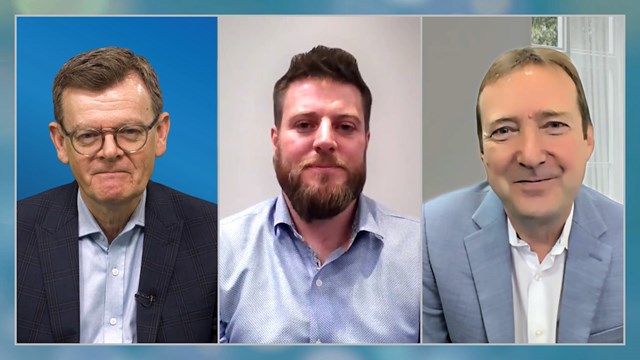
Hello, you're watching Telecom TV. I'm Guy Daniels, and in today's program, we look at how one of the UK's largest operators keeps its mobile cloud infrastructure secure and continuously available as it scales. Now, as AI raises the stakes for operational resilience, how operators handle patching, maintenance, and security at scale matters more than ever. And joining me to explain more are Dale Pluthero, who is senior manager, mobile cloud design and build at BT, and Paul Turner, chief product officer at VMware by Broadcom. Well, hello, and good to see you both. Thanks so much for taking part today. Dale, if I can start with you, and can you talk a little bit about the history of BT's relationship with VMware? How long have you been running the VMware telco stack in your network's environment, and how has your use of it evolved as the network has scaled?
Dale Pluthero, BT (01:07):
Yeah, absolutely. Our journey with VMware started, believe it or not, all the way back in 2011 with vSphere 4, and it's evolved all the way up to the latest offering for us, which is Telco Cloud Platform 5. So a really long journey, 15 years of working together, and that's really sort of evolved into using the full platform and all of the capabilities that are built into it. We run about 67,000 cores across our infrastructure. That's distributed across eight data centers with a total of 1,500 servers, so a reasonably decent scale. The infrastructure hosts some really critical applications, most notably the IMS network, which is our mobile and digital voice network. And we've got 35 million voice subscribers registered on that network, and at any given time, 20 million active sessions. So really important that we ensure that that has continuous uptime. We've got a combination of different virtual network functions as well as containerized network functions, and we've got 14 different parent tenants using vCloud Director to segregate those tenants with 54 unique different apps.
(02:18):
And we use all of the observability tools that the telco stack provides, that's Aria suite of tools to give us intrinsic logging, monitoring, and also anomaly detection. So yeah, quite a large scale solution, really using all the different components within the telco stack.
Guy Daniels, TelecomTV (02:33):
Great. Thanks very much, Dale. And Paul, as you've just heard, there's been a long relationship. From your side, how would you characterize this partnership?
Paul Turner, VMware by Broadcom (02:42):
I think you just listen to those numbers. Everything, what really matters is how do we deliver for customers? 35 million IMS subscribers, this is a massive network. It means that as we sit down with Dale and his team, we're looking at how do we architect, how do we implement, how do we build the most resilient infrastructure possible that can be protected and secure from any of the threats that you're seeing out there in the environment? And so it really is a partnership. It's a technology partnership where together we actually go and integrate our products together. We make sure that they are right-sized, they are performant, they have the availability and the uptime and the security, the critical infrastructure like BTs requires. And to do that, we do sit down, we don't just deliver software, we implement solutions with our customers, we sit down and we help them size, help them implement, and help them operate effectively a large scale infrastructure.
(03:39):
And that's how you deliver success. It's not just package software.
Guy Daniels, TelecomTV (03:43):
Indeed, no. And Dale, the world is today, it's trying to cope from the risks of AI on infrastructure and these increasing risks to maintaining operations. So how do you run your operations at scale? How do you patch and conduct systems maintenance to deliver the continuous uptime for the infrastructure that you absolutely require?
Dale Pluthero, BT (04:07):
Yeah, so Paul's mentioned there that it's about a collaborative approach, not only with VMware, but also with the vendors of the applications. So our primary solution is to design the applications to work together with the telco cloud platform. So we understand the fault tolerances, the zoning, how many sets of redundancy, as well as the disruption factor that that application can tolerate. And then secondly, through the great relationship we have with VMware and Broadcom is we use the partner lab, which is where we engage with the vendor of that application and Broadcom to validate that application on the TCP stack prior to it coming to BT. And that gives us a huge amount of confidence that that application is fit for purpose on the infrastructure. We take a risk-based approach when it comes to how we manage the patching as well as all of the resilience of the distribution of infrastructure as well as the application.
(05:09):
And so from that perspective, we look at how we patch ESXi and the NSX using vMotion for our workloads. And we have two different methods, whether that's supported by the operations team or whether that's unsupported depending on the maturity of the application on the infrastructure. And so we use a host of tools that come with the TCP solution. So we use the Aria Suite to give us real time visibility of the application as we're patching. And also we use inbuilt solutions like VDS HealthCheck, which gives us real-time insight to the network health. One of the key decisions we made a few years ago is to build in that capacity to patch multiple hosts and also clusters in parallel. Lifecycle management is so important, especially in, as you mentioned, the security landscape that we're in. So we design the infrastructure and the processes to make sure that we are set up to succeed.
Guy Daniels, TelecomTV (06:09):
So you have a strong collaborative process, but Paul, can you share more about the features that you deliver to secure and protect environments from AI threats?
Paul Turner, VMware by Broadcom (06:19):
Yeah, for sure. Well, you heard from Dale about TCP and you're probably thinking, what is TCP? It's actually the telco cloud platform. So on top of our VCF stack, we actually implement a custom set of extensions directly for telco customers. And then we take it further by actually integrating that product with the network equipment manufacturers and third parties that are actually operating those applications as Dale has talked about. So this is a full integrated solution with third party and them working with the customer to actually implement it as we have with BT. But as you think about the security side of things, think about what Dale, security threats, risks, a very important thing is you need to be able to patch and update your environment much more frequent and quickly. How do you do that? We actually implemented in version 9, which is VCF 9, which is what Telco Cloud is now based on.
(07:12):
We implemented full live patching capability. Live patching actually allows us to completely update the software that's running on that ESX host, whether that's vSAN or NSX or ESX in terms of all the data pieces. And we're able to update that without even moving the applications without what's called maintenance mode. So it's been a very purposeful kind of effort, but we didn't just stop there. We've actually gone and built into the hypervisor, a protection mechanism to protect against security threats that's called HyperArmor. We actually just launched that and we built in more intelligence into the system to basically protect against risks and threats that can happen, including into our network. We have something called vDefend, which is actually implemented across all of our telco customers. And that looks at how do we actually go and isolate the networks, protect them, and even look for threats that are running on that network and be able to block them with dynamic software-defined firewalls when we need to.
(08:21):
So there's lots of mechanisms that we've built in to make it the most secure platform. And in light of what's happening out there in the world right now, I mean, you don't have to look very far, but it seems like every few days we're worried about security threats. So the more that you build, have the software that allows you to secure your environment to run with continuous uptime to allow you to live patch, that's what Dale and the team at BT need.
Guy Daniels, TelecomTV (08:51):
Absolutely. Thank you, Paul. And Dale, it'd be really insightful if you could go into a little more detail and describe your current process for patching and how you actually maintain continuous operations throughout.
Dale Pluthero, BT (09:05):
Yeah, absolutely. So as a partner of VMware, we have an active disclosure agreement, which means that as the vulnerabilities and the patches are made available, we immediately receive a notification from our technical adoption or our service account management team. That notification is triaged by a number of SMEs across our operations team design and security compliance, and the decision is made when and how to roll out that patch based on the information in that disclosure agreement. We start by taking that patch through what is our sandpit environment, which is an environment which doesn't have any applications on it. It's purely there for us to validate methods of procedure and add any BT nuances to that method of procedure to comply with some of our own standards. And we do that to ensure that the operations team have early visibility of how this patch will be rolled out.
(10:04):
We then subsequently roll out the patch into our mobile labs. So we have a reflective set of labs that carries all of our different services that our live network has. It's about one-tenth the scale of our live network, and we essentially roll out that patch under controlled conditions under each of the service types to ensure that we can do that in a controlled execution manner. That also automatically triggers a service regression. So at BT, service is paramount, so we don't want to be introducing anything that could impact that. So we do a service regression as we roll out the patch, we receive a test exit report, and ultimately a validated method or procedure that is then issued to our operations team. The platform operations manager will then start to raise a series of changes across the network depending on the different type of applications. We run about 14 different tenants on the VMware stack and 54 unique applications.
(11:06):
Some of those are on dedicated infrastructure, some of those are on shared. So the changes reflect how we approach those different environments and the patches are rolled out typically during working hours. That's something that we changed recently because having the most amount of support and also the wellbeing of our team members doing it during working hours in a controlled manner is the way that we found works best. We do parallel clusters in a controlled way. We put the servers, as Paul mentioned, into maintenance mode and batches. We apply the patches, reintroduce those servers back into the cluster, allow the vSAN to rebalance, and then we move on to the next set of servers. And the compliance is monitored through the aforementioned sort of tooling like Aria and vCenter so we can quickly see how the patch is rolling out and if we see any issues.
(11:58):
And service is monitored through some of our third party tools to make sure that there's no impact to the service during the works. And once complete, we then perform a retrospective to ensure that as we rolled out, was there any lessons learned and we can feed that back to Broadcom or internally within our teams how we can improve in the next rollout. And across 1500 servers in various different methods, we typically roll out a patch between 40 to 80 hours depending on the patches complexity, whether it's a multi-patch. And so that's how we proceed with that. And obviously live patching would drastically reduce that time because we wouldn't need to move the application workloads around.
Guy Daniels, TelecomTV (12:47):
That's fascinating, Dale. Thanks very much for going through that for us. Well, Paul, live patching, we just heard about it there. Can you talk a little bit more about this and how it works and what percentage of security patches can be applied live today without a reboot or without workload migration?
Paul Turner, VMware by Broadcom (13:03):
Yeah. Well, I mean, let's go a little back and just talk about Dale's environment. 3000 servers across multiple data centers, and he's able to do it while normal working hours. That's only possible because entire fleet management is built into the software to actually do the upgrades. And as part of doing that, one of the most essential tools that Dale is using is actually vMotion. And what vMotion allows us to do is actually move completely live, move those workloads around without any disruption to the client side of things and to do that while continuous operations are happening. It's kind of like magic. Now we take that a step further with live patching because what we actually do is depending on the type of patch, and we're actually able to do it now for almost all ESX patches. In fact, every one of our monthly release patches is going to be live patchable.
(13:55):
And in live patching releases, what we're able to do is go into ESX and effectively update the kernel in a live way and all of the dependent kind of libraries in a live way. And then without the operating system reboot, we're able to basically restart the services. So we kind of pause the services really temporarily on ESX. ESX is an operating system and we basically are able to bring everything back up. So it's kind of a magic way of updating software without any change at all. Now for super large memory dependent environments where these are very big systems, this becomes more and more important to be able to live patch environments. And I was out with a customer actually in Singapore who'd implemented full live patching. It was a very large bank that is out there, full live patching of their environment. They applied our last monthly patch and that monthly patch set they were able to roll out across their entire infrastructure in 45 minutes.
(14:56):
So Dale, if you love vMotion, you're really going to love live patching. It is going to make your lives so much easier. You're going to be able to run operations the way you like, which is during daytime hours. So look forward to that.
Guy Daniels, TelecomTV (15:11):
Well, we look forward to continuing developments in this field, but I've got a question now for both of you. And Dale, come to you first. We have to discuss AI. It's part of every conversation today. So tell me, what do you think is the potential for AI within operations?
Dale Pluthero, BT (15:27):
So much potential, and I'm going to give you some examples of where we are using some of the inbuilt AI functionality today within vDefend, which is the security function within the TCP stack. So today we run distributed firewall rules on all of our services, and to make sure that we're running them in an optimized way, we're using the security services platform. And essentially what that does is we use an Intelligent Assist and security intelligence products to optimize our distributed firewall rules, and it does this in such an efficient way using AI. If we were to do this manually, it would take many, many weeks, huge amounts of data analysis. The inbuilt tools allow us to continuously evolve and adapt and optimize our distributed firewall rules, which is a micro-segmentation on steroids. We also use some of the NTA, which is the network traffic analysis solutions as well.
(16:24):
So detecting anomalies in any network traffic is really, really helpful, especially if we are seeing any security related issues or any sort of service related issues. And then finally, something that we've not managed to use just yet, but we're hoping to do so in the next six months, is the intrusion detection and prevention solution. So this is where you can get a signature of how a threat comes into your network and the system generates an AI profile or a signature for that attack. And that buys you time between when the vendor might be patching their particular OS or the application. You can actually apply these signatures to the firewalls and essentially have notifications through to your security center if we see that type of exposure. So AI for us is about accelerating the speed at which we could do tasks, be more efficient in it, and detecting anomalies way faster than a human can.
Guy Daniels, TelecomTV (17:25):
Great. Thanks so much, Dale. And Paul, your views on the potential for AI in operations?
Paul Turner, VMware by Broadcom (17:30):
Yeah, I was going to actually add to what Dale was saying, because if you think about the security services platform, we built that purposely for customers like Dale. It's automatically looking at all the flows within your network, what application chatting with which application, and then based on that, recommending what are your firewall rules. So what you're doing is changing your security posture from locking the doors of the data center to application to application kind of traffic management and being able to then automatically apply policy rules and firewall policy rules to basically block which applications in chat with which applications. Now, think about AI threats now. It's all done the same way as before. Yeah, maybe faster now with AI software, but what you're really doing is using attacks, you're going in and attacking, compromising one part of an infrastructure, and then you're going and trying to probe in and attack other parts of the infrastructure.
(18:26):
You can't do that when you lock things down with firewall rules because what you've just done is application to application traffic management. So that's very neat. I think the security services platform solves a lot of problems with AI to actually help customers build those firewall rule sets, but it's not the only place that we went. We actually recently, just in 9.1 of VCF, actually released the Intelligent Assist. And Intelligent Assist has been built into VCF operations. It's to help you run large scale infrastructure to get you the performance that you need to identify issues. And it does it all with this effectively a chatbot application that is powered by all of the data inside an operations and logs and actually helps you as an administrator team really scale your team and more importantly, root cause issues quicker, get back online quicker, get back into continuous operation, optimize your services.
(19:27):
And it's something that we're going to continue to build on because customers need to run large scale infrastructure, continuous and secure infrastructure. And to do that, we're going to make it simpler with Intelligent Assist and with things like the security services platform and the extended capabilities that we built like HyperArmor. So we're continuing to innovate for customers like BT.
Guy Daniels, TelecomTV (19:53):
Okay, so what's next? Dale, as you look ahead, what would you want VMware to prioritize next in this relationship?
Dale Pluthero, BT (20:00):
I mean, I've got it quite excited today about what Paul's been talking about on ESXi live patching. That is going to be a game changer for us. To be able to get faster at being compliant, faster at patching against threats is going to be a huge advantage for us and also reduces the workload strain on our operations teams who are rolling out patches. So for me, ESXi live patches are really exciting, and the more that those patches come through as a live capability, that's going to be fantastic. Similar to the NSX side, adopting a similar live patch capability, those two really work in tandem. And then finally, as we move more towards containerized network functions from virtualized, we're going to be looking forward and prioritizing some Avi enhancements to do traffic separation, which is in line with our TSA compliance. So really excited about what Paul's talking about here is making it easier for us to run our platform at scale and keep our service up.
(21:02):
And the easier we can make it on our operations team, the better the system's going to be.
Guy Daniels, TelecomTV (21:08):
Absolutely. Clear message there, Dale. Thank you. And to close, Paul, where does this partnership go from here? What's the next milestone that you're both working towards together in the telco space?
Paul Turner, VMware by Broadcom (21:19):
I think Dale touched on it, and I think it's really important. Of course, we are a company that established effectively virtualizing the network with VMs. And of course, we have implemented a full container-based platform inside in VCF and inside in the telco version of the VCF platform. And that container platform is full CNCF compliant Kubernetes container-based system. We've integrated it in with all of the leading NEP vendors, so all of those application vendors that you need for your telco network. So the most exciting thing for me is, and I think working with BT, is how do we actually take that forward? How do we implement that at scale with the continuous operations? And the neat thing is you're running your telco container-based workload, your CNF-based environment as it's called, and your VNF, your VM-based environment, and you're able to run those on the same operational platform.
(22:21):
Dale doesn't have to worry about different platforms for different things. He's running one infrastructure platform, he's fleet managing it, he's lifecycle managing it, he's securing it, he's doing live patching on it all based on one consistent platform. So Dale, hopefully you'll be able to continue to just do it during normal working hours, which is what I heard from you, and we'll make your lives just a little bit better and a little easier. And those 35 million or hopefully 40, 50 million people, I think you have a few more tens of millions of customers to win over, I think, in the UK, but hopefully we can be part of that and help you win.
Guy Daniels, TelecomTV (22:59):
Well, we'll have to come back next year and get an update on this, but we must leave it there for now. It's been really great talking with both of you, and thanks so much for sharing your insights with us today.
Paul Turner, VMware by Broadcom (23:09):
Thank you so much. Yeah, great to catch up.
Dale Pluthero, BT (23:11):
Thank you.
Please note that video transcripts are provided for reference only – content may vary from the published video or contain inaccuracies.
Dale Pluthero, BT & Paul Turner, VMware by Broadcom
BT’s Dale Pluthero and VMware by Broadcom’s Paul Turner, discuss the two companies’ long-running relationship, revealing their rigorous daytime patching workflows, live patching capabilities, how built-in AI tools defend against emerging network threats, and much more.
Featuring:
- Dale Pluthero, Senior Manager, Mobile Cloud Design & Build, BT
- Paul Turner, Chief Product Officer, VMware by Broadcom
Recorded November 2026
Email Newsletters
Sign up to receive TelecomTV's top news and videos, plus exclusive subscriber-only content direct to your inbox.