Ribbon and AWS on the path to autonomous network operations

By James Pearce
Nov 19, 2026
To embed our video on your website copy and paste the code below:
<iframe src="https://www.youtube.com/embed/C69JKdChZEI?modestbranding=1&rel=0" width="970" height="546" frameborder="0" scrolling="auto" allowfullscreen></iframe>
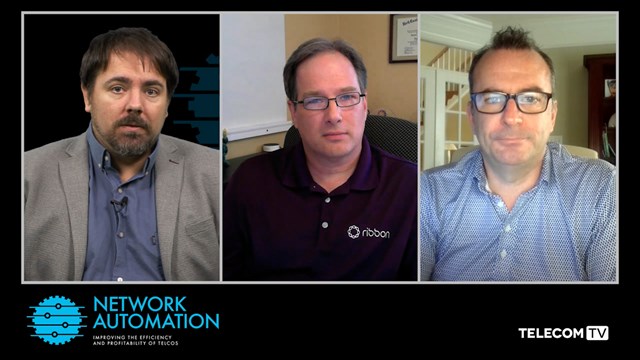
Hello and welcome to TelecomTV. Telecom operators are accelerating towards autonomous networks, but if the end goal is AI-driven network management systems that can run routine operations and heal networks with minimal human oversight, how far are we from that goal? What practical steps can operators take today towards it? To answer these questions and many more, I'm delighted to be joined today by Rich Krizan, who's the director of product management at Ribbon Communications, and Chris McKenna, who's business development leader, 5G Networks at AWS. Thank you both so much for joining me today. We hear about AI impacting network operations, but where are we actually seeing use cases that operators can use today? Rich, I'm going to come to you first on that one. What are your thoughts?
Rich Krizan, Ribbon Communications (01:16):
Well, thank you. What we're seeing in engaging with the operators is that, with the AI injection that's happening, everyone is looking for it to help solidify or reduce the complexity of some of the problems they're running into. They're really focused on troubleshooting in the NOC operations centres - and you mentioned the healing - trying to close the gap in the meantime to repair and bring services back up to speed quicker, in a more automated way, and to reduce the time it takes them to troubleshoot some of these problems. They're really applying the AI to that aspect of it, basically as massive data analysis assistance.
James Pearce, TelecomTV (01:57):
And Chris, what about you? What are your thoughts on this?
Chris McKenna, AWS (02:00):
Yes, the encouraging thing that we're seeing is that many of these use cases today are no longer theoretical. They are production use cases, and we have customers with them live today. I would say they broadly group into three categories: anomaly detection, root cause analysis and AI NOC advisors. Anomaly detection is where machine learning models are assessing thousands of KPIs in real time, looking for deviations and making predictions about issues before they happen. Then we see root cause analysis use cases, which are designed to assess issues after they've happened. They walk multiple systems and correlate potentially thousands of alarms, and we have customers that have taken their root cause analysis timelines from hours, and sometimes days, down to minutes. And then the last category, the AI NOC advisor, is where NOC engineers can query the network in natural language with an agent that can respond in natural language, taking into account the RCA use cases and the anomaly detection use cases I just described.
Chris McKenna, AWS (03:30):
Those are the three areas where we are seeing the most traction today, and our guidance to our customers is to start there. Start with assurance, start with operations and build from there, because there is already value to be had in those use cases.
James Pearce, TelecomTV (03:44):
I think there are some great use cases in there, so thanks for sharing them. You mentioned NOCs, and the dark network operations centre is often seen as the end goal, but what can operators deliver today? What are the practical capabilities that they can implement right now? Rich, let's hear your view on this first.
Rich Krizan, Ribbon Communications (04:06):
It really leads into some of the discussion that Chris had. The dark NOC concept is about having no humans in the NOC and the system autonomously managing itself and making updates and changes. I think the big gap to that is around the liability and trust in the agents, which will have to be earned and built up over time. Similar to what Chris mentioned, we at Ribbon are building what we call our NOC agent, which is a support agent to help you go through root cause analysis, investigate problems in the network, and highlight things going on in the network to help you bring it up to speed. So we see this as a transition into an assisted state, supporting the operators. Then, once the operations centres reach a trusted capability, they will let the agents start making their own decisions and actions.
Rich Krizan, Ribbon Communications (05:04):
Initially it's still going to be a human in the loop validating all the decisions that the agents and the AI are proposing, and then at some point the trust will build and they will hand more over. You see this in multiple industries. It's slowly happening, but again, that trust needs to be built because of the telecom industry and the very mission-critical capabilities that we are enabling here.
James Pearce, TelecomTV (05:33):
Chris, coming to you, what's your take on the dark NOC and the journey to it?
Chris McKenna, AWS (05:37):
I think the keyword there is journey. The dark NOC is a destination - it's not something we get to overnight. Another keyword Rich just mentioned is earning the right to have agents performing some of the very mission-critical activities in a dark NOC. What we're seeing today is that most operators are human-led and rules-based in how they respond to issues in the NOC. I think a realistic move for everyone now is towards some sort of supervised autonomy, where agents are doing, let's say, 80% of the routine detection, correlation and triage, and maybe even clearing some well-known alarms. The next stage after that is to move towards closed-loop automation, but for very low-risk and well-understood actions. So that means not doing anything that is going to immediately interrupt the network or make changes to it, and not doing anything that may be customer impacting, which is still left to humans to approve.
Chris McKenna, AWS (06:54):
But the message, very similar to my last point, is that there's value to be had now. Moving towards that supervised autonomy type of setup is something that can be done now, and the stage after that is moving towards closed loop. But the value is there to be had now, so we are recommending that our customers start now.
James Pearce, TelecomTV (07:23):
I think that's really interesting, and the question of when to go with it is an important one. Now, if an autonomous network needs to make decisions in real time, does all that intelligence really belong in the cloud, or are we heading towards a much more distributed model of AI across cloud, network and edge? Chris, you work for one of the biggest cloud providers in the world. What's your take on this?
Chris McKenna, AWS (07:48):
Good question - we hear this one all the time, of course. Our recommendation is not to think of it as cloud versus the edge. It's very much a tiered decision tree, where we encourage our customers to run the AI models, or inference, where it needs to run. Let me give you a couple of examples. If you have a use case that relies on reflex decisions - millisecond decisions, decisions that can't wait, even if your backhaul goes down, for example - then obviously those models need to run at the edge. But even in those cases, we would recommend that the models are built, trained or retrained in the cloud, where we have the horsepower to run digital twins of the whole network and build models that can then go and act locally.
Chris McKenna, AWS (08:56):
We'd then recommend that customers put lightweight edge agents into the on-prem environment, and those edge agents operate through policies that are pushed down from the cloud. So it's distributed AI, as we call it: put the agents where they need to be based on latency and blast radius, but maintain control, policy and the training of those agents in the cloud.
James Pearce, TelecomTV (09:24):
I think that distributed side is really interesting. Rich, what's your take on this?
Rich Krizan, Ribbon Communications (09:28):
Similar to what Chris is saying, we see it as a hybrid model, because there are many different aspects to it. AI itself is hugely resource intensive when you get to the model side. The agent code and the agents themselves running are not as intensive, but reaching out to the models can be. So we see things happening in a hybrid mode, partly because of concerns about restricting very sensitive information. Certain industries, whether banking or some of the federal areas, have more concerns around privacy and security and information that they are trying to restrict. But we are still pushing the hybrid approach, because some of the foundation models or frontier models need a lot more horsepower than can only be acquired through cloud resources.
Rich Krizan, Ribbon Communications (10:31):
And just as Chris said, in a distributed model multiple agents don't always use the same model for everything they're doing. So there will be cases where we push for mission-critical capabilities to be on-prem or onsite, in data centres local to the service providers, to maintain that mission-critical capability at that level. But the more advanced and complex items, which may not need to run instantly, can be done up in the cloud. So they can still maintain a data model that manages information locally, yet reach into the cloud only as needed for the larger horsepower on big decisions.
James Pearce, TelecomTV (11:15):
That's really interesting stuff. Rich, perhaps you could give me an example of where you're working together with AWS to deliver some of these agents.
Rich Krizan, Ribbon Communications (11:24):
Yes. Together with AWS, we are working on a hybrid solution to enable an on-demand NOC agent, making it easier for service providers to leverage analytics, automation and the elasticity of cloud resources, so they can expand the agent capabilities into the cloud when big events happen and then scale them back after the event has been closed out. It's a very good partnership and plays off that hybrid model.
James Pearce, TelecomTV (11:53):
Thank you. Now, not every network decision carries the same risk. How are operators thinking about where they can let automation take action and where they still want a human in the loop? Chris, I'm going to come back to you for this. What are your thoughts?
Chris McKenna, AWS (12:11):
You're absolutely right that not every decision carries the same level of risk, so we recommend that our customers risk-tier the decisions. We're not looking to automate everything equally, all at the same time - that's not realistic. We grade the decisions by blast radius and reversibility. For closed-loop use cases, we would say only do that on low-risk, reversible, well-understood decisions. It might be restarting a pod, reallocating resources or clearing known alarms - events that do not pose a high risk to the network. We recommend that customers always start with human in the loop when it comes to higher blast radius, hard-to-reverse, customer-affecting operations. And we've used the word earned a great deal. I think this is a very good example of where autonomy is earned.
Chris McKenna, AWS (13:27):
So start with low risk and gain confidence there. Put in your guardrails, safety and scoped permissions, and make sure full observability and explainability are in place, with post-action KPI validation, before you move into higher-priority closed-loop use cases.
James Pearce, TelecomTV (13:54):
Thanks, Chris. I think that tiering model is really, really important as well. Rich, do you agree with that?
Rich Krizan, Ribbon Communications (13:59):
Yes, we definitely see it. With the Acumen product line that we're building at Ribbon, it's about pushing that governance and policy level so that you can control what the agents are doing and what is allowed, what models are used and which information goes out to them, because the point is to manage the trust level and ultimately get to closed loop. You may let some of the agents make snap decisions, with the human in the loop looking at quick things. Beyond the NOC agent I mentioned, another one we focus on is the network change agent, because one of the bigger problems we see operators having is upgrading their network. There are inherent security problems, and they have to constantly update because of CVEs and so on. The agents we see there help them with upgrades, making decisions on digital twinning and testing and validation prior to pushing anything out into the network.
Rich Krizan, Ribbon Communications (15:02):
But again, as Chris was saying, this is low-hanging fruit: I can do a test validation through an agent that lets me see that it is clean, and then I can let that agent go ahead and perform the network upgrade with a new software release.
James Pearce, TelecomTV (15:22):
Thanks. Some really good points in there. So let's move on. As operators introduce AI agents for different parts of network operations, how do you get multiple AI agents, potentially from different vendors, to work towards the same operational intent? What needs to happen to make that possible? Rich, I'm going to come to you first on this.
Rich Krizan, Ribbon Communications (15:43):
Well, the industry's changing so quickly with AI. There are multiple protocols, such as ACP and A2A, that are being introduced, but you have to start with a tiered approach. You would have an orchestrator agent doing primarily the planning and instructing, which would then reach out to more task agents, which could be agents from other vendors or dealing with third-party devices. That's the tack Ribbon has taken. We've been building agents, but a lot of what we've been doing is enabling customers to build their own agents and providing the infrastructure for that, because it lets us sit between multiple third-party devices and allow different networks and information to come into play. But those interactions still need to be managed through different gateways, MCP interfaces and the like, which help mitigate and manage the interaction between them.
Rich Krizan, Ribbon Communications (16:49):
Things become universal slowly, but there's still that level where we keep going back to the human in the loop, or the orchestrator agent overseeing what is going on and allowing humans to make decisions when other agents are involved in the construct or the outcome.
James Pearce, TelecomTV (17:07):
Brilliant, because it is a very complex environment, isn't it? Chris, what's your take on orchestrator agents and the role of agents talking to agents?
Chris McKenna, AWS (17:16):
I completely agree with Rich. This is an environment where there will be many agents working across the network, and those agents will not come from one vendor. Our customers don't want that anyway - they don't like that level of vendor lock-in. So we will see a multi-vendor estate of agents, and that relies on three key areas. One is open protocols, so that agents can speak to agents, which is how Ribbon and AWS agents are able to operate in the same environment today. Number two is a shared source of truth, so that agents have a common network context. This is where things like digital twins come in, making sure those agents are all working with visibility of the network as a whole, not just one portion of it.
Chris McKenna, AWS (18:17):
The third is the intent-based orchestration part: having an environment where a statement like "keep this service healthy" translates into a team of coordinated agents working across the network, with guardrails, observability and rules built into them, which come out of your intent-based orchestration environment. If you get those three right, then we'll see that mixed-vendor estate, an army of agents running across the network in a coordinated manner.
James Pearce, TelecomTV (18:59):
An army of agents - that sounds really, really interesting. Rich, I'm going to come back to you to give you the final word. Maybe you can give us the lowdown on the relationship between Ribbon and AWS and how you're working on this army of agents together.
Rich Krizan, Ribbon Communications (19:13):
Thanks, James. Multiple questions tie together here, with the hybrid and the cloud capability. Ribbon is working very closely with AWS. We're building on-prem agent structures and infrastructure, but we are also closely linked with AWS, able to provide our own agents up in AgentCore from AWS to have that cloud capability and provide that hybrid sense, which allows AWS and Ribbon to offer a more powerful solution to customers.
James Pearce, TelecomTV (19:46):
Brilliant. That relationship is so interesting as well, but I'm afraid that's all we've got time for today. I'd really like to thank you both for joining us. For much more on autonomous networks, AI and automation, and discussion on similar topics, please do check out the TelecomTV website. For now though, thank you for watching, and goodbye.
Please note that video transcripts are provided for reference only – content may vary from the published video or contain inaccuracies.
Rich Krizan, Ribbon Communications & Chris McKenna, AWS
Rich Krizan, director of product management at Ribbon Communications, and Chris McKenna, business development leader for 5G networks at AWS, discuss where AI is being applied in network operations today, the journey towards the dark NOC (network operations centre), how AI is distributed across cloud and edge, balancing human oversight with risk-tiered automation, and how agents from different vendors can work together.
Featuring:
- Chris McKenna, Business Development Leader, 5G Networks, AWS
- Rich Krizan, Director, Product Management, Ribbon Communications
Recorded November 2026
Email Newsletters
Sign up to receive TelecomTV's top news and videos, plus exclusive subscriber-only content direct to your inbox.