Swisscom on its approach to network autonomy

By James Pearce
Nov 13, 2026
To embed our video on your website copy and paste the code below:
<iframe src="https://www.youtube.com/embed/9JuTe8NNSds?modestbranding=1&rel=0" width="970" height="546" frameborder="0" scrolling="auto" allowfullscreen></iframe>
James Pearce, TelecomTV (00:05):
Hello and welcome to TelecomTV. I'm James Pearce, and I'm delighted to be joined today by Mark Düsener, who is the CTIO of Swisscom. Mark, thank you so much for joining us today.
Mark Düsener, Swisscom (00:14):
Thank you for having me.
James Pearce, TelecomTV (00:16):
So we're at the Ericsson OSS/BSS Summit. What are your expectations from an event like this, which brings together thought leaders from across the globe?
Mark Düsener, Swisscom (00:24):
I think none of us know the truth. And the only way to find truth and get better, serve our customers with better quality, is by having a regular exchange. And this is what I love in an event like these. It's operator driven, supported by our partners, but operator driven. So we have an exchange of ideas, exchange on problems and potential solutions, and this will help us to level up as an industry.
James Pearce, TelecomTV (00:55):
You presented the keynote at today's summit. Can you please talk us through Swisscom's approach towards achieving a higher level of autonomy, and what business and operational outcomes has the company achieved during this journey?
Mark Düsener, Swisscom (01:07):
So first of all, autonomy isn't an end in itself. It's a means. The cause is definitely quality. Another cause - and this is what I talked about most - it's about innovation. If you want to innovate, you need to be able to fail fast and cheap, and therefore have a system in place that allows that. So constant changes, changes on a daily basis, are a prerequisite to create autonomy.
James Pearce, TelecomTV (01:36):
So many operators are trying to layer AI agents on top of legacy monolithic systems. In your vision, why is a decoupled architecture an absolute structural dependency and not just a nice to have for building true agentic autonomous network loops?
Mark Düsener, Swisscom (01:53):
I think there are two aspects to it. First of all, if you have a very old-fashioned monolithic architecture, you by default have a lot of dependencies. And these dependencies are often unknown, unspoken. It's like you need a firewall change, so you need to fill out an Excel sheet. You need to call your colleagues to prepare that manual change and do that change, which is a trivial change, but might take a few weeks because of that. In a modern world, this is an API call. This is a matter of milliseconds. And if you think about AI agents driving operations and networks, there's a prerequisite that architectures like these are existing. Otherwise, you can't scale. The knowledge will be there quite quickly, but the agent can't act - because the only thing the agent could do is fill in an Excel sheet and send it over to another agent, unpacking the Excel sheet and transforming that into action again. So clear data, clear context, and the availability of APIs to act are prerequisites for that.
James Pearce, TelecomTV (03:12):
Let's look ahead a bit. If Swisscom successfully masters its decoupled architecture and cognitive autonomy, what will the core business actually look like in your view? Are we looking at, say, a fully autonomous software company that happens to own physical assets?
Mark Düsener, Swisscom (03:29):
That sounds a bit negative, but I would say yes. In the end, already today, networks are driven by software. We turned to SDN - software defined networks - a term we don't use anymore, but principally it showed us the way forward, and it's reality right now. We're just phasing out MPLS, so every enterprise access is software defined in Switzerland. A lot of our radio deployments and radio optimizations are all happening in software. That doesn't mean that hardware is legacy - it's not. The antenna designs are a beauty. I'm not a hardware guy, but I can see that this is magic. But driving innovation, driving customer perception and quality is happening with the means of software technologies.
James Pearce, TelecomTV (04:29):
Thank you so much for joining us today.
Mark Düsener, Swisscom (04:31):
Thank you for having me.
Please note that video transcripts are provided for reference only – content may vary from the published video or contain inaccuracies.
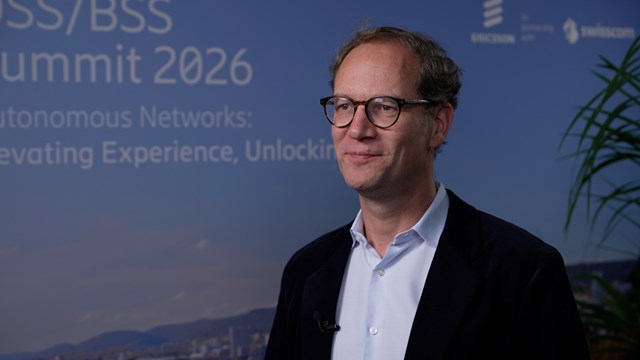
Mark Düsener, CTIO, Swisscom
At the Ericsson OSS/BSS Summit 2026 Mark Düsener, CTIO, Swisscom discusses building true agentic autonomous network loops while mastering decoupled architectures and cognitive autonomy. He also discusses how this will impact the future of Swisscom's core business.
Recorded October 2026
For more information read this blog: Focus on the customer: building Swisscom's autonomous network
Email Newsletters
Sign up to receive TelecomTV's top news and videos, plus exclusive subscriber-only content direct to your inbox.