How Singtel is evolving BSS for prioritised experiences

By James Pearce
Nov 26, 2026
To embed our video on your website copy and paste the code below:
<iframe src="https://www.youtube.com/embed/PXjuyZAAX7M?modestbranding=1&rel=0" width="970" height="546" frameborder="0" scrolling="auto" allowfullscreen></iframe>
Hello and welcome to TelecomTV. I'm James Pearce. I'm delighted to be joined today by Yeen Chin Chan from Singtel. Thank you so much for joining us today. What are your expectations when you come to an event like the Ericsson OSS/BSS Summit?
Yeen Chin Chan, Singtel (00:17):
This event, the Ericsson OSS/BSS Summit, is a convergence of ideas and innovation. So I particularly like this event because it allows us to share with operators, to hear from operators, to hear from technology partners what they have been doing. So some of my key takeaways are the alignment of technology, the alignment of our roadmap, what we need to build towards the future, in particular on 6G and monetization.
James Pearce, TelecomTV (00:50):
Singapore is a highly saturated market and consumers expect flawless connectivity. How is Singtel evolving beyond flat data tiers towards real-time experience monetization?
Yeen Chin Chan, Singtel (01:01):
You are right that Singapore is a highly demanding country that requires flawless connectivity, and rightfully so for the consumers, because mobile service is so important that everybody depends on it for their livelihood. Be it whether they are working or they are studying or they are working from home or taking a Teams call, they need good connectivity. And for us at Singtel, we have envisioned network slicing pretty early that we are able to solve some of those connectivity issues. So we have now launched our 5G+, which comes in the form of three performance tiers for our customers. So the first tier, which is Priority, gives very good performance to the customer with security protection. And we have enhanced with better quality and experience on our base 5G+. So our customers who are on these prioritized plans would get seamless connectivity wherever they go—in a stadium, in the subways—and they will get that good quality experience throughout.
James Pearce, TelecomTV (02:12):
What's the single biggest architectural evolution required in telecom charging engines over the next three to five years to keep pace with programmable autonomous networks?
Yeen Chin Chan, Singtel (02:23):
The charging system will need to evolve from its current role of being an engine that meters and charges for utility usages, like data volume, SMS, and voice volume. It will need to pivot away into a platform that holds the subscriber's entitlement. So with the subscriber's entitlement, it is then able to be relevant to control the performance tiers that the customer is entitled to. Now, secondly, we also envision that the charging system needs to evolve beyond its current scope, and in particular, the metering of AI tokens to come. So it's really interesting that we are hearing some early solutions coming from Ericsson on this tokenization that allows us to do that.
James Pearce, TelecomTV (03:14):
So engineering for monetization, including for 5G, requires tight alignment between commercial offer creation and the rating engines that you were just talking about. How have you decoupled your product catalog and rating system so business teams can launch new 5G offers in days rather than in months?
Yeen Chin Chan, Singtel (03:34):
We have embarked on this journey, I think about one to one and a half years ago on this journey itself to introduce a templatized catalog-based charging. So with this setup, we are able then to create an offer for the business in a matter of two days. And from there, when a customer purchases a particular offer, we are able to register the request and then activate the 5G profile, including the slice for the customer. And on that offer itself, it is mapped to a certain network policy which allows the customer to enjoy the prioritized experience. So this is how we have shifted away from static network configurations into an offer-driven performance tier provisioning approach.
James Pearce, TelecomTV (04:29):
Brilliant. Thank you for joining us today.
Yeen Chin Chan, Singtel (04:30):
Thank you.
Please note that video transcripts are provided for reference only – content may vary from the published video or contain inaccuracies.
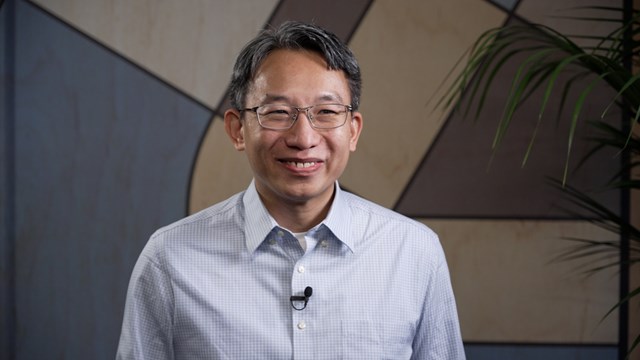
Yeen Chin Chan, Senior Director, Mobile Service Engineering, Singtel
At Ericsson’s OSS/BSS Summit 2026, Yeen Chin Chan, senior director of mobile service engineering at Singtel, shares his perspective on how BSS must evolve to monetise user experience rather than data volume. As a pioneer of network slicing, Singtel is now preparing its charging engines to act as dynamic entitlement platforms – unlocking guaranteed service tiers in real time and paving the way to bill for AI tokens.
For more information on Ericsson OSS/BSS explore OSS/BSS Solutions - Sell. Deliver. Get paid
Recorded October 2026
Email Newsletters
Sign up to receive TelecomTV's top news and videos, plus exclusive subscriber-only content direct to your inbox.