How AI agents, observability and trust are reshaping OSS

By James Pearce
Nov 25, 2026
To embed our video on your website copy and paste the code below:
<iframe src="https://www.youtube.com/embed/MXL4acWvtOY?modestbranding=1&rel=0" width="970" height="546" frameborder="0" scrolling="auto" allowfullscreen></iframe>
James Pearce, TelecomTV (00:25):
Hello and welcome to TelecomTV. I'm James Pearce, and one of the topics that have been at the forefront of the industry in recent years is AI, automation, and how they fit together. What role will AI play as network operators look to automate more of their network functions? How does this fit with existing OSS systems? And how much autonomy should be handed to AI agents? And what about observability and trust? Those are some of the key questions facing telecom operators. And to answer some of them, I'm delighted to be joined today by Vivek Murthy, who is MD and President of OSS at Rakuten Symphony. Vivek, thanks for joining us. Now, given AI is the hottest topic in tech right now, as it and automation reshape network operations, where does OSS fit into that picture?
Vivek Murthy, Rakuten Symphony (01:14):
Yeah, I mean, like everything else in the world, OSS is a bunch of applications. So that's also changing. The way people want to use OSS, they want a lot more of the kind of ChatGPT kind of thing. Can they actually use the interface a lot more intelligently and state their intent as opposed to the good old traditional ways of getting dashboards and reports and KPIs? So OSS as a whole is also fundamentally transforming itself in the way it's going to be used. I think there are two or three things that are happening to support the way in which OSS gets used. I mean, number one, I mean the OSS as such is becoming a lot more AI-native. What I mean by that is the agents and the orchestration of the agents is happening intrinsically from the OSS. In fact, if I may say so, agents are the new users.
(02:15):
So all the things that users used to traditionally do, a lot of that will increasingly get done by agents, and they will know what to do in what context, they'll understand, pick up the reasoning side of it, and actually execute on certain actions. So agents will become what today are the real human users. And so then what do the users do? The users will become more intent-based actors. So humans will say, "Hey OSS, can you reduce the, for example, energy of consumption in the night for the next few months to a certain amount?" Or, "Hey, can you make sure that the download speeds, for 90% of the users, doesn't go below this threshold? And by the way, can you do that while keeping the energy costs within this band?" sort of thing. So they start to state intents. So you're going to see that happen.
(03:13):
The second thing is the observability as an area is going to become hugely important. We'll touch upon it later, but essentially when you're collecting so much data and information and picking up what you call are the right signals, the observability as an area becomes a huge kind of a feeder into what is fundamentally now a more intelligent OSS system. So I think observability will evolve a lot. And finally, I think the thing for me is trust. I think trust is a big part of the product that we sell and package as part of OSS. And by trust, I don't just mean security and making sure that it's secure, but also can users actually trust these systems to give them predictable, consistent kind of explanations of what's happening, not just the final outcomes, but also explaining along the way the granularity, the flexibility to intervene, and get that kind of response that they can really rely on to run the network.
(04:08):
I think for me, these are the two or three things which are underpinning how the OSS will evolve in the world of AI.
James Pearce, TelecomTV (04:15):
Some really, really interesting points there. You mentioned trust. So what does closed-loop remediation look like in practice, and how much autonomy should operators hand to AI agents?
Vivek Murthy, Rakuten Symphony (04:26):
Yeah, I mean this is the big change management aspect of everything. I think, look, at one level, people want to, and I draw this over two different axes actually. On one axis is the way in which they will interface with these OSS systems, starting with, like I said, ChatGPT, an assistant, a co-pilot that they can interact with on a regular basis and start to get a feel of what it is because it's different from getting dashboards and the old KPIs and everything else. This is, can I ask intelligent questions? How much can I push the boundary of the kind of questions I can ask? How sophisticated can they be? They'll get a feel for it. And I think that evolves to eventually get into a place where they say, "You know what? I can now get some autonomous level expectation." That's on one axis.
(05:16):
On the other axis, you're talking about initially starting with basic querying, being able to do things which detect problems, for example, where is a problem occurring? And then you get into a little bit more intervention, a bit more bolder in it as you start to build confidence. Can you restart a pod, for example, because you know that's a problem? Or then you increasingly get into more sophisticated, and eventually you can get to a level where you can actually say, "Can I just route traffic from this place to that place because I know I can have confidence that these computers and machine learning and AIs will do the right thing." So you have these two axes on which you're traversing to eventually get to that kind of Autonomous Level 4 or 5, dare I say it, at some point in the future.
(06:03):
That's kind of how it's going to happen. And I think the way this will happen is, like I said, back to the question of trust, being able to play with it, being able to understand, respond, the system should be flexible enough for you to intercept when things are happening. The explanations are given and you start to basically intervene and say, "You know what? Actually, I'm not sure about it. Can I go this path?" You need that ability for... At the end of the day, when a CTO goes to a NOC and says the exam question, "Are you in control of the operations? Are you in control of knowing where the problems are in the network and able to fix it?" You want that NOC person, operations person to be able to have control over these systems. The more sophisticated OSS becomes and the more AI-native and all that intelligent, the more the responsibility for the creators of these products to provide that flexibility to step in, the NOC people, the operations people to step in, intercept, change course and so on.
(07:01):
So I think it's about giving control to the operations people, but again, being in the loop, on the loop, and outside the loop and so on over a period of time. And that's a classic change management and operational evolution kind of a question that one has to traverse.
James Pearce, TelecomTV (07:20):
I think that's really, really interesting. Another factor that is important here is that more and more operators are relying on a multi-vendor network. So how can they build a single observability layer when every vendor speaks a different data language?
Vivek Murthy, Rakuten Symphony (07:35):
I mean, this problem has been there for a long time, but like I said, and I think as you rightly say, observability is becoming such an important piece of this. Let's take a step back. If you think about what observability is, from the good old fault management alarms and KPIs from performance management and various things, you're getting logs, but you're starting to get events, you're getting metrics, you're also starting to get topologies and things that you can use to enrich your data. All this data is actually extremely important for observability. On top of it now, imagine the networks itself are becoming more cloud-centric. So you can certainly start to look at pods and clusters and these worker nodes and microservices and all. You're throwing all this in. So there's a huge amount of information that you collect. And like you said, rightly, these networks that we are interacting, getting the data, you got all these different devices.
(08:32):
I mean, there's no magic formula for all this. You got to be able to ingest the data, normalise this data so that it's like apples for apples comparison. When you show dashboards of all this data coming from networks, if you don't normalise, don't harmonise all that, you will be showing different things from different vendors. You got to be able to do that. You got to be able to work with different kinds of interfaces from where all this is coming. Ultimately, it's about creating abstraction layers and being able to shield. I mean, that's more of a software engineering as well. How can you modularise this so that you can shield all the upper layers from this kind of network intricacies and proprietary things coming from the networks as well as some of them which are standards-based. But ultimately, I think observability as an area is something that needs to ingest all this data, take the signal from, and then separate out the noise, mask out the noise, and be able to take intelligent decisions, do the detection of these problems.
(09:31):
So yeah, it's kind of all this in one place.
James Pearce, TelecomTV (09:35):
And it's not just the complexity on the vendor side, but also as networks are becoming more distributed across the edge, RAN, transport, space. How does observability keep pace with that?
Vivek Murthy, Rakuten Symphony (09:48):
Yeah, you're absolutely right. Given all the complexity I said and the humongous amount of data, you then look at all these disparate networks and the customer gets one single connected service. But behind the scenes, you've got all these networks and being able to do cross-domain analysis, kind of finding root cause, you have to be able to ingest data from all these different network elements. In fact, now with satellite and non-terrestrial networks coming in, we are having at Rakuten Symphony, we are actually having to ingest data from there. And there's some very interesting use cases that are coming from there as well in terms of how, for example, cell in space versus cell on terrestrial and being able to manage the observing, rather, the experience of the customer as he moves from one cell to another. There's interference issues and so on. So the complexity is getting more and more as the networks are getting more and more diverse.
(10:45):
Add to that this layer of almost like a temporal to this. You got time-series data to ingest now. It's not just about all these different networks, but the data that you collect over a period of time because don't forget, some faults, you just want to be able to look at data for the last few seconds and you want to respond to that in a minute or two minutes because it's a big problem. There are other kinds of problems which are like a degraded service over four hours. So therefore, you then have to start looking at data over the last four hours, last one day, capacity issues that happen over a week's time. So the observability platform has got to be able to deal with all this complexity of networks, but also over a period of time. And that's what makes this area very complex in terms of engineering.
(11:29):
It's not just about picking up the right signals, but also suppressing a whole amount of noise which is not needed because for example, if there's a pod which restarts, but it may not impact the service because there is enough resiliency on the upper layers, you want to really mask that noise. You don't want that to be manifesting up because you don't really care. So it is a very complex area, observability. And it's about picking the right signals. It's ingesting the data, but also enriching it with kind of topologies, network context, and being able to bring intelligence into all this. One last thing in all this, I know it's a little longish answer here because observability is one of those topics. You're also trying to use a lot of machine learning, statistical algorithms, deep learning to figure out, predict what's happening because if you then are able to predict with good accuracy, you can also then, when real problems occur, you can actually compare with this prediction and then figure out what are the root causes, the kind of KPIs which are really impacting the end result.
(12:32):
So there's a number of layers in all this observability, and the more you're able to manage this huge amount of data that's coming in, and don't forget the AI economics behind all this, because the more data you collect, the more expensive it gets, the latency around how frequently you want to get that data in. Yeah, like I said, a huge amount of complexity in all this. And ultimately, it's about picking the right signals and then solving the root cause of what's happening, going wrong with the network.
James Pearce, TelecomTV (13:00):
Thanks for that because as you said, it's a massive topic. I just want to finish up by looking forward a little bit. So what should operators prioritise over the next 12 to, say, 18 months to move from automation to autonomy?
Vivek Murthy, Rakuten Symphony (13:16):
Yeah, I mean look, we are talking to a number of customers around the world, and there's no doubt that everybody wants to go to Autonomous Level 4. Some of them wrongly, I think, dare I say, think that they can move from Autonomous Level 2 or 2.5 to 4. I don't think there's any magic wand here. It takes time to traverse that journey. You have to get the foundations right. Like I said, the data that you're collecting from all these different networks and cloud infra and so on, maintaining, managing the pipelines of that, not just one time, but on an ongoing basis. So good clean data normalised and so on, that's important. But then also being able to then build the AI agentic solutions on top. So all that we covered, right? So I think it's about bringing all those together. Most important, of course, all this is change management.
(14:06):
This is about re-imagining the business process that runs and underpins and is, sorry, built on top of this. There are so many people running operations and network optimisation today. A lot of those jobs go away when you move into Autonomous Level 4. So it's a huge change management scenario for customers, and how do they change the business process, move people, roles around? And I do think that a lot of these experts, and I have interacted and known them for a number of years in my previous jobs as well, they're super knowledgeable about what's happening. And I think there is a role for them to play. They just don't have to do the jobs they do today. They just have to move on to a little more sophisticated, intelligent, intent-based kind of driving of the networks using these kind of OSS platforms. So that sort of change management journey and taking people into confidence, I think that's a big part of all this.
(15:05):
But as I said, the foundations is where it starts, the data, making sure the pipelines are good, collecting all that across all the different networks, and then building the kind of AI-native components inside it, the sort of context, the knowledge base, and then all these tools and MCP and so on. I mean, these are all harness engineering, being able to explain all this simply to users so that they get the trust. I think these are all elements that every operator has to go through, and they will go through it in a step-by-step process. They'll go from Level 2.3, 2.4 to 3 and 3.5. The one thing that I really think successful operators are doing, they're focusing on use cases when they're going through all this. Identify use cases, start with simple ones, energy saving for example, or finding root causes, and then being able to do a closed loop for certain kinds of scenarios.
(15:58):
I think focusing on use cases is super important, and I think you build on that and slowly get to more sophisticated use cases. It's a three or four-year journey to get to that point where humans are truly on the loop or outside the loop, and they're just watching the machines do things. One final thing in all this, it has to be married to things like security. There is a SOC, security operations centre, dealing with all kinds of hacking and threats happening from outside, the DDoS attacks and so on. And there's a lot of things that you can bring across NOC and SOC and so on from an operations perspective. And it's these AI systems, if they truly do real AI, I think they can fulfil all these needs.
James Pearce, TelecomTV (16:40):
Thanks for that. I'm really excited to see how they progress on that journey to Level 4 and even Level 5 autonomous networks, but I'm afraid that is all we have time for today. You can read much more about AI and autonomy in telecoms networks and other topics which have been discussed today on TelecomTV. But for now, I'm James Pearce, and thank you for joining me.
Please note that video transcripts are provided for reference only – content may vary from the published video or contain inaccuracies.
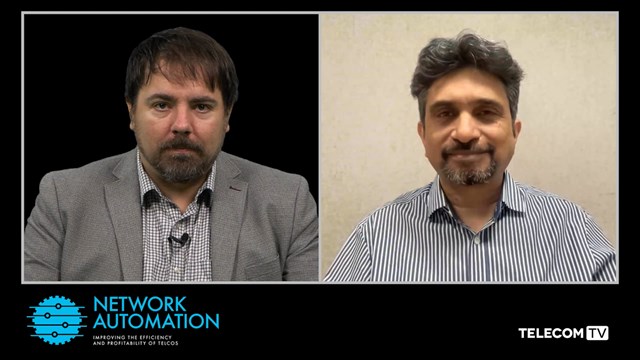
Vivek Murthy, MD & President OSS, Rakuten Symphony
Vivek Murthy, MD and president of OSS at Rakuten Symphony, discusses the role of OSS as AI and automation reshape network operations, how much autonomy operators should allow AI agents to have, how to build a single observability layer across multivendor and distributed networks, the priorities for moving from automation to autonomy, and much more.
Recorded November 2026
Email Newsletters
Sign up to receive TelecomTV's top news and videos, plus exclusive subscriber-only content direct to your inbox.