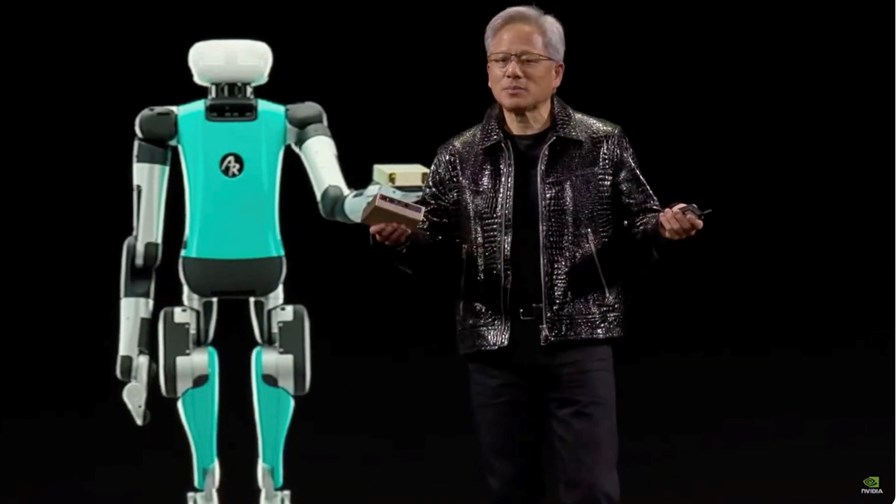
Nvidia CEO Jensen Huang takes to the keynote stage at CES 2025.
- Will Nvidia’s CEO be Huang out to dry?
- Vodafone Germany to cut 2,300 staff
- Rakuten and AST SpaceMobile form a D2D JV
In today’s industry news roundup: Nvidia’s CEO is under intense scrutiny and the subject of company and federal probes after becoming embroiled in a honeytrap espionage scandal that wouldn’t look amiss in a James Bond novel; Vodafone Germany is the latest telco to link AI efficiencies to headcount reductions; Rakuten and AST Spacemobile form a direct-to-device joint venture that will benefit from $1bn of state funding; and much more!
Nvidia CEO Jensen Huang is to be the subject of a security probe by the company’s board, as well as by the US government, after it was revealed that he had an extra-marital relationship with a Chinese businesswoman called Huang Le (aka Alice Huang) who is believed to be a spy for the People’s Republic of China (which has denied all knowledge of the situation). The news has raised concerns that Nvidia’s chief may have shared confidential information with someone suspected of being a foreign agent (oh the irony). Nvidia issued a statement on Sunday 8 November to note that its CEO had “been the target of a foreign intelligence effort” and that it had initiated an independent investigation. “The board prioritises US national and economic security, which is paramount to the interests of Nvidia and its shareholders. While the board has no reason to believe that either national security or Nvidia secrets were compromised, the board’s inquiry will examine all available information,” it added. The CEO also issued a statement, via the Nvidia media channels, to apologise to everyone (including his family), stating that “leading Nvidia is the privilege of my life. My responsibility is to serve you and be worthy of your trust. I have fallen short of that responsibility. I am fully committed to Nvidia and will work to earn back your confidence. Regarding the national security concerns raised in news reports, Nvidia’s board of directors has initiated an independent investigation. I support the investigation and will cooperate fully. I love our country and our company. I am committed to protecting Nvidia and supporting America’s national security. I am proud and grateful to be an American.” The somewhat aptly named US House Foreign Affairs Committee has requested a “closed-door briefing on Huang’s interactions with Megaspeed executive Alice Huang, a publicly reported People’s Republic of China (PRC) intelligence asset, and Nvidia’s security protocols against foreign adversary espionage.” It added: “Recent reports raise significant national security concerns regarding the PRC’s access to sensitive US technology and information. The issue of PRC infiltration and access to cutting-edge US technology is core to the investigative work of our three committees this Congress. It is vital that Congress determines the extent to which US national security has been placed at risk.” Jensen Huang is a powerhouse of a CEO – he is the public face of the company as well as its founder and driving force – and anything that could result in him being ousted is of great concern to Nvidia’s customers, partners and investors, as well as to the US administration, so it’s no surprise that Nvidia’s share price dropped by 4% to $179.16 in early trading on the Nasdaq exchange on Monday. Pre-market trends suggested the stock might be subject to a greater loss, so are fears of an AI tech intelligence leak already subsiding? Seasoned industry analyst Richard Windsor believes Jensen Huang will weather the storm, even if his reputation will be somewhat tarnished. In his latest Radio Free Mobile blog, Windsor notes: “It is more likely than not that the committees and the board conclude that while Jensen has had a serious lapse of judgement, no material harm has resulted. Furthermore, given the contribution that Jensen has made to both the shareholders of Nvidia and the US technology industry more generally, I think they [will] conclude that the interests of the US AI industry are best served with him leading Nvidia as opposed to leaving the company. Consequently, I think Jensen will survive this severe test and will continue to lead Nvidia and that the company will end up more resilient than it was before.”
The telco job cuts just keep rolling in… Only days after the UK’s Virgin Media O2 announced plans to cut thousands of jobs and BT provided an update on its headcount reductions, Vodafone Germany has announced it is “accelerating its transformation” by using more AI, simplifying its structure and targeting greater efficiencies. In this announcement (in German) the operator noted that it will “further integrate sales and customer service – for both residential and business customers” and deploy more automated processes to “enable faster resolution of customer requests, quicker development of products and services and a reduction in operating costs,” all of which will result in a headcount reduction of about 2,300 roles in the next two fiscal years. The operator, which is the largest single market in the Vodafone Group empire, noted: “Processes will be further automated. The use of AI will be expanded throughout the company. For example, AI will analyse network disruptions and develop solutions, create and manage advertising campaigns, and support colleagues in customer service. Processes will also be simplified and accelerated in other business areas. The structural changes and increased use of AI will also lead to savings in material, operating and personnel costs… Digital customer channels are being expanded to improve customer experience and loyalty. AI will reduce costs within the company and boost revenues in new business areas.” Some of the savings will be invested, as Vodafone Germany “is increasing its investments in AI, IT, fibre optics, digital services and digital customer channels,” it added.
Japan’s Rakuten Group has partnered with AST SpaceMobile to launch a joint venture (JV) that will build a direct-to-device satellite communications network. The JV – which will operate as Rakuten AST – will use low-earth orbit (LEO) satellites to provide D2D services to commercially available smartphones in Japan, according to an announcement from Rakuten. Rakuten AST has been backed by Japan’s Ministry of Internal Affairs and Communications (MIC) to the tune of around $1bn in funding over three years to manage the Japanese government’s J-LEO Project. It will be tasked with building a disaster-resilient sovereign communications infrastructure, which includes both satellites compatible with the mid-band spectrum, and a domestic operation, which is to commence by April 2029. When Tokyo announced the J-LEO Project earlier this year, the government said it expected its partner to match its investment. Rakuten and AST SpaceMobile were announced as the winning bidders in June, but the partners have now established this joint venture to deliver J-LEO. It is an extension of their existing relationship – Rakuten Group is one of the satellite firm’s investors and the Japanese firm’s telco arm, Rakuten Mobile, is set to use AST’s large-scale satellites to support its own D2D plans, with tests due to begin this year. Mickey Mikitani, chairman and CEO of the Rakuten Group, commented: “This project is a key pillar of Rakuten Mobile’s network strategy. By building an integrated framework spanning satellite procurement through operations and accelerating technological innovation, we will contribute to the development of disaster-resilient communications infrastructure and the improvement of Japan’s communications environment. We will maximise capital efficiency and pursue the expansion of business opportunities in the satellite communications sector.”
One challenge for AST SpaceMobile – and the rest of the satellite industry – is getting its satellites into space, with significant competition for limited launch opportunities. So the satellite firm could be going out on its own: Last week it announced a $1.3bn agreement with Firefly Aerospace for 36 rocket engines. The deal will see Firefly deliver 36 of its Miranda rocket engines, provide a licence for the engine’s IP, and provide engineering support for a three-year period. The core engineers will go into new rockets being developed by AST, which it has named Blacklift, as part of efforts to wean itself away from SpaceX and other third-party launches. AST said it is targeting late 2028 for the debut launch of Blacklift, an ambitious development timeline. The company said the rocket is “designed for reusability” and can lift up to five of its BlueBird satellites per launch. Blacklift isn’t it’s only solution, however, as AST has over 100 launch agreements in place as part of its aim to deploy 248 satellites to its global D2D network.
Sticking with satellites, after a trial lasting more than nine months, Vodafone IoT, which is wholly owned by Vodafone Group, and Skylo have launched a commercial satellite connectivity service for the telco’s internet of things (IoT) customers in the UK, Spain, Italy and Canada. The non-terrestrial narrowband IoT satellite service will see Vodafone IoT and Skylo integrate their network cores, allowing IoT devices to switch between cellular and satellite connectivity through a standard Vodafone global SIM, noted the partners in this press release. It will be available for both new and existing Vodafone customers with the aim of reducing coverage blackspots without the need to buy expensive satellite hardware. The service will be managed by Vodafone’s Managed Connectivity Platform, which already connects more than 240 million devices worldwide. Erik Brenneis, CEO of Vodafone IoT, said: “Integrating satellite connectivity directly into our cellular estate is a gamechanger for enterprise operations. Moving to a full commercial launch with Skylo allows us to offer our customers truly ubiquitous connectivity. Whether that’s tracking supply chains across continents or monitoring utilities in unreachable locations, businesses can count on Vodafone IoT for continuous, resilient connectivity, wherever they need it. This is only the beginning of our hybrid cellular-satellite journey and we look forward to connecting more customers, in more countries, on more networks.” The rollout of commercial services comes off the back of a trial, launched earlier this year, which saw Vodafone IoT and Skylo carry out tests with customers across the UK, Spain, Italy and Canada, with use cases ranging from the monitoring of remote storage tanks to micro mobility and e-bikes.
Vodafone Qatar has struck a memorandum of understanding with general-purpose robotics firm Agibot to explore the development of embodied AI robotics solutions for the public, enterprise and education sectors. Vodafone Qatar’s chief operating officer, Baran Yurdagul, signed the MoU alongside Agibot’s Qatar general manager, Vera Liu, as part of Mobile World Congress Doha, which is taking place this week in Qatari capital. The agreement sees both companies team up to assess how Vodafone’s connectivity solutions can support the rollout of Agibot’s robotic solutions in Qatar, as reported by the Qatar News Agency. Shanghai-headquartered Agibot develops foundation models, data infrastructure, simulation and hardware for humanoid, quadruped and dexterous robots, as well as automated commercial cleaning solutions. Earlier this year, the company saw its twenty-thousandth general-purpose robot roll off the production line.
The UK Competitions and Markets Authority (CMA) has published the third-party responses to its interim report on Nexfibre’s proposed £2bn takeover of Netomnia, which the regulator is investigating over competition concerns. Notably the likes of CityFibre, Community Fibre, Gigaclear and the Greater Manchester Combined Authority all responded to the CMA’s invitation to comment on remedies for the deal, which would see Nexfibre’s owners – InfraVia, Liberty Global and Telefónica – combine Netomnia with the fibre assets owned by Virgin Media O2 (which is co-owned by Liberty Global and Telefónica). At the beginning of October, the CMA provisionally found competition concerns in the wholesale supply of fixed broadband services in its initial fast-tracked investigation, a decision that resulted in Nexfibre deciding not to suggest any remedies, so disgusted was it at what it called a “fundamentally flawed” decision. CityFibre – which itself has been linked to a potential takeover of Substantial Group’s Netomnia – expressed objections to the deal, saying it “strongly supports the CMA’s provisional conclusion that the transaction will result in a substantial lessening of competition” in the UK’s wholesale fibre space. The GCMA also opposed the deal, saying it could “materially weaken infrastructure competition” in the Manchester region it represents. However, many of the responses speak favourably of the deal, which Nexfibre CEO Rajiv Datta claims demonstrates the industry is supportive. “The third-party responses published today speak for themselves,” said Datta in a note to the media. “The clear weight of industry opinion reinforces our position that the CMA’s interim report is based on highly speculative assumptions that lack evidence and need to be re-examined.” Other UK altnets, such as Gigaclear, raised concerns over the CMA’s report and its conclusions. They warned that if the CMA rules against this decision, it could create uncertainty for investors and harm potential exit strategies for those who have built up significant network assets. “Gigaclear’s concern is broader than this transaction alone,” stated Gigaclear. “The UK’s fibre market is expected to undergo significant consolidation over the coming years. In assessing such transactions, the CMA should be cautious about relying on highly speculative counterfactuals that assume alternative transactions would have occurred. Such an approach risks creating uncertainty for investors and may discourage the consolidation necessary for a competitive fibre sector.” You can read all of the responses to the CMA here. The CMA has a statutory deadline of 15 December to issue its ruling on the merger.
Veon subsidiary Beeline Kazakhstan has completed an $81m takeover of online classifieds platform OLX KZ after receiving all relevant regulatory approvals, as the operator continues to expand its digital services portfolio. OLX serves as a marketplace for goods, services, real estate, jobs and automotive listings, reaching more than 52% of Kazakhstan’s 20 million-plus population. It has around 9 million monthly active users and will add around $28m in sales to Beeline’s revenue, based on figures to the year ending March 2026. This latest acquisition is part of Veon’s strategy to advance digital services within its portfolio and scale them through its connectivity base. “This acquisition marks another milestone in the digital operator strategy that is reshaping Veon,” said the operator’s CEO, Kaan Terzioglu. “Across our markets, we are building digital ecosystems that give millions of people meaningful access to digital financial services, healthcare, education and entertainment, and OLX KZ brings Kazakhstan’s leading classifieds platform into that portfolio.” According to a report by Bloomberg, Veon’s plans include launching a digital bank in the country by the end of 2027. In an interview, Terzioglu explained: “I would like to be number one or number two in financial services,” though he did not share a timeline for this goal.
– The staff, TelecomTV
Email Newsletters
Sign up to receive TelecomTV's top news and videos, plus exclusive subscriber-only content direct to your inbox.