Rakuten Symphony on the journey from cloud native to AI native

By Ray Le Maistre
Nov 9, 2026
To embed our video on your website copy and paste the code below:
<iframe src="https://www.youtube.com/embed/lc7l6IUp0tI?modestbranding=1&rel=0" width="970" height="546" frameborder="0" scrolling="auto" allowfullscreen></iframe>
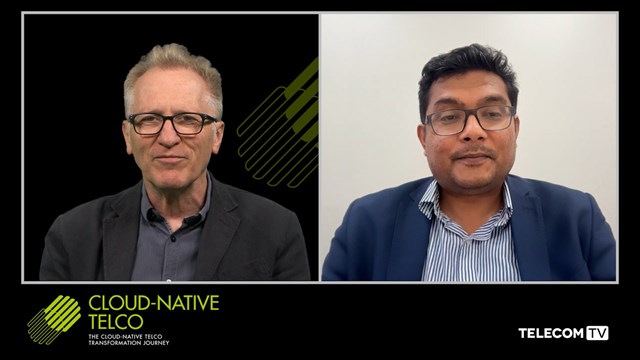
After years of working towards their cloud-native telco goals, network operators are now factoring in AI and evolving their strategies to become AI-native. I'm talking today with Devesh Gautam, global head of solution and pre-sales at Rakuten Symphony, about some of the key considerations for telcos as they take this critical next step. Devesh, welcome to TelecomTV. Great to see you. Now, Rakuten Symphony works with operators at very different stages of the cloud-native journey. What separates the operators that make the jump to AI-native from those that stall on making that move?
Devesh Gautam, Rakuten Symphony (00:56):
Thanks, Ray, for inviting me on. To address this particular journey for any operator from cloud-native to AI-native: for any operators who is actually fast enough to adopt cloud-native to AI-native, it's not a new technology purchase. It's a sequencing problem. And we, Rakuten Symphony, believes to meet them wherever they are in their journey. So if you think the journey from cloud-native to AI-native, cloud-native always provides agility and flexibility and speed as a structure and foundation. AI-native will comes with a smart knowledge on top of it and autonomy comes along with that. But the fundamental pieces are how you will unify the entire silos in your network and come up with a complete Level 4 automation, which is designed by the TM Forum to enable the operators. If you see the current states, around 80% of the network operators are still either Level 2 or below in their automation journey.
(02:18):
Rest 17% are actually having a defined goals for their next future path to achieve the automation exactly where they have to take it forward for the intent-based architecture. Rakuten Symphony exactly comes on that particular play where we enable the operators to unify all the silos, provide the guardrails to trust the network and build a foundation for them so they can achieve the repeatability to have the complete AI-native journey from the current level of their automation.
Ray Le Maistre, TelecomTV (03:06):
Okay. Now most operators though are brownfield and multi-vendor. So how does Rakuten Symphony engage with these operators and help them evolve from their legacy estates?
Devesh Gautam, Rakuten Symphony (03:21):
That is excellent question. So our solution is completely horizontal Kubernetes platform with single control plane and single tool chain, which enables operator not to differentiate between the domains which are like RAN, core. The entire convergence happens there at this particular layer. So there is no rip and replacement is required to start with to achieve this journey. Our Kubernetes platform is actually onboarded Samsung virtual core and virtual RAN without any significant changes on their software stack. Same goes with the Nokia Packet Core solutions which we onboarded on our cloud-native platform without any major hassles. So any brownfield operator which is having an existing core transport partner, we are able to onboard them seamlessly with the openness in our architecture and that is the fundamental piece. If you see the current AI era, openness is not a big challenge. It's not questionable. It's now accepted by all the Tier 1 operators.
(04:56):
In fact, in Kuwait, the Tier 1 operator, Zain, we are deploying end-to-end stack of Kubernetes platform along with our RAN software, which is integrating their existing core transport and other ecosystem partners. So the idea here is to meet them wherever they are in their journey and being agile and flexible enough to adopt the brownfield situation of their network.
Ray Le Maistre, TelecomTV (05:29):
Okay. Now you mentioned the different network domains there and domain awareness and ontologies have cropped up as key talking points during this Cloud Native Telco Summit. With these topics in mind, what does Rakuten Symphony bring to the AI layer that let's say a generic AI platform cannot?
Devesh Gautam, Rakuten Symphony (05:54):
Yeah. So Rakuten Symphony actually working on the telecom-specific language model, which is trained across a real operational data, which is providing the ontology converge layer, which is again create the skill convergence across the domain, including RAN, core, transport in each and every possible domain with the real data. And that is actually creating the value for our customer as well as within Rakuten Symphony to fine-tune it further to have a repeatable solution across any domain. Along with that, we are heavily working on the skill layer improvement with the data which we are working with other frontier models as well. So we Rakuten Symphony actually bring the knowledge base and data unification as a fundamental layer and not completely relying on any specific language model. We are agnostic to that, but at the same time we are working to develop our telco language model, which is going to benefit across our partners as well as to the customers.
Ray Le Maistre, TelecomTV (07:28):
Okay, great. Now earlier on you mentioned the telco journey towards autonomous networks and Rakuten Symphony's platform powered the first TM Forum Level 4 validation for RAN energy efficiency. What does this mean for other operators? How could you engage with other operators to deliver such autonomy?
Devesh Gautam, Rakuten Symphony (07:56):
Yeah, so that is the visible benefit I must say about adopting cloud-native architecture in early phase. For Rakuten Mobile as a customer for us, Rakuten Symphony customers, we were glad to see how fast they achieved the TM Forum Level 4 energy optimisation achievement. The similar path can be achieved for the other operators without having an Open RAN and vRAN architecture as well because the fundamentals which we created as a platform for us, which is agnostic to any interfaces and any operators, be it with a traditional vendor, can be able to achieve the energy automation journey. We certainly achieved in Rakuten Mobile around 20% energy saving across the domain and specifically on the RAN. So that is a big achievement I must say.
Ray Le Maistre, TelecomTV (09:07):
Okay, excellent. Now AI in its nature is probabilistic, but operators need to run deterministic networks and answer to regulators. How does Rakuten Symphony build enough trust for operators to let AI act on a live network?
Devesh Gautam, Rakuten Symphony (09:30):
So we as Rakuten Symphony work on basic fundamentals of releasing any software stack to our customer, agreed and do the proper validation with our digital twin as well as the complete autonomy on the QA cycle. And we build trust with the choices and the solution which we provide as a guardrail to pass through any information telemetry across the domains. Rakuten Symphony is also a very big contributor on the security forum, which works on the O-RAN as well as on the AI-native forum space. And we are delivering significant role to make sure all the networks should be compliant as well as creating the trust with the guardrails which are actually defined by all the relevant standards committees.
Ray Le Maistre, TelecomTV (10:39):
Okay. Yeah, really important points there. Now looking ahead and beyond network operations, where is Rakuten Symphony taking AI native next? I mean onwards from AI workloads at the edge and towards the 6G era.
Devesh Gautam, Rakuten Symphony (10:59):
Apart from 6G, I think the fundamental choices of the architecture in Rakuten Symphony was always related to cloud-native, to give maximum importance to the data and the telemetry which comes from any network component, as well as the third fundamental principle was to have the openness and modularity in the architecture. And that is actually now adopted by 5G-Advanced and 6G standards as well, be it any new adoption of the deployment technology in terms of sensing, having a distributed edge architecture, the flexibility you can receive from cloud-native architecture. We provide the end-to-end solution for the edge and the hybrid cloud story. We do have the complete automation story from our OSS portfolio, and that is actually enabling us. And in fact, I must say we are going to be much ahead of other competitors in terms of adopting 5G-Advanced and 6G for any new standards coming up and any new adoption of the technology which is going to be available in coming few years.
Ray Le Maistre, TelecomTV (12:24):
Okay, excellent. Well, there you go. The power of a cloud-native heritage. Well, Devesh, great to talk with you today. Thanks so much for joining us and look forward to talking with you again in the future.
Devesh Gautam, Rakuten Symphony (12:37):
Thank you.
Please note that video transcripts are provided for reference only – content may vary from the published video or contain inaccuracies.
Devesh Gautam, Global Head of Solution and Presales, Rakuten Symphony
Devesh Gautam, global head of solution and presales at Rakuten Symphony, discusses what separates operators that make the jump from cloud native to AI native from those that stall, how Rakuten Symphony engages with brownfield, multivendor operators through a horizontal Kubernetes platform, what its telecom-specific language model and ontology bring to the AI layer, the first TM Forum Level 4 validation for RAN energy efficiency, how it builds trust for AI to act on live networks, and much more.
Recorded October 2026
Email Newsletters
Sign up to receive TelecomTV's top news and videos, plus exclusive subscriber-only content direct to your inbox.