To embed our video on your website copy and paste the code below:
<iframe src="https://www.youtube.com/embed/Xn8oIW4GWG8?modestbranding=1&rel=0" width="970" height="546" frameborder="0" scrolling="auto" allowfullscreen></iframe>
Ray Le Maistre, TelecomTV (00:05):
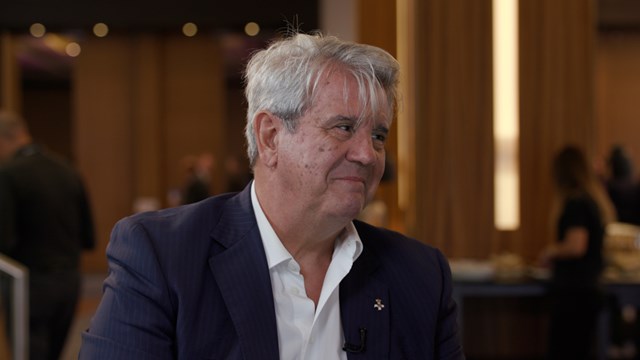
So we're in London at FutureNet World 2026. I'm here with Scott Petty who is Group CTO at the Vodafone Group. Scott, great to see you again. Thanks so much for joining us.
Scott Petty, Vodafone (00:16):
Pleasure, Ray. Always great to talk to you.
Ray Le Maistre, TelecomTV (00:17):
So it's day one of this event. You were on the stage earlier on today. One of the topics that cropped up in the panel you were on was the issue of sovereign services, what that means for network operators like Vodafone. There were some interesting conversations around that. So what does this mean to Vodafone in terms of the way that you are thinking about the potential services that could be offered and how from your network and IT systems those services can and should be delivered?
Scott Petty, Vodafone (00:52):
Sovereign is a really hot topic at the moment. Everyone wants to talk about it, lots of discussion. I think sometimes the conversations are a little bit too simplistic. So thinking about sovereignty is quite broad and it's not a binary topic. If you think about the three key pillars, first of all in sovereignty is how do you encrypt the data and where is that data stored, who's got the encryption keys is really important. What people don't understand is actually the identifiable metadata is probably more important, the file name. If a file is called payroll.xls, that's probably more interesting to you than info.txt. People look for identifiable metadata to gather information and capture that. Also networking information, IP addresses, DNS addresses are all part of the data that you want to be able to encrypt in a sovereign solution. The second pillar is all around the operating model. Where are the people that operate those systems and platforms and what laws and jurisdictions do they come under. Are they under European law, UK law, US law and what rules would apply to information they need to give. How good is your role-based access control and the models that you have in place for separation of data and functions. And third is the technology sovereignty. So where does the technology come from, where is it manufactured and what kill switches might be involved, what software might be involved. People focus a lot on that pillar. Actually it's the first two pillars that are much more important in building a sovereign solution. Secondly there are layers of sovereignty. What the Ministry of Defence wants for a core application is much more complex than what a public private hospital might want or a public service might want. So it's very nuanced. As you go up the layers of sovereignty the cost increases dramatically and therefore people have to make business or commercial decisions of what layer of sovereignty do I want, what level of functionality do I require. Why is this interesting to telcos? Well if you're going to build a sovereign data centre or sovereign cloud service you're going to want a sovereign network that goes with that. It's no use having an open internet connecting to those services. That's a great opportunity for telcos to control the network path, do the encryption, manage the role-based access controls. Our networks are almost always sovereign anyway because of the way we build our infrastructure in every country, we're regulated. So sovereignty is an opportunity for growth particularly in B2B for telcos but you have to understand the entire sovereignty stack.
Ray Le Maistre, TelecomTV (03:03):
And for Vodafone obviously, I mean Europe seems to be a hotbed of sovereign discussions for multiple different reasons and obviously Vodafone has got quite a few operations in Europe and while I think then almost all but not all within the European Union, so not all have the same regulations, there's lots of local regulations as well. So how do you manage that or how do you think about that in terms of your networking choices about how your routing platforms for example and also about what this means for your edge infrastructure because you're part of an edge consortium at the moment that's very focused on the delivery of sovereign services?
Scott Petty, Vodafone (03:46):
You're right, the regulation around sovereignty is evolving. The European Union is pushing that probably faster than other countries and they're developing mechanisms for scoring levels of sovereignty, the rules that are associated with that and we've launched sovereign services in markets like Germany where there's a bigger appetite from our customers to be able to leverage that and we built sovereign network capabilities that sit below those solutions. That regulation is going to continue to evolve over the next 12 to 18, 24 months and I think we'll see different models in different parts of the world and we'll have to adapt to those capabilities. From a mobile network point of view, mobile networks are always built inside an individual country, that's how we do regulatory compliance that we have today. It's a little bit trickier as you get into the fixed network, particularly the international network and we have developed levels of sovereignty for our connectivity that we can build into those solutions for our customers. So we feel we're well positioned to offer sovereign solutions for those B2B customers and public sector customers who want to look at that capability.
Ray Le Maistre, TelecomTV (04:42):
In terms of the edge, I mean people have been talking about the telco edge for a long time and it seemed to be an architecture that was looking for a reason to exist. Is sovereign the reason for telco edge to exist?
Scott Petty, Vodafone (04:55):
I think the jury's out, I think it's early days. There is an argument as we build more AI applications and we want to do inference further away from the data centre for latency and performance reasons, we might push those to the edge. I think that's still very much in the proof-of-concept exploration phase and whether that will translate into large-scale deployments in telcos, I think you're going to need to ask me that in a couple of years time to see if that's really... I guess it depends, it's all going to depend on demand from the B2B sector right and figuring out... Why are we working on it now? Well because we're a standards-based industry and we need to architect how we would do GPUs at the edge, how it would fit into our RAN infrastructure, how the operating models would work, so we have to invest in how it would work, how we would build it as we keep a track of the demand that's growing and we'll see over the next few years how it evolves.
Ray Le Maistre, TelecomTV (06:06):
What kind of role does the relationships that you have with the hyperscalers, how does that play into this? Because you also mentioned earlier on that it's very handy to be able to rent a GPU rather than buying them and building your own AI infrastructure. Does those kind of relationships give you the flexibility you need to be able to move with the demand trends from the...
Scott Petty, Vodafone (06:27):
As hyperscalers have huge scale in cloud infrastructure and AI infrastructure, I think a general trend for all industries is migrating to cloud services. Even if you want to have sovereign services, not everything will be sovereign. The Ministry of Defence has applications they want sovereign but they have a public-facing website, so why would they not run that on public cloud services? So having those partnerships is important. So far we've found working with those hyperscalers and renting GPU infrastructure has been a really cost-effective way to build applications. We can focus our efforts in the application layer, adding value to Vodafone and not in deploying the infrastructure. That may change over time as we get to scale. If we find very specific applications that would be better off having our own GPUs, we would clearly invest in those, but today that's not what our AI estate looks like and we don't have those workloads that justify that.
Ray Le Maistre, TelecomTV (07:38):
Okay, and then another topic that actually cropped up early on and hasn't been widely discussed at the moment is the potential for AI voice services. And if those were to take off, I guess you'd think of telcos first, right? Voice is what they've been associated with for more than 100 years. How are you seeing that play out? Are there discussions around AI voice already and are companies like Vodafone, do you think, in a position to be able to react to the demand for various AI voice applications and services should they arise? And they do seem to be actually coming up the pipe, some of them network-based and some of them not.
Scott Petty, Vodafone (08:10):
Voice in AI is a really important topic. Most people interact with AI today in a chat sense. You talk to a chatbot, an agent, you ask it to do something, but multi-modal AI where you bring voice or video capabilities into that experience opens up a whole new world of applications and services that you can offer. We're seeing it today in the applications we build. People want to interact with our customer services via voice, not by chat, to have questions answered. So we need voice capability in our AI solutions to be able to have the conversation, complete the journey, and deliver what the customer is asking for. So investing in voice is really important, but it's hard. It requires latency to be very low. It requires a lot of tuning, a lot of linguistics to make that work really effective and to sound human-like, not robotic-like. It's a little bit easier to do in text or other areas. So I think you'll find most people are investing in multi-modal AI to build those capabilities. We use it, for instance, for translation services in our contact centres. So someone who's in a foreign country, they can use their home language, our agents can understand them and deliver a service back to them, which really opens up digital services to a broader community than we have today. In terms of whether it should be in the network or should be on top of that, it really depends on how you want to deliver the solution that you're delivering. If you're looking at in-network translation, spam calling and protection in the network as an IMS application, it makes perfect sense. In a customer care sense, it's probably going to be in your contact centre. It's going to fit inside your data platform that you use for those services. So I think it'll be built in the location that makes the most sense to deliver that service. But it's a real opportunity for telcos, because voice is going to become increasingly more important. The quality of the voice, the way it interacts with those services is an opportunity for us to remind people just how important the connectivity is that we provide.
Ray Le Maistre, TelecomTV (10:28):
So do you think this is a classic example? I mean, one of the big topics here this morning was how do telcos remain relevant in the AI era? Is this voice legacy knowledge, domain understanding, is this one of the key platforms that's going to help telcos to remain relevant in, say, 10 years' time?
Scott Petty, Vodafone (10:47):
I think it's one of them. I think playing a role in multimodal AI, in physical AI, so connecting devices into the network are real opportunities. The short to medium-term opportunities is us deploying AI ourselves to drive much better customer experience, much better network performance, being a better company, running ourselves more efficiently that delivers better value to our customers, learning how to use and deploy AI that will help us build solutions in the future that really capture monetisation opportunities.
Ray Le Maistre, TelecomTV (11:18):
Right. So drinking your own champagne, as they say, to prove that you know what you're talking about.
Scott Petty, Vodafone (11:23):
Everyone in the world is going through the same learning curve. Telcos have an opportunity to go faster than other industries and then use that skills and knowledge and capabilities we build to deploy solutions into other industries.
Ray Le Maistre, TelecomTV (11:36):
And then finally, as we're surrounded here by companies that are primarily focused on software development rather than traditional telecom infrastructure hardware, what kind of message would you say to these companies about what they can deliver or develop that will meet your needs in the next year? You mentioned earlier on about open interfaces and making sure that companies' products and tools are open. Is this a key message that you're trying to send to suppliers?
Scott Petty, Vodafone (12:03):
Absolutely critical. We're moving away from monolithic closed applications to horizontal platform layers. The most important thing in AI is your unified data platform, how it connects and gathers data from all the elements in the network. So those have to be open, how you control your data products that sit on top of that platform, and then you can build the applications that deliver the amazing things that AI can do in an accurate, responsible, high-performing way because you're giving it context and accurate data to work on. Software vendors need to adapt to that model and start saying, well, I'm not going to build a closed application that I pay licensing for forever. I need to help enable those services and those horizontal platforms. The ones that do that first are the ones that we're going to partner with and build services from. The ones that stick in the old mindset of monolithic applications, I think, will find themselves replaced over time as we find it cheaper and easier to do with AI-based solutions.
Ray Le Maistre, TelecomTV (13:01):
And hopefully some of them are doing this already because the telcos have been asking the vendors to open up cloud-native functions, et cetera, for years already. So are we reaching a crunch point now for this relationship with the vendors?
Scott Petty, Vodafone (13:15):
I think we are. I think it's why hyperscalers have done well with telcos. They built platforms that we could use and consume. We've seen some software vendors really move to a much more open platform model that we're leveraging in our AI applications, but it's not the whole industry. And I think there's a change coming where people need to move to a much more open microservices-based model, accept that we run features or agents from them, but we don't run monolithic software stacks anymore.
Ray Le Maistre, TelecomTV (13:47):
Scott, appreciate you taking the time to talk to us today at this event, and good luck with the rest of 2026, and look forward to the era of voice AI.
Scott Petty, Vodafone (13:56):
Thanks, Ray. It's always a pleasure talking with you.
So we're in London at FutureNet World 2026. I'm here with Scott Petty who is Group CTO at the Vodafone Group. Scott, great to see you again. Thanks so much for joining us.
Scott Petty, Vodafone (00:16):
Pleasure, Ray. Always great to talk to you.
Ray Le Maistre, TelecomTV (00:17):
So it's day one of this event. You were on the stage earlier on today. One of the topics that cropped up in the panel you were on was the issue of sovereign services, what that means for network operators like Vodafone. There were some interesting conversations around that. So what does this mean to Vodafone in terms of the way that you are thinking about the potential services that could be offered and how from your network and IT systems those services can and should be delivered?
Scott Petty, Vodafone (00:52):
Sovereign is a really hot topic at the moment. Everyone wants to talk about it, lots of discussion. I think sometimes the conversations are a little bit too simplistic. So thinking about sovereignty is quite broad and it's not a binary topic. If you think about the three key pillars, first of all in sovereignty is how do you encrypt the data and where is that data stored, who's got the encryption keys is really important. What people don't understand is actually the identifiable metadata is probably more important, the file name. If a file is called payroll.xls, that's probably more interesting to you than info.txt. People look for identifiable metadata to gather information and capture that. Also networking information, IP addresses, DNS addresses are all part of the data that you want to be able to encrypt in a sovereign solution. The second pillar is all around the operating model. Where are the people that operate those systems and platforms and what laws and jurisdictions do they come under. Are they under European law, UK law, US law and what rules would apply to information they need to give. How good is your role-based access control and the models that you have in place for separation of data and functions. And third is the technology sovereignty. So where does the technology come from, where is it manufactured and what kill switches might be involved, what software might be involved. People focus a lot on that pillar. Actually it's the first two pillars that are much more important in building a sovereign solution. Secondly there are layers of sovereignty. What the Ministry of Defence wants for a core application is much more complex than what a public private hospital might want or a public service might want. So it's very nuanced. As you go up the layers of sovereignty the cost increases dramatically and therefore people have to make business or commercial decisions of what layer of sovereignty do I want, what level of functionality do I require. Why is this interesting to telcos? Well if you're going to build a sovereign data centre or sovereign cloud service you're going to want a sovereign network that goes with that. It's no use having an open internet connecting to those services. That's a great opportunity for telcos to control the network path, do the encryption, manage the role-based access controls. Our networks are almost always sovereign anyway because of the way we build our infrastructure in every country, we're regulated. So sovereignty is an opportunity for growth particularly in B2B for telcos but you have to understand the entire sovereignty stack.
Ray Le Maistre, TelecomTV (03:03):
And for Vodafone obviously, I mean Europe seems to be a hotbed of sovereign discussions for multiple different reasons and obviously Vodafone has got quite a few operations in Europe and while I think then almost all but not all within the European Union, so not all have the same regulations, there's lots of local regulations as well. So how do you manage that or how do you think about that in terms of your networking choices about how your routing platforms for example and also about what this means for your edge infrastructure because you're part of an edge consortium at the moment that's very focused on the delivery of sovereign services?
Scott Petty, Vodafone (03:46):
You're right, the regulation around sovereignty is evolving. The European Union is pushing that probably faster than other countries and they're developing mechanisms for scoring levels of sovereignty, the rules that are associated with that and we've launched sovereign services in markets like Germany where there's a bigger appetite from our customers to be able to leverage that and we built sovereign network capabilities that sit below those solutions. That regulation is going to continue to evolve over the next 12 to 18, 24 months and I think we'll see different models in different parts of the world and we'll have to adapt to those capabilities. From a mobile network point of view, mobile networks are always built inside an individual country, that's how we do regulatory compliance that we have today. It's a little bit trickier as you get into the fixed network, particularly the international network and we have developed levels of sovereignty for our connectivity that we can build into those solutions for our customers. So we feel we're well positioned to offer sovereign solutions for those B2B customers and public sector customers who want to look at that capability.
Ray Le Maistre, TelecomTV (04:42):
In terms of the edge, I mean people have been talking about the telco edge for a long time and it seemed to be an architecture that was looking for a reason to exist. Is sovereign the reason for telco edge to exist?
Scott Petty, Vodafone (04:55):
I think the jury's out, I think it's early days. There is an argument as we build more AI applications and we want to do inference further away from the data centre for latency and performance reasons, we might push those to the edge. I think that's still very much in the proof-of-concept exploration phase and whether that will translate into large-scale deployments in telcos, I think you're going to need to ask me that in a couple of years time to see if that's really... I guess it depends, it's all going to depend on demand from the B2B sector right and figuring out... Why are we working on it now? Well because we're a standards-based industry and we need to architect how we would do GPUs at the edge, how it would fit into our RAN infrastructure, how the operating models would work, so we have to invest in how it would work, how we would build it as we keep a track of the demand that's growing and we'll see over the next few years how it evolves.
Ray Le Maistre, TelecomTV (06:06):
What kind of role does the relationships that you have with the hyperscalers, how does that play into this? Because you also mentioned earlier on that it's very handy to be able to rent a GPU rather than buying them and building your own AI infrastructure. Does those kind of relationships give you the flexibility you need to be able to move with the demand trends from the...
Scott Petty, Vodafone (06:27):
As hyperscalers have huge scale in cloud infrastructure and AI infrastructure, I think a general trend for all industries is migrating to cloud services. Even if you want to have sovereign services, not everything will be sovereign. The Ministry of Defence has applications they want sovereign but they have a public-facing website, so why would they not run that on public cloud services? So having those partnerships is important. So far we've found working with those hyperscalers and renting GPU infrastructure has been a really cost-effective way to build applications. We can focus our efforts in the application layer, adding value to Vodafone and not in deploying the infrastructure. That may change over time as we get to scale. If we find very specific applications that would be better off having our own GPUs, we would clearly invest in those, but today that's not what our AI estate looks like and we don't have those workloads that justify that.
Ray Le Maistre, TelecomTV (07:38):
Okay, and then another topic that actually cropped up early on and hasn't been widely discussed at the moment is the potential for AI voice services. And if those were to take off, I guess you'd think of telcos first, right? Voice is what they've been associated with for more than 100 years. How are you seeing that play out? Are there discussions around AI voice already and are companies like Vodafone, do you think, in a position to be able to react to the demand for various AI voice applications and services should they arise? And they do seem to be actually coming up the pipe, some of them network-based and some of them not.
Scott Petty, Vodafone (08:10):
Voice in AI is a really important topic. Most people interact with AI today in a chat sense. You talk to a chatbot, an agent, you ask it to do something, but multi-modal AI where you bring voice or video capabilities into that experience opens up a whole new world of applications and services that you can offer. We're seeing it today in the applications we build. People want to interact with our customer services via voice, not by chat, to have questions answered. So we need voice capability in our AI solutions to be able to have the conversation, complete the journey, and deliver what the customer is asking for. So investing in voice is really important, but it's hard. It requires latency to be very low. It requires a lot of tuning, a lot of linguistics to make that work really effective and to sound human-like, not robotic-like. It's a little bit easier to do in text or other areas. So I think you'll find most people are investing in multi-modal AI to build those capabilities. We use it, for instance, for translation services in our contact centres. So someone who's in a foreign country, they can use their home language, our agents can understand them and deliver a service back to them, which really opens up digital services to a broader community than we have today. In terms of whether it should be in the network or should be on top of that, it really depends on how you want to deliver the solution that you're delivering. If you're looking at in-network translation, spam calling and protection in the network as an IMS application, it makes perfect sense. In a customer care sense, it's probably going to be in your contact centre. It's going to fit inside your data platform that you use for those services. So I think it'll be built in the location that makes the most sense to deliver that service. But it's a real opportunity for telcos, because voice is going to become increasingly more important. The quality of the voice, the way it interacts with those services is an opportunity for us to remind people just how important the connectivity is that we provide.
Ray Le Maistre, TelecomTV (10:28):
So do you think this is a classic example? I mean, one of the big topics here this morning was how do telcos remain relevant in the AI era? Is this voice legacy knowledge, domain understanding, is this one of the key platforms that's going to help telcos to remain relevant in, say, 10 years' time?
Scott Petty, Vodafone (10:47):
I think it's one of them. I think playing a role in multimodal AI, in physical AI, so connecting devices into the network are real opportunities. The short to medium-term opportunities is us deploying AI ourselves to drive much better customer experience, much better network performance, being a better company, running ourselves more efficiently that delivers better value to our customers, learning how to use and deploy AI that will help us build solutions in the future that really capture monetisation opportunities.
Ray Le Maistre, TelecomTV (11:18):
Right. So drinking your own champagne, as they say, to prove that you know what you're talking about.
Scott Petty, Vodafone (11:23):
Everyone in the world is going through the same learning curve. Telcos have an opportunity to go faster than other industries and then use that skills and knowledge and capabilities we build to deploy solutions into other industries.
Ray Le Maistre, TelecomTV (11:36):
And then finally, as we're surrounded here by companies that are primarily focused on software development rather than traditional telecom infrastructure hardware, what kind of message would you say to these companies about what they can deliver or develop that will meet your needs in the next year? You mentioned earlier on about open interfaces and making sure that companies' products and tools are open. Is this a key message that you're trying to send to suppliers?
Scott Petty, Vodafone (12:03):
Absolutely critical. We're moving away from monolithic closed applications to horizontal platform layers. The most important thing in AI is your unified data platform, how it connects and gathers data from all the elements in the network. So those have to be open, how you control your data products that sit on top of that platform, and then you can build the applications that deliver the amazing things that AI can do in an accurate, responsible, high-performing way because you're giving it context and accurate data to work on. Software vendors need to adapt to that model and start saying, well, I'm not going to build a closed application that I pay licensing for forever. I need to help enable those services and those horizontal platforms. The ones that do that first are the ones that we're going to partner with and build services from. The ones that stick in the old mindset of monolithic applications, I think, will find themselves replaced over time as we find it cheaper and easier to do with AI-based solutions.
Ray Le Maistre, TelecomTV (13:01):
And hopefully some of them are doing this already because the telcos have been asking the vendors to open up cloud-native functions, et cetera, for years already. So are we reaching a crunch point now for this relationship with the vendors?
Scott Petty, Vodafone (13:15):
I think we are. I think it's why hyperscalers have done well with telcos. They built platforms that we could use and consume. We've seen some software vendors really move to a much more open platform model that we're leveraging in our AI applications, but it's not the whole industry. And I think there's a change coming where people need to move to a much more open microservices-based model, accept that we run features or agents from them, but we don't run monolithic software stacks anymore.
Ray Le Maistre, TelecomTV (13:47):
Scott, appreciate you taking the time to talk to us today at this event, and good luck with the rest of 2026, and look forward to the era of voice AI.
Scott Petty, Vodafone (13:56):
Thanks, Ray. It's always a pleasure talking with you.
Please note that video transcripts are provided for reference only – content may vary from the published video or contain inaccuracies.
Scott Petty, Group CTO, Vodafone
Vodafone’s group CTO, Scott Petty, discusses one of the key trends in the telecom sector, the opportunity for telcos to develop and deliver sovereign services, the impact that sovereign services and AI might have on telco edge opportunities, and why telcos need to set an example when it comes to deploying and using AI.
Recorded April 2026
Email Newsletters
Sign up to receive TelecomTV's top news and videos, plus exclusive subscriber-only content direct to your inbox.