DT’s chief network architect talks automated networks

By Ray Le Maistre
Apr 22, 2026
To embed our video on your website copy and paste the code below:
<iframe src="https://www.youtube.com/embed/VMnY8GtmhW8?modestbranding=1&rel=0" width="970" height="546" frameborder="0" scrolling="auto" allowfullscreen></iframe>
Ray Le Maistre, TelecomTV (00:04):
So we're in London, we're at FutureNet 2026. I'm here with Thomas van Briel. He is Chief Network Architect at Deutsche Telekom. Thomas, thanks so much for joining us today, taking time out of your busy schedule here at the event. Good to see you.
Thomas van Briel, Deutsche Telekom (00:19):
Great, great to be with you today. Thank you.
Ray Le Maistre, TelecomTV (00:23):
So just in general, there's a lot of focus here at this event about automation, automated networks, and of course the use of AI. How is Deutsche Telekom progressing with its efforts to run automated networks?
Thomas van Briel, Deutsche Telekom (00:41):
So we are really scaling up our game as far as this is concerned. You know that we are very active in that, also deepening our value creation in specific parts, like building our own SMO solution and things like that. What we really focus on right now is, for one, to scale the best solutions that we have across the footprint. We announced that in our latest strategy update in the last Capital Markets Day that this is one of our focus areas. And the other thing is making sure that we set the right foundation to scale also agentic AI for the operational use cases that we see. I mean, we have delivered and in operation use cases, also multi-agentic use cases, but the question is how do you organize your network and your operations so that you can draw the value across.
Ray Le Maistre, TelecomTV (01:33):
Right, okay. Yeah, because over the years there's been a lot of talk about automated networks, but very often it's domain-specific. Has this moved on to multi-domain automation? Is that something that's possible now?
Thomas van Briel, Deutsche Telekom (01:49):
Yes, yes. So, where we have put a lot of brain work in is how do we maintain visibility of our service chains across the network domains so that we know about the dependencies of the individual moving elements that really make up the experience of our customers and across all OC layers. You can imagine that that takes quite a relationship so that you can actually find out, okay, now we have a flipping firewall somewhere here and it's impacting on the application layer somewhere on application so that you really can identify and have a monitoring on that level. It takes quite a bit of effort to get there.
Ray Le Maistre, TelecomTV (02:35):
And I'm sure quite a bit of the effort has been focused on your data strategy. So, what kind of data collection, storage, and management has Deutsche Telekom taken to get to the point it's at now?
Thomas van Briel, Deutsche Telekom (02:49):
So, there's a lot to unpack on that, so stop me if I'm taking too much time here. I start from the bottom. We have set a paradigm that we just ingest data once and use it everywhere where we have to. So, we have all the variations that are required, batch ingest, streaming ingest, that is also fit for purpose to deliver sub-second round-trip time for our data. And then we have our data platform layer where we follow a cloud-first but hybrid approach, meaning that after we have preprocessed the data and condensed it to a level where we can properly treat it, whatever has to be on-prem, we put on-prem, that may be because of legal requirements, that may be just because of efficiency in the compute, and whatever can go to the cloud, we put into the cloud, and we make sure that the data is moving free. So, that's the second thing. And that's something that we don't build for the network only. That's something that we do across all business domains, so from HR, finance, market side, network data, to make sure that we can really undock the cross-references between that. And another angle that we add to that is that we bake in governance as code, so that basically we have all the policies in place, and at the point where you want to access the data, you can get an immediate feedback on this is what you're capable of doing, those are the roles that actually have the freedom to access that kind of data. And if you have that in place, then you also have a sound foundation where you can work on top with generative AI, because then it becomes even more crucial to make sure that just whatever you intend to do with the data can be done. So, that's the kind of thinking that we have behind that, that's paired with mature data product thinking. So, we have data contracts in place that make sure that the data is fresh, that we have a clear availability, that there's a clear ownership on the data. You can imagine, if you want to roll this kind of thinking out across an organization, it's quite a way to go.
Ray Le Maistre, TelecomTV (05:13):
Okay. And for years in this industry, there's always been talk about the accuracy of data or the veracity of it. Have we reached a point now where the OSS, BSS and other IT systems have developed to a point where you know you can trust the data that you are then using to feed into your automated networks?
Thomas van Briel, Deutsche Telekom (05:40):
You can imagine, the answer is it depends, right? So, most important thing for me is that any data product that we have available in our data platform has a defined level of availability and trust that is monitored and can be tracked. And then, we have the opportunity to really put in the extra efforts to scale that one up, where we see this providing the biggest business value and can make that an outcome-driven decision on where we invest in order to bring it to a higher level.
Ray Le Maistre, TelecomTV (06:10):
And then, in terms of the kind of tools or platforms that you're using for data management, storage, analysis, etc., is this something that you've been able to work with your technology partners? Or is it something you've been developing in-house because you have the best knowledge of what you need? Or is it a mixture of both?
Thomas van Briel, Deutsche Telekom (06:49):
Yeah, it's a mixture. And I would put it like that. If we just look at our network data close to the source, we still intend to use bespoke systems in order to do a lot of the pre-processing because the pure volumes of data that we have are way beyond something that we can put efficiently to the cloud. We talk of petabytes of data that just our fixed network is creating every day. So, that one doesn't work. So, there is a whole layer underneath the generic data platform that we have to maintain and optimize over time. Now, on top of that, as I said, we are going for a unified data platform which follows a hybrid approach. So, cloud first and, wherever necessary, some on-prem components. We are focusing on GCP for the cloud part and using tools like Vertex, BigQuery, and things like that in there. Going with an iceberg-based approach that we also can use on-prem. And that's also one of the paradigms that we apply. So, across the data stack that we are using, and, yes, we are integrating the different tools that partners have or that open source environment delivers, we're integrating them as a data platform for us. We make sure that we use technologies that are available in an open source manner wherever possible and whether they are fit for purpose and competitive.
Ray Le Maistre, TelecomTV (07:59):
And, obviously, at this particular event, there's a lot of companies here who have a software history, software legacy. So, they've always been working with data, starting to develop new tools, new features, new applications. What would be your message to the companies here and in the broader ecosystem about what they can be developing and delivering to help you take the next steps on Deutsche Telekom's goal towards automated networks?
Thomas van Briel, Deutsche Telekom (08:29):
So, one message that I tend to repeat over these kinds of occasions, sounding a little bit like a broken record, make sure that you have open interfaces so that the kind of data, the kind of functionality that you're offering is openly declared. If you deliver a context, it will even be more important going forward if you go into an AI-first area because otherwise you can't work on top of that with agents. So, that's one of the messages. The other message is make sure that you offer your secret sauce as packaged applications that can be properly integrated into an open platform because this gives you the opportunity to scale, to differentiate properly, and to unlock the value that you have for the operators.
Ray Le Maistre, TelecomTV (09:02):
Well, it's interesting, you know, this event is only a couple of hours old. We've already heard the stress on open interfaces from a couple of operators already this morning. So, it's obviously a very clear message from the network operator ecosystem that this is what's required from the supplier side. So, Thomas, thanks very much for taking time to talk with us today and for your insights and enjoy the rest of the show.
Thomas van Briel, Deutsche Telekom (09:38):
Thank you so much. Great to be here with you. Thank you.
So we're in London, we're at FutureNet 2026. I'm here with Thomas van Briel. He is Chief Network Architect at Deutsche Telekom. Thomas, thanks so much for joining us today, taking time out of your busy schedule here at the event. Good to see you.
Thomas van Briel, Deutsche Telekom (00:19):
Great, great to be with you today. Thank you.
Ray Le Maistre, TelecomTV (00:23):
So just in general, there's a lot of focus here at this event about automation, automated networks, and of course the use of AI. How is Deutsche Telekom progressing with its efforts to run automated networks?
Thomas van Briel, Deutsche Telekom (00:41):
So we are really scaling up our game as far as this is concerned. You know that we are very active in that, also deepening our value creation in specific parts, like building our own SMO solution and things like that. What we really focus on right now is, for one, to scale the best solutions that we have across the footprint. We announced that in our latest strategy update in the last Capital Markets Day that this is one of our focus areas. And the other thing is making sure that we set the right foundation to scale also agentic AI for the operational use cases that we see. I mean, we have delivered and in operation use cases, also multi-agentic use cases, but the question is how do you organize your network and your operations so that you can draw the value across.
Ray Le Maistre, TelecomTV (01:33):
Right, okay. Yeah, because over the years there's been a lot of talk about automated networks, but very often it's domain-specific. Has this moved on to multi-domain automation? Is that something that's possible now?
Thomas van Briel, Deutsche Telekom (01:49):
Yes, yes. So, where we have put a lot of brain work in is how do we maintain visibility of our service chains across the network domains so that we know about the dependencies of the individual moving elements that really make up the experience of our customers and across all OC layers. You can imagine that that takes quite a relationship so that you can actually find out, okay, now we have a flipping firewall somewhere here and it's impacting on the application layer somewhere on application so that you really can identify and have a monitoring on that level. It takes quite a bit of effort to get there.
Ray Le Maistre, TelecomTV (02:35):
And I'm sure quite a bit of the effort has been focused on your data strategy. So, what kind of data collection, storage, and management has Deutsche Telekom taken to get to the point it's at now?
Thomas van Briel, Deutsche Telekom (02:49):
So, there's a lot to unpack on that, so stop me if I'm taking too much time here. I start from the bottom. We have set a paradigm that we just ingest data once and use it everywhere where we have to. So, we have all the variations that are required, batch ingest, streaming ingest, that is also fit for purpose to deliver sub-second round-trip time for our data. And then we have our data platform layer where we follow a cloud-first but hybrid approach, meaning that after we have preprocessed the data and condensed it to a level where we can properly treat it, whatever has to be on-prem, we put on-prem, that may be because of legal requirements, that may be just because of efficiency in the compute, and whatever can go to the cloud, we put into the cloud, and we make sure that the data is moving free. So, that's the second thing. And that's something that we don't build for the network only. That's something that we do across all business domains, so from HR, finance, market side, network data, to make sure that we can really undock the cross-references between that. And another angle that we add to that is that we bake in governance as code, so that basically we have all the policies in place, and at the point where you want to access the data, you can get an immediate feedback on this is what you're capable of doing, those are the roles that actually have the freedom to access that kind of data. And if you have that in place, then you also have a sound foundation where you can work on top with generative AI, because then it becomes even more crucial to make sure that just whatever you intend to do with the data can be done. So, that's the kind of thinking that we have behind that, that's paired with mature data product thinking. So, we have data contracts in place that make sure that the data is fresh, that we have a clear availability, that there's a clear ownership on the data. You can imagine, if you want to roll this kind of thinking out across an organization, it's quite a way to go.
Ray Le Maistre, TelecomTV (05:13):
Okay. And for years in this industry, there's always been talk about the accuracy of data or the veracity of it. Have we reached a point now where the OSS, BSS and other IT systems have developed to a point where you know you can trust the data that you are then using to feed into your automated networks?
Thomas van Briel, Deutsche Telekom (05:40):
You can imagine, the answer is it depends, right? So, most important thing for me is that any data product that we have available in our data platform has a defined level of availability and trust that is monitored and can be tracked. And then, we have the opportunity to really put in the extra efforts to scale that one up, where we see this providing the biggest business value and can make that an outcome-driven decision on where we invest in order to bring it to a higher level.
Ray Le Maistre, TelecomTV (06:10):
And then, in terms of the kind of tools or platforms that you're using for data management, storage, analysis, etc., is this something that you've been able to work with your technology partners? Or is it something you've been developing in-house because you have the best knowledge of what you need? Or is it a mixture of both?
Thomas van Briel, Deutsche Telekom (06:49):
Yeah, it's a mixture. And I would put it like that. If we just look at our network data close to the source, we still intend to use bespoke systems in order to do a lot of the pre-processing because the pure volumes of data that we have are way beyond something that we can put efficiently to the cloud. We talk of petabytes of data that just our fixed network is creating every day. So, that one doesn't work. So, there is a whole layer underneath the generic data platform that we have to maintain and optimize over time. Now, on top of that, as I said, we are going for a unified data platform which follows a hybrid approach. So, cloud first and, wherever necessary, some on-prem components. We are focusing on GCP for the cloud part and using tools like Vertex, BigQuery, and things like that in there. Going with an iceberg-based approach that we also can use on-prem. And that's also one of the paradigms that we apply. So, across the data stack that we are using, and, yes, we are integrating the different tools that partners have or that open source environment delivers, we're integrating them as a data platform for us. We make sure that we use technologies that are available in an open source manner wherever possible and whether they are fit for purpose and competitive.
Ray Le Maistre, TelecomTV (07:59):
And, obviously, at this particular event, there's a lot of companies here who have a software history, software legacy. So, they've always been working with data, starting to develop new tools, new features, new applications. What would be your message to the companies here and in the broader ecosystem about what they can be developing and delivering to help you take the next steps on Deutsche Telekom's goal towards automated networks?
Thomas van Briel, Deutsche Telekom (08:29):
So, one message that I tend to repeat over these kinds of occasions, sounding a little bit like a broken record, make sure that you have open interfaces so that the kind of data, the kind of functionality that you're offering is openly declared. If you deliver a context, it will even be more important going forward if you go into an AI-first area because otherwise you can't work on top of that with agents. So, that's one of the messages. The other message is make sure that you offer your secret sauce as packaged applications that can be properly integrated into an open platform because this gives you the opportunity to scale, to differentiate properly, and to unlock the value that you have for the operators.
Ray Le Maistre, TelecomTV (09:02):
Well, it's interesting, you know, this event is only a couple of hours old. We've already heard the stress on open interfaces from a couple of operators already this morning. So, it's obviously a very clear message from the network operator ecosystem that this is what's required from the supplier side. So, Thomas, thanks very much for taking time to talk with us today and for your insights and enjoy the rest of the show.
Thomas van Briel, Deutsche Telekom (09:38):
Thank you so much. Great to be here with you. Thank you.
Please note that video transcripts are provided for reference only – content may vary from the published video or contain inaccuracies.
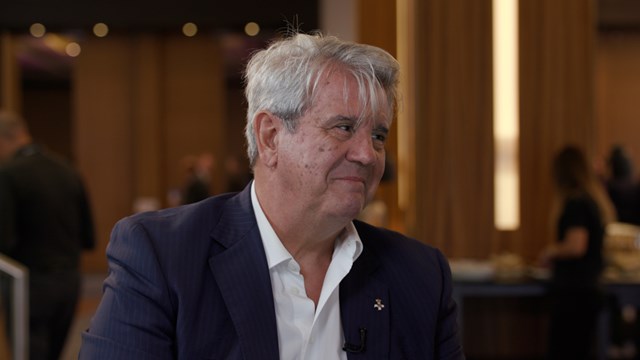
Thomas van Briel, Chief Network Architect, Deutsche Telekom
Deutsche Telekom’s chief network architect, Thomas van Briel, discusses the telco’s automated networks strategy, its approach to data management, the reality of cross-domain automation and what DT needs from the ecosystem to help it achieve its goals.
Recorded April 2026
Email Newsletters
Sign up to receive TelecomTV's top news and videos, plus exclusive subscriber-only content direct to your inbox.