From legacy to cloud native: How telcos can win the AI era

By James Pearce
Aug 13, 2026
To embed our video on your website copy and paste the code below:
<iframe src="https://www.youtube.com/embed/igqDoPNNY3M?modestbranding=1&rel=0" width="970" height="546" frameborder="0" scrolling="auto" allowfullscreen></iframe>
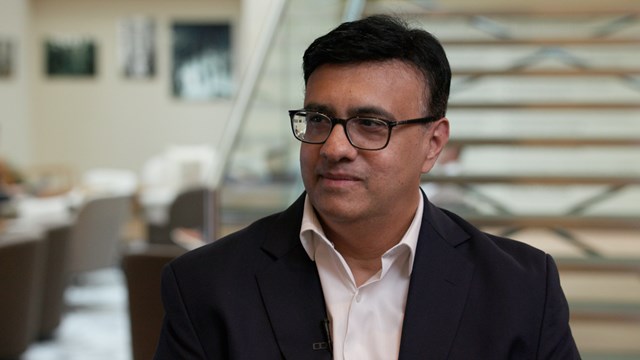
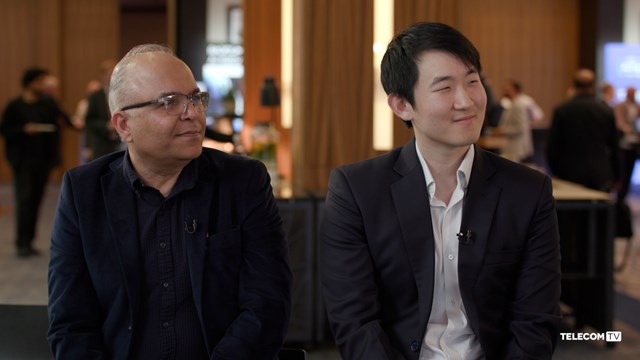
Welcome to TelecomTV. I'm James Pearce. I'm in Copenhagen for DTW Ignite, and I'm delighted to be joined today by some really special guests. First, I'd like to introduce you to Jeff McSchooler, who's the Executive Vice President of Wireless Engineering and Operations at Boost Mobile. And we're also joined today by Manish Mangal, who's the President of America's Communication Business for Tech Mahindra. Welcome both. So let's dive in. Jeff, we'll start with you. The industry's going through a bit of a period where terrestrial, satellite, fibre, fixed wireless and mobile are all increasingly converging into a single connectivity fabric. How do you see the industry evolving and what role will hybrid networks play in that future?
Jeff McSchooler, Boost Mobile (00:44):
Yeah, it's a great question, James. So we're pretty lucky because Boost actually had this in mind in our blueprint. So we're a satellite company first and then became a mobile company. So we put that as part of our entire process in our build. So we're completely cloud-native, which makes our future a lot better there than some of the legacy that others have to deal with and what they're going to have to build. And really in the end, it has to become almost like an amalgamation of the two together so that a consumer doesn't care whether their phone's on a cell tower, whether it's on a satellite, or whether they're in the mountains, or whether they're in downtown Copenhagen — they want it to work. And so it'll be our job to basically make sure we clear that pathway for them and we deal with the complexity and let the consumer have one heck of a ride.
James Pearce, TelecomTV (01:30):
Really, really interesting. Thanks, Jeff. Manish, let's come to you. The industry spent years modernising networks and IT systems, but CSPs still face real pressures when it comes to costs, things like that. What do you think will define the next chapter of telecom transformation and how should the leaders within the industry think differently about investments in AI?
Manish Mangal, Tech Mahindra (01:50):
I think the telecom industry, if you look at it over the last two decades, one of the common problem statements has been that traffic has been growing exponentially and consistently — especially when the smartphone came in, it really became a big driver for traffic on the network. And the primary purpose became to drive the cost per gigabit down over the years. And that's what we have been doing so far. And now we have really reached a point where there's only so much more that you can drive in terms of spectral efficiency. So effectively when I look at it now, the board conversation is: how do I really allocate capital for the business? And the allocation of capital really comes in two directions — I can invest to save and I can invest to grow.
(02:36):
Invest to save is really the transformation area, because AI is much more prevalent, it's available, and the technology is getting much more mature. So I think to me, the next transformational journey for telecom operators is really to use capital in the most efficient way — to use technologies like AI to drive costs down beyond the spectral efficiency gains we have achieved so far — and then use those same investments to learn so much more about what customers really want, to give them hyper-personalisation and better experiences that drive revenue upside. So I think we are at a great transformation stage at this point in time, which is very different from all that we have done before and is really going to drive both sides of the equation: cost and revenue.
James Pearce, TelecomTV (03:17):
So Jeff, coming to you — much of the industry is focused on AI, and we've just touched on that a little bit. Network monetisation is a big thing, as is value creation. Where do you think the next wave of value creation will come from, and what opportunities do you think the industry may be underestimating or not capitalising on enough?
Jeff McSchooler, Boost Mobile (03:33):
Yeah, that's a great question. So there's a big hurdle that everyone has to get over here, which is actually what they achieve with AI and how. And everyone's focused on so many different things that I'm not really sure how it's going to pan out for everybody, but really the right direction is to focus on the ones that bring value to your organisation and bring value to your customer. If you do those first, I think you're heading in the right direction. I think the big challenge is that a lot of the telcos have a massive legacy to deal with — systems they can't get the data out of very easily and can't pull into AI. And so the future for them is really going to be culturally getting people to buy in and then making that change. In our network, like I said at the beginning, we're pretty lucky — we actually cloudified everything from day one and have it all integrated together, whether it's satellite or whether it's terrestrial.
(04:24):
So I think you're going to see things, especially around what I would call radical flexibility of your network. I mean, you're going to have to change on the fly, you're going to have to change quickly, you're going to have to do things like you've never done before, and you're going to change processes like they've never actually been changed before as well. So that's probably going to be the biggest thing that comes out of it. And then once you get past that, there are areas around security that can be addressed in ways that would genuinely increase security for our subscribers. And the other one would really be network as a service. So if operators open their networks and allow people to actually build on them, they're going to increase the capability of what they offer. For example, if you had a drone company that said, look, we just want to pay when the drone's in the air and only when it's communicating — you could actually put that into your model and make that work. And none of that exists today. It's pretty much buy a SIM, we'll put it up and you'll pay a monthly fee. So I think those are going to be some of the big things we go after.
James Pearce, TelecomTV (05:21):
Manish, let's come to you. There's so much excitement around AI-native networks and obviously there's a lot of technological change needed, but there's also a cultural element to it. Can you talk us through what needs to change from a cultural and business point of view?
Manish Mangal, Tech Mahindra (05:34):
I think that's a fantastic question and I think it's also very fundamental to what it means to be an AI-native telco and an AI-native organisation. It really comes down to culture. To me, the number one question that every telecom operator is asking themselves is whether their workforce is ready to drive a culture in the organisation where they believe AI is here to help them achieve the highest level of efficiency and the highest level of productivity. So the first thing is really to believe in what AI can bring to the table. And I think that's a cultural change. And it really starts from the CEO level — when the CEO and the board say: look, I really want everyone to adopt AI, not to fear it, but to adopt it, use it, and understand that it's going to be much better for everybody.
(06:16):
And there's a future beyond that in terms of what you can do with it and all the possibilities that exist. That's the first place I think a company needs to start. The second thing is really to prioritise what it means to leverage AI. It's not just about having access to tools that help you do better coding — it's really a more pervasive use of AI. That's really important in my mind to drive the transformation we're talking about. We basically compartmentalise this into four broad categories. One is the customer lens: from the lifecycle of customer acquisition to serving a customer, what can you do better with AI? Can you serve the customer better through agentic AI operations? Can you serve the customer better by learning more about their patterns and behaviours so that you are being more personalised to them?
(07:01):
The second area is really around your IT stack itself. Can I build features and functionality and software faster so that I can deliver more capabilities to the customer and drive better efficiencies from a cost point of view? Third is your network. Can I manage the lifecycle of the network — from planning, design and build through to operations — with AI-driven identification of issues, such that it's much more cost-effective? And I put my capital to maximum efficiency, measuring what my return on capital actually looks like, and by applying AI I can maximise it. And the fourth is all my back-office functions — finance, HR, legal — can I transform them so that they become not just a support function but an enabler for business growth? So when you put all of this into the equation and you say that culture will drive behaviour, and if adoption happens across all four of these domains, you are really going to end up becoming an AI-native telco — and that's going to be the real game changer for the industry.
James Pearce, TelecomTV (07:56):
So let's look to the future a little bit. If we were to sit down here in, say, three to five years' time, what would distinguish the companies — the telcos — that have achieved everything we've talked about and completed this transformation journey from the businesses that maybe got left behind? What would be the big difference? How would the winners stand out?
Jeff McSchooler, Boost Mobile (08:14):
So for me, part of the AI journey is how we actually implement it — and right now a lot of companies are trying to implement AI into old systems, 20-year-old systems that they're simply not going to be able to adapt. It's a bit like taking an autonomous driving system from a Tesla and sticking it into a 1972 Malibu Classic station wagon — it's probably not going to work that well. And what I believe we as an industry have to change is this: we can't build AI against what we've had. We have to build AI against what it should be and not live in the past. And so as engineers, we have to make a lot of harder decisions about what we're going to get rid of, how we're going to replace it, and how we're going to move forward.
(08:59):
The right answer is really to cloudify everything so you have it where you want it, when you want it — but not all systems can be that way. I think the ones that do well are going to be the ones that don't try to force a round peg into a square hole from the past, but really try to build the right thing going forward. And if they don't, I think you're going to see massive failures along the way that will be very expensive and very painful.
James Pearce, TelecomTV (09:23):
Manish, maybe the final word to you.
Manish Mangal, Tech Mahindra (09:25):
I was just going to add to that. Jeff said it very well. I'll just add that three years from now, I just want everyone to say telecom is cool again. It's one of the most useful industries in my mind for humanity. It's also one of the most underrated and undervalued from that perspective. And I think AI has the potential to bring that sense of excitement back to it, so that a fresh graduate coming out of university would say: I want to be part of the telecom industry because it's cool again. I think that will be the outcome that tells me everything we have done as an industry has reached a point where we have given the industry the right place where it needs to be.
James Pearce, TelecomTV (10:04):
Seeing telecom be cool again — I like that. Thank you so much for joining me today.
Please note that video transcripts are provided for reference only – content may vary from the published video or contain inaccuracies.
Recorded at DTW Ignite in Copenhagen, this conversation brings together Jeff McSchooler, EVP of Wireless Engineering and Operations at Boost Mobile, and Manish Mangal, President of the Americas Communications Business at Tech Mahindra. They examine how satellite and terrestrial networks are converging, why AI investment must address both cost reduction and revenue growth, and what cultural change is required for operators to become genuinely AI-native. McSchooler argues that legacy system constraints will determine which operators succeed, while Mangal outlines four domains — customer, IT stack, network and back office — where AI can drive transformation.
Featuring:
- Jeff McSchooler, Executive Vice President of Wireless Engineering and Operations, Boost Mobile
- Manish Mangal, President & Head - Americas Communications Business, Tech Mahindra
Recorded June 2026
Email Newsletters
Sign up to receive TelecomTV's top news and videos, plus exclusive subscriber-only content direct to your inbox.