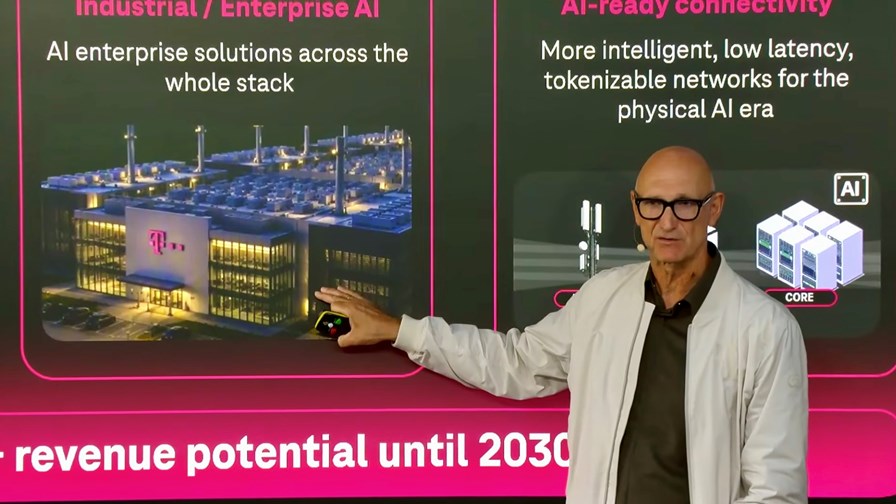
Deutsche Telekom CEO Tim Höttges addresses the company's first AI Investor Day.
- Deutsche Telekom has held its first ever AI Investor Day
- The telco’s CEO, Tim Höttges, highlighted the potential of AI-related revenue opportunities, which he valued at €1bn+ by 2030
- Höttges also signalled the demise of the smartphone as voice-native control takes over
- The CEO also said DT will deploy ‘inference datacentres in the telecom infrastructure’
Tim Höttges, the ambitious and outspoken CEO of Deutsche Telekom (DT), used the telco’s first AI Investor Day (Monday 5 October) to highlight the potential of driving near-term incremental AI-related revenue opportunities, predicting his company will generate an additional €1bn-plus in revenues outside the US by 2030 as a result of such investments.
DT, one of the AI-native telco frontrunners, is already generating revenues from AI services developed for its B2B/enterprise customers outside the US and these are set to increase from an expected €250m this year to €800m in 2030, as we reported on Monday.
But Höttges went a step further in his investor day presentation, noting that the overall opportunity for DT’s AI-related service revenues is set to exceed €1bn in 2030 (outside the US), and could even be much greater than that figure.
The CEO stated: “€1bn in extra revenue [outside the US by 2030] is something we have in mind. To be honest, this is a conservative number. I do not want to commit to a bigger number because you will not believe it. So we go with €1bn, but our internal plannings are much more optimistic than what we have laid out. Let’s start with €1bn and then we will see. But the opportunities along that value chain are unique for a telco.”
He concluded: “These are our audacious targets going forward. And by the way, that doesn’t mean that they are visionary; they are just implemented in our planning process, which we are working out right now.”
Given that DT has a target of €800m of AI-related service revenues from B2B customers in 2030, this puts the consumer AI revenue opportunity in 2030 at greater than €200m: DT had not included a forecast for consumer AI revenues in its official press release, but the Deutsche Telekom media relations team confirmed to TelecomTV that Höttges had “gone further” in his presentation to set the business-to-consumer (B2C) revenue ambition for 2030 at €200m+.
Key to this ambition is a change in the way consumers will use AI to organise their lives. Höttges is anticipating that AI will help deliver what he described as “the next iPhone moment” for smartphones, when voice-native controlled devices take over from traditional app-based phones.
Talking about Apple’s globally popular device, he stated: “Having seen 18 versions of the same smartphone, we all know there is a moment coming, we don’t know when [or] where this is over. You do not need this kind of device where you have to tap apps, where you have to go through complex administration, where you have to write your intent. The future will be voice-native, and there will be a moment where a new device is coming where you have an iPhone moment and you say, ‘I do not need this smartphone any more.’
“The question is, when is that going to take place? We have our theory on that one, but this is a big opportunity because, for the new devices, we’re going to need the same safe, smart, secure support for this infrastructure, and we have another opportunity as well to build a new competition, a new ecosystem in this highly subsidised hardware world in which we are suffering today,” said Höttges.
Deutsche Telekom has already launched its AI-phone (the T Phone 3), an affordable smartphone device that integrates generative AI (GenAI) capabilities from AI tech partner Perplexity.
The CEO’s focus on AI-related revenue generation chimes with the aspirations of many of DT’s peers, as identifying and driving new sales from the use of AI is now the main focus for AI-native telcos around the world.
But it’s not all about adding to the top line, of course. As well as incremental revenues, DT is also making good progress with its AI-related efficiency programme: AI and automation is now forecast to generate gross savings of about €1.1bn outside the US by 2027 compared with 2023, rising to €2.5bn by 2030 (again compared with 2023).
Höttges noted that the 2027 figure is €300m higher than the AI-related cost savings target set for that year during the operator’s Capital Markets Day in 2024.
The importance of the network
Of course, none of this will be possible without an AI-native approach to the evolution of the network, and Höttges is particularly excited about the unique opportunity that telcos, such as DT, have to deploy and monetise AI infrastructure at the network edge.
“If you have AI everywhere – if the AI GPUs or inference is sitting not only in big clouds but sitting in the [distributed] infrastructure… you have AI at the RAN [radio access network]. You can optimise compute and you can optimise connectivity latency – jitter is becoming super relevant for robots and other things… This is something we’re going to do, which we are able to drive – we will have inference datacentres in the telecom infrastructure going forward, which is an additional opportunity for us to monetise.”
Keeping the human touch
Höttges has been leading DT’s AI drive since 2020 and said around 500 AI projects are now in the works. Here, he also cited the recently launched AI factory in Munich and highlighted how DT regards Europe’s need for sovereign AI as a major business opportunity.
However, he wanted to make one thing very clear: DT has no plans to become an “AI company”. He insisted: “We want to stay a human-led company. We want to enable AI for our customers and make their life as easy as possible.”
At the same time, DT does not regard AI as “just another tool” but as a means to “redesign the whole enterprise” in terms of how it manages its workflows and processes.
Overall, Höttges said that while the capabilities of AI are “scary” to a certain extent, he remains an AI optimist and wants to see DT become a “leading AI telco” with the “best AI network”.
In his view, telcos will form a key part of future AI infrastructure as their networks will remain a “core competence of every AI functionality which we’re going to have”.
Alluding to recent discussions on the need for an AI emergency brake, Höttges also claimed that a “kill switch for every AI [workflow] sits in the network. If we’re switching off the network… there’s nothing happening”, he opined.
- Anne Morris, Contributing Editor, and Ray Le Maistre, Editorial Director, TelecomTV
Email Newsletters
Sign up to receive TelecomTV's top news and videos, plus exclusive subscriber-only content direct to your inbox.