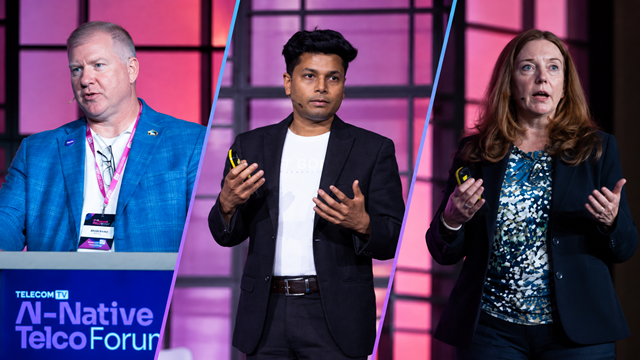
Presentations from MetTel, Mavenir and TM Forum

By Guy Daniels
Sep 14, 2026
To embed our video on your website copy and paste the code below:
<iframe src="https://www.youtube.com/embed/3lfkeuba-Bk?modestbranding=1&rel=0" width="970" height="546" frameborder="0" scrolling="auto" allowfullscreen></iframe>
We're going to continue our strategic intent theme, and we have three presentations for you along this theme. So first of all, Brian, I'm going to ask you as our first guest, if you would like to pop up to the left. Yes, please. Pop to the lectern. The clicker should be there and please start our first presentation. Brian Baird is at MetTel.
Brian Baird, MetTel (00:32):
All right, thanks for having me. So I'm from Victoria, Canada, but yet I work in Manhattan. We'll have a discussion outside of... It's interesting how that happened. It's a little bit odd. The other thing about MetTel, we're a full stack communication solution provider, so we're not technically a telecom, although I do have roots in that space. I also have founded start-ups, come from IBM, Sun Microsystems, et cetera. So possibly a little bit different perspective from maybe what we've heard so far today. So the thing that really stuck with me when preparing for this is we hear about business outcomes, we hear about MNOs, we hear about the value stack, but how can you possibly hold an AI model or the use of an AI model accountable if you don't actually control the inputs? Because let's be honest, the much desired business outcomes are simply a trailing metric from what the input metrics are.
(01:46):
And you can hope at the board level, you can pound your fist at the board level, but you really don't control the outcome, you control the inputs.
(02:00):
So what we've seen over the last number of years is a slow, steady pace where we can update our run books or operational books. We can take, if I could go so far back as to say mainframes to distributed, distributed to cloud, cloud back to edge, so it kind of went full circle. And the same thing with networks is went from copper to fibre to the MPLS and circuits to SD-WAN, and it's all fairly methodical. Same thing happened with the Gs, right? 1xEVDO, 2G, 3G, 4G, 5G, and I think we heard Daniel and others this morning talk about 6G. Again, very methodical, predictable, steady heartbeat of five to 10 year cycles perhaps. That's over. What my team is being faced with right now as a full stack communication solution provider is everything happening all at once. On one hand, we're trying to figure out this AI thing and what does it mean and how can it benefit our customers?
(03:18):
On the other hand, we're dealing with space towers, with Starlink and LEO, formerly known as Kuiper and AST. And how does that all fit into the stack? And then of course, the very rapid evolution and demands of enterprise. I should note that MetTel exclusively serves medium to large enterprise with that full stack that I suggested. So everything from the fibre and the circuits into even the POTS replacement, which is a very big thing in the Americas right now, probably coming soon to Europe and other areas, all the way up to cellular connectivity. And of course, as I mentioned, space towers, we're a huge Starlink distributor. We're in discussions with LEO, as is probably most folks. What does that all mean? How can you make sense of it? And if I could share some advice based on the telemetry data that we've learned from is sometimes slow is smooth, but smooth is fast.
(04:27):
It's an old saying, but it's very true. Don't fall for fake AI. I don't know if DR is still here, but she kind of coined this term fake cloud. We're already starting to see the elixir of instant gratification from, if I may say, fake AI. Don't fall for it. Do the hard work, investigate your own metrics, improve your own people with the upscaling we've heard this morning, your processes and your procedures and supporting technology. If you don't, all you might do is expedite your own demise. Nobody wants that. So why should the business even care? We've heard a few times today about this feedback loop thing. So the input metrics, of course you can control them. Output metrics, they're a lagging indicator. You don't really control them even if the C-suite takes credit for it. It's this very complicated orchestrated dance with AI in the dead centre of all of it.
(05:37):
So I think some of these metrics on the left-hand side we've heard about this morning, largely operational. The metrics on the right-hand side are more business orientated that the last panel discussed. But what does it really mean? Let's take a silly use case of something very modest. Let's take, I don't know, 100,000 subscribers, which for most of us in the room is nothing, and just apply the model of maybe reducing churn, which we heard about this morning from 5% down to 2%. What does that really mean? So what if you could save nine million bucks per 100,000 subs over a period of time, say three to five years? Okay, maybe not compelling, but attention grabbing and interesting. Now, what if your long-term value ratio is increased from a more modest level to maybe something like 18 to one? Well, the outcome, as we saw recently with Peter and some of the others that are going through this very active market consolidation M&A cycle, you boost your market valuation from a very who cares commodity two to three X multiplier to something much more substantial, maybe like an 8x multiplier.
(07:02):
So the gap in real terms could be around $200 million. Now that should get anybody's fiduciary responsibility attention. It's real money.
(07:16):
So the thing that I deal with every day having come from the background of SaskTel in Canada and then a start-up founder and now working with the CSP serving enterprise accounts is consumer drivers and enterprise drivers couldn't be more different. So if we look at what drives consumer behaviour, traditionally it's features and price. I don't know if you guys would agree, but that's what I've seen. It's who gives me the newest iPhone or the newest Google Pixel 11 at a discounted rate? Now, the problem with that is the consumer market doesn't much care. It's probably a CGNAT, meaning just a generic connection out to the internet, some kind of APN, and then there's not a whole lot of intrinsic value. So you're competing on price. That pyramid is very tippy. The whole thing could fall over and crumble because the customer has no real loyalty to the operator or the service.
(08:29):
Now, if you look at enterprise, it's almost the complete opposite. In a lot of cases, there's a fiduciary responsibility and regulatory controls where the data can't under any circumstances touch the public internet. And you're talking about static IPs and private routes and multinational deployments versus individual opcos or national providers. And then eventually, of course, you put a price on it. But the enterprise workload, which is very often overlooked in the MNO, it feels like sometimes the wholesale folks and the for-business folks are maybe put to the back of the bus compared to net adds and vanity metrics, they impress Wall Street. The reality of it, it's great business. It's incredibly sticky.
(09:28):
My daughter told me one time, nobody cares about the cheese in a Happy Meal, but they sure like the Happy Meal, even if it's just for the toy. So if you're the MNO and you think the world is the be-all and end-all is cheese, you're totally missing the point. Terrible analogy, but it seems to work. So in the case of MetTel, if we look just a little bit deeper from a consumer TaaS point of view, so telecom as a service, and then the enterprise hybrid platform, I think the colleague from Dell just mentioned the aggregation of neutral host, private cell and macro connectivity. The enterprise says, yes, please, all of it on a global scale. Even if you happen to be UK, EU or US or APAC anchored, you still have global operations and you desire operational sameness. So if we look at a typical use case that MetTel would deal with, suppose you have trucks that go in and out of depots, you have proof of completion on tablets, all of these things have to be organized by classification and categorization of the device, the user and the data.
(10:49):
So it's a very complicated thing, but when you get it right, as I mentioned, it's incredibly sticky and incredibly profitable.
(10:59):
So if I could leave you with three main points, the enterprise has to go FAST and FAST is an acronym for flexibility, agility, security, and most of all, transparency. For the MNOs in the room, this notion of cannibalization of revenue, get over it. The audacity to think the next dollar in an Elon Musk world is yours is a little bit optimistic. I would encourage you to think beyond per gig and per line and think about enterprise value. And that's routed at lot in opening up and sharing that very rich data set that most of us have and turning that into enterprise value. Because number two, telemetry data is in fact the AI rocket fuel that is needed for not only the operators to create value, but the operators' enterprise accounts to create value. And then of course, last but not least, you only influence the business outcomes.
(12:03):
You don't really control them. So build your new business AI-driven, but on a very rock solid foundation driven by value, not price. Thank you.
Guy Daniels, TelecomTV (12:17):
Brian, thank you very much. Thanks very much. That's terrific. Please come and sit now. I've just got a quick question from me before we go into our next presentation though. One of your early slides there, you said strategic AI operational transformation is a moat. Can you expand on that for us because that's really interesting?
Brian Baird, MetTel (12:37):
Sure. So if this stuff is really complicated and really hard, perhaps the ability to use agentic methods to get it right or partially right, maybe that is a moat. Maybe that's something that if you achieve escape velocity, the competitors, not that they could catch up, they can't because it's an exponential escape, not a linear escape.
Guy Daniels, TelecomTV (13:01):
I got you. Thanks so much for that. We've got some questions at the end from the audience hopefully, but let's move on to our next presentation. Bejoy, if you'd like to take to the lectern, the clicker I think is there. Bejoy, of course, is CTSO of Mavenir.
Bejoy Pankajakshan, Mavenir (13:16):
Thank you. What I'm going to cover is from our customer perspective operators, what do we see in terms of the AI use cases that they're implementing today versus what they're considering for the future? So jump straight into the four strategic plays that we see today. A lot of the morning session was spent on OpEx reduction and the whole operational transformation use case, which is the first one there. But the second one, which is AI services, which is some operators in the US have now launched it. For example, T-Mobile, live translation is one of the key use cases that's garnered a lot of interest globally now. Additional AI-based communication protection, you're seeing a lot more of security use cases in AI, especially anything involving communication. So deepfake side of use cases that exist today where voice is cloned and you can't figure out if it's AI generated audio or not.
(14:10):
So we see some of those use cases also coming in. And then there are these other two areas that I've highlighted. One is the Sovereign AI Cloud, which is a big deal in the European market. You see a lot more of the European operators play in that space. And then the last one is AI Grid, which goes towards the whole distributed compute and distributed inferencing. So I was looking at one of the charts which Intel shared earlier, which shows the amount of inferencing traffic that's supposed to happen by 2035, 37% if I remember the chart. This is the opportunity that the operator has to monetize on the distributed inferencing given the footprint that they have. So that's the fourth opportunity that we see. So today, if you look at where the operators are, primarily you have end devices with ChatGPT application or any frontier model access application on the device connecting over the top to the operator and going to the frontier model.
(15:06):
So the value chain is essentially being bypassed where even in 5G or the new version of AI services, the operator is being bypassed and just becoming a data pipe. Now in 6G, there's a lot of discussion happening on the AI for network and the network for AI concepts. There's many considerations there as to whether you create a whole different 6G core just for AI, meaning a separate domain on which AI services run. That is going the other extreme where the operator could be completely bypassed. There's also discussion on how we would enhance some of the existing nodes to support AI services. So keeping aside 6G opportunity, what is doable today? So that's what's shown on the right side where operator could be the intermediary which actually channels the services for AI through their network and becomes part of the value chain. And we are seeing this, especially in the Chinese operator market, this actually happened, come to fruition.
(16:01):
A lot of discussion now on Model-as-a-Service, Token-as-a-Service capability. In China, it was more easy to do because a lot more access to open source models versus in North American markets in Europe, it's more the frontier access. There's a lot more considerations on what's called model routing, selecting the right model for the right use case.
(16:24):
So what value does the operator bring? First, the distributed network, which of course is a lot more than what even hyperscaler, the other networks that have been built out there for AI services can provide. Secondly, embed communications natively in the operator network. So doing AI voice, which earlier was not very sexy, but now we are seeing a lot more focus of operators on communication and how AI is applied and that becoming a monetization angle for them. The third is a trusted relationship in terms of billing that they have with the end customers, be it consumers, enterprises. And then finally the sovereignty, which goes back to the third and the fourth bucket of pillars that I mentioned earlier, AI Sovereign Cloud and AI Grid. So what does it take for them to actually offer these services, which is where the AI integrated platform comes in. So pretty much all of you have gone through a cloud native transformation, is familiar with the Kubernetes-based distribution and how workloads today run on top of Kubernetes.
(17:24):
When it comes to AI workloads, there's a similar need to run the lifecycle management of these AI workloads within the operator network. So pretty much all the main players that are in the Kubernetes cloud native space have now evolved to also offer AI platforms. Now this is different for the neo-cloud providers like CoreWeave and Nebius and others who build their own stack and are using open source distribution of Kubernetes versus in the operator network you have an SLA driven Kubernetes network. So on top of it, you need to build an AI platform to support the AI workloads that the operators could serve. When it comes to simple operational use cases like AI service assurance, even to support something like that, you need an AI platform that's running within the operator network. So that becomes a key new capability that needs to be built within the operator network itself.
(18:15):
So one of the key capabilities here is what's called model routing, which is essentially picking the right model for the right use case. And that is a capability within the AI platform with something called an AI gateway. So most of you may be familiar with API gateways. This is different from an API gateway. There's some functional overlap with API gateway, but it does a lot more in terms of how you count the amount of tokens that are used as the different models are used and then giving a way for it to be charged eventually.
(18:45):
The next piece to it is the whole AI orchestration piece. So earlier in the panels and discussions, there's a lot of focus on intent management and the intent piece of this can come from enterprises that's buying a service from an operator. It can come from the operations team, which is trying to run the network, or it can come from the billing side, which is checking on the subscriber experience. In all these cases, when it comes to AI-based services, there's a need for an intent orchestrator as well, which can bundle along from a practical purpose being integrated with the intent orchestrator, the end-to-end orchestrator that the operator launches. But what that essentially does is captures the intent and orchestrates it downstream to the right node. So for model routing functions, it can route it to the AI gateway. If it's an operational use case, route it to the AI service assurance use case.
(19:38):
So these are the kind of capabilities that's required within the AI platform that operators have to launch. And this is a concept that I mentioned earlier, which is not a concept anymore because pretty much all the operators in China have launched this, just like you have data buckets that are sold by operators or voice buckets that are sold by operators. The concept here is you're now selling AI plans. So it's AI token buckets, which means that there are a few key capabilities that needs to be within the operator network. The first part, as I mentioned, is a model routing capability, selecting the right model for the right use case. The second is the token metering. How exactly do you count these tokens as they pass through the network, be it models that are hosted locally within the operator network or when it goes to the external frontier model, because not every use case is going to be driven by an on-prem model.
(20:32):
Take translation as an example, because this is a use case that a few operators have launched and pretty much all the operators that we talked to globally are interested in it. You could have the majority of languages, which are the high hitters, be using the local models versus the language which is used in a few countries not widely deployed or widely used by consumers, enterprises. That could go towards a frontier model like use OpenAI or some other frontier model. So that is an example of a model routing use case. And even in those use cases, you need to be able to count the tokens that are used. So essentially you could charge for it, which takes us to how the Token-as-a-Service or tokenomics and Model-as-a-Service will come together so the operator could start monetizing this. So Model-as-a-Service is essentially the same concept as model routing, which is based on the use case you route to the right model.
(21:30):
But the Token-as-a-Service, this is one of the key new capabilities that operators need to build into their network to be able to monetize on these AI services. And that cannot come at the expense of billing systems that take years to upgrade. So essentially, and this is not work that's happening in 3GPP, it's not work that's happening directly in TMF either, but across different organizations, even NVIDIA themselves are driving a lot of this in the AI-as-a-Service space. And pretty much all the neo-cloud providers have to have some offering that's similar to this. And the way Mavenir, we have architected the solution is a modification of what 3GPP has defined with a Charging Enforcement Function. So essentially based on what the AI gateway counts, we are able to convert these tokens into a metric which can be integrated into the operator charging system.
(22:22):
So essentially allow the capability to integrate existing AI services that are being launched by the operator, be it translation or operational transformation use cases or future ones like AI Grid or Sovereign Cloud. And for all of these use cases, being able to count the token usage and charge for it. So in summary, if we look at these four buckets of operator use cases under AI transformation, the primary one is a whole journey to level five and what does it take to enable those AI services there? This is pretty well understood. Pretty much all vendors in this space have solutions in this domain. The second one is more of making bets based on the business case. And this is one that we see different operators take different approaches. Some may put more emphasis in something like translation. Some of the more advanced ones are looking at Token-as-a-Service, Model-as-a-Service use cases.
(23:24):
Of course, the third bucket is purely driven by operators who want to launch sovereign clouds for government interest. It's being pushed by the government or for their own monetization angle. In Europe, for example, you've got Deutsche Telekom that's launched it, Telefónica Spain has launched it. And the last one is the emerging one, which is how do you leverage the AI inferencing distributed network, the operator network, which is more widely distributed, cater to new use cases around monetization. And in the Mavenir booth here, we got all these services actually running live. If you stop by during any of the breaks, you could see how different AI services, translation, consumer protection can be charged to an operator bill using Token-as-a-Service. It kind of put together all these services and being able to charge for it. Thank you.
Guy Daniels, TelecomTV (24:20):
Great. Thanks very much. Just before we start our next presentation, I just want to follow up if I can on one aspect. Tokenomics is somewhat polarizing at the moment, bit controversial. You've got real advocates and supporters of the approach, and equally you've got people who are very sceptical. How do you convince the industry that this is a viable route to revenue growth? How do you get the message across? Or do you just say, no, this is just one of numerous possible revenue opportunities that are available?
Bejoy Pankajakshan, Mavenir (25:00):
So I mean, one easy answer is to say this is just one of several approaches that's there. Whether tokenomics is going to be a challenge for an operator providing services or a frontier model guy doing it, it's the same question actually, because when you think about the compute that's being built by the frontier guys and the amount of token that they're charging for, the charges that they have for tokenization today, I was reading just an article two days ago where it's actually come down significantly in the last few months and it's expected to further go down as well. Now it is a question of supply and demand, right? So ultimately as the operators launch these new services, do they need a way to be able to monetize on it? Even if it's a single service which is not very widely adopted or it's a harder new use case that they're able to launch and nobody knows what those use cases can be, but when they launch it, should they have the capability to monetize on it?
(25:54):
And that's what tokenomics is. It's not the absolute metric of whether I'm going to charge one cent for using a thousand or a million tokens or 10 cents for a million tokens. It's the method by which the operator network is enabled to be able to charge for it. And that's the Token-as-a-Service capability.
Guy Daniels, TelecomTV (26:11):
Thanks very much. Joann?
Joann O'Brien, TM Forum (26:12):
And also even just, you need to understand the cost to serve the customer. You need that information real time. You can't be finding out months later that you've actually had a huge spike in your cost to serve the customer. So you need that intelligence in order to be able to manage your cost effectively. So there's two sides to that equation, the potential new revenues, but even in the short term, there is absolutely the intelligence of how much it's costing to serve.
Guy Daniels, TelecomTV (26:40):
Good point. Thanks for making that and leads very nicely to our next presentation because you're giving our next presentation. So Joann, if you'd like to take to the lectern and start our third presentation.
Joann O'Brien, TM Forum (26:54):
So my name is Joanne O'Brien. My role at TM Forum is VP of composable IT and ecosystems. What that means is we've been hearing an awful lot about autonomous networks, but there's also a bigger story here. There's really a story about converging the business, the IT and the networks to get value for the operator in their transformation. And what I want to talk to you about is a step-by-step approach to achieving that value using various models of TM Forum. So we're talking about AI and making the investment in AI. And what I'm really advocating is that there's a huge transformation that we need to make in order to be able to capitalize fully on AI. So there's AI projects, use cases, et cetera, that everyone's been talking about. But really, if you don't have the underlying architecture, that composable AI, API-driven architecture, event-driven architecture, then you really are limiting the scope of the benefits that you can get from that investment.
(27:55):
So we're talking about becoming truly autonomous. We need to reinvent IT through composability. So the age-old story of composability and APIs are still very much important as that foundation for your AI investment. Make networks self-governing through autonomy and ensure AI decision making is trustworthy and drive towards that AI native enterprise into the future. So when we think about our work, we generally, particularly in my area of the business, we think from the perspective of the CIO and right across the business. What are the pressures that the CIO has on them? They have pressures from many different dynamics. They have pressures from the customer with regards to higher expectations, pressures with regards to legacy IT infrastructure, pressures regarding costs and trying to drive down costs, huge pressures from the board with regards to making AI investments and getting return on those investments.
(28:55):
And of course, risk. Risk has also gone up all at the same time. So the dynamic and role of the CIO has become increasingly difficult in this AI era. So when we think about the crucible of the CIO, you really, on the one hand, you've got the legacy drag of your legacy infrastructure, and on the other hand, you've got the need to get that return on investment from 5G and now AI. And Anthony Rodrigo, CIO of Axiata, put it very succinctly when I was talking to him, and it was really about we need to reinvent IT on a daily basis. We need to shift from those five to seven year monolith transformation projects to something much more finite and reinvent every single day. We need to intensify our AI scaling and get efficiency and return on investments. In our recent survey, 55% of CSPs said they were still managing three full stacks across their business, which is a lot of a legacy and difficulty in managing that.
(30:00):
So really we need to shift to something much faster, reinvent our software development life cycles in order to get that agility into the business. So when we talk about legacy IT and what we need to move away from, we need to shift from the monolith and rigid architectures from manual high touch siloed waterfall and reactive standardized to something that is much more dynamic, API first, event driven architectures, autonomous zero touch, agility at scale. We're really after that speed and velocity into the business, but it has to be accurate. As we all know with AI, you basically personify the behaviours that are already in your architecture. So you need to have accuracy and precision at scale and capitalize on your AI investment. So that's really what we're really advocating, that you still need to continue with your foundations of your IT architecture and invest in your AI over and above that.
(31:04):
Recent survey shows this is where CSPs are investing right now. So speed and agility, software development life cycle being fundamentally reinvented through use of agents right across that life cycle. Trust, cybersecurity and resilience, high investment and customer experience transformation. So interestingly, really 88% of CSPs prioritizing customer experience transformation as their top investment right now. And what we're seeing is really that it's not focused on one specific area that is getting the best results. It's really those who are investing on their AI for customer experience, AI for BSS, including their ability to monitor and manage tokens, understand how we can drive down cost of the legacy architecture, but also drive up new revenues. So there's those who are managing all the dimensions of experience, cost reduction and growth of new revenues that are leading the way in the industry. CSP predictions of their AN levels and where they're making investments.
(32:16):
By 2027, just next year, 20% of CSPs expect to be at level four or above for AN levels. And by 2030, so this is the notion of the race to 2030, 80% of CSPs anticipate to be at level four or above for their AN levels of autonomy across their network. So we're advocating essentially a step-by-step approach to achieving that degree of autonomy. Identify your priority areas to invest. Select these high value investment areas. We call them high value scenarios. They're essentially use cases with specific key measurables inside that that will actually enable you to achieve your results, but in a measurable way and in a transparent way. Measure your capability, close the gaps, understand where you are relative to the best in the industry as well. This is important. The industry is moving incredibly fast. If you are not investing in a particular area and others in the industry are, just by standing still, you are actually going backwards.
(33:22):
So it's very important to continuously understand where you are relative to others in the industry. Design using technical solution packages, which will give you a lot of the blueprints that you need to accelerate your transformation, implement, pilot and develop your solutions, validate your progress and share. So when we talk about a high value scenario, the step-by-step approach, the elements that you can get at least from TM Forum, which will help you have a synchronized approach to this, essentially a scalable, repeatable process for driving your AI investment and roadmaps, you can design using value streams, capabilities, processes, data, APIs, KPIs across all of your ODA from the Open Digital Architecture of TM Forum. That will give you a framing, clear scope of value driven by intent, understanding your stakeholder needs, understanding your triggers and your outputs, your metrics, your capabilities and how they need to mature, your processes and how they need to be reinvented, the underlying data constructs to enable that, that are relevant to your context, the underlying APIs that are relevant to that context plus the metrics, components, et cetera, all in a single package that will allow you to drive forward.
(34:41):
So basically using AI and also designing your investment strategy, you can basically collect and see all of these essential elements that will get precision into your execution. And that's really what we're about. Get precision into your execution so you can get your business results faster and do it at scale. All of these that I mentioned, they're harmonized with each other. They align with each other. They're different perspectives of the same thing using common data constructs. We talked earlier about data, common definitions, taxonomy, ontologies. Essentially with common definitions used across all these different perspectives, you get a huge amount of precision and increased and improved decision making into your transformation roadmap, all that can be executed using ODA AI native canvas. So we're ultimately advocating autonomous networks experience. It's not exclusively about the network itself. It's about getting that business value. Look at AI for CX, AI for BSS, two new projects that I run as part of TM Forum and also your ecosystems work.
(35:54):
We need to drive down costs, understand real time what the customer is needing and deliver on that intention and drive up new revenues. We have to unlock growth in the industry. So some examples, China Mobile achieved 30% reduction in fault management mean time to resolution, 30% reduction on their backend manpower. 5G network slicing, basically some significant values there by using closed loop automation achieved fully autonomous in 30 seconds. So I'm basically advocating that kind of collective package approach to your strategy. You still need to do the foundations to enable your AI investment, but upon that, take your scenario by scenario, use case by use case, but inside that, unravel it, understand it end-to-end from a value perspective, understand the capability, the maturity you are and where you need to get to and all of the other remaining assets that will give you a very structured approach and a much, much faster... ability to move very fast.
(37:04):
So three actions, fund your outcomes, not AI projects, build scenarios into autonomous flows and end-to-end autonomous flows and use the Open Digital Architecture and that'll help you to improve your outcomes. That's it.
Guy Daniels, TelecomTV (37:20):
Joann, thank you very much. Round of applause. Fantastic. Thanks very much for going through that. That quote from Axiata is a scary one, isn't it? The imperative is to reinvent IT on a daily basis. That's quite horrifying, but I suppose reinvent a small bit a day.
Joann O'Brien, TM Forum (37:37):
Exactly. Step by step.
Guy Daniels, TelecomTV (37:39):
Yeah. And you also say it's not a cost reduction exercise. Don't treat it as a cost reduction exercise.
Joann O'Brien, TM Forum (37:43):
Not exclusively.
Guy Daniels, TelecomTV (37:44):
Not exclusively. Right. Do we have some questions from the audience before we head into the networking break? Alex is at the back. Do we have any hands in the air? Do we have any hands in the air if anyone wants to quiz our guests? Otherwise, I tell you what, have a think about it. I'll start you off. You also mentioned Joann at the end there, and it leads back to conversations we've had earlier, the AI native transformation ideally set at an executive level, ideally set at an executive level. Is it not essential that it's set at an executive level? Where do you see this possibility?
Joann O'Brien, TM Forum (38:29):
I think, well, yes, it's driven from the business. The investment is driven from the business and they want to see the return on investment. So I think there's measures that we need to stand back from and understand more holistically as this whole area is evolving. We need to think more about, well, is that the right thing for us? Is it the right thing to get our mean time to reduction down to actually zero? Maybe actually our strategy is a little bit different. Maybe actually we want to resolve customer issues much, much faster and be the hero. These are business decisions. I'm not saying it's right. I'm just saying these are strategies that different companies take and they need to be decided upon as a business-driven approach.
Guy Daniels, TelecomTV (39:14):
Great. Thanks very much indeed. That's given our audience a bit of a chance to have a think. Anything on transformation, even the contentious subject of tokens, we'll take anything. Or is the question, when can I get my coffee refill? It's coffee refill wins. So we're only a couple of minutes away from the break anyway, so let's break it there. We've got about 35 minutes of networking time outside. Coffee and refreshments are being served in the lobby. And I'll say it again, please do stop by our exhibitors and have a chat with them and see their demos. And there's all sorts of goodies going on outside. When we get back at 4:00 PM, James is going to be taking over, you'll be pleased to know, and I will be stepping down for a few hours and we'll round up the day with some more presentations and a final panel.
(40:06):
So networking time now, let's give our guests a round of applause, please.
Please note that video transcripts are provided for reference only – content may vary from the published video or contain inaccuracies.
Keynotes
During this session, MetTel’s Brian Baird explored how operators could make AI accountable by controlling its inputs and considered the differing priorities of consumer and enterprise customers. Mavenir’s Bejoy Pankajakshan then addressed the vendor and technology perspective on AI-native transformation, while the TM Forum’s Joann O’Brien examined the race towards Level 4 autonomy, advocating a step-by-step approach focused on high-value scenarios, Open Digital Architecture and funding business outcomes rather than AI projects.
Broadcast live Sept 2026
Participants

Bejoy Pankajakshan
EVP, Chief Technology & Strategy Officer, Mavenir

Brian Baird
VP, Wireless Network Engineering, MetTel

Joann O’Brien
VP Composable IT and Ecosystems, TM Forum