To embed our video on your website copy and paste the code below:
<iframe src="https://www.youtube.com/embed/lyViIlqv-aI?modestbranding=1&rel=0" width="970" height="546" frameborder="0" scrolling="auto" allowfullscreen></iframe>
Welcome back everyone. And as you can see, I am not Guy. So I'm James Pearce. I'm an editor at TelecomTV. And now we're going to move on to the final session of the day, which is on execution evidence. And we're going to start with some further presentations for you. So let me ask our first guest to step over to the lectern, and that's Karl.
Karl Havard, Era4 (00:28):
Thank you. So I'm not from the telco industry, so you might think, what the hell am I doing here? Well, Sean, the CEO of TelecomTV invited me to say something about what he felt you may be interested in. So I guess after I've spoken, you'll be able to judge whether it was or not. But I'm from the cloud industry, which clearly doesn't dress as smartly as the telco industry. So I spent a few years at AWS, a few years at Google, and actually now nearly four years in the neo-cloud industry, so standing up AI infrastructure. It's quite scary how time flies because ChatGPT in November will be four years old. Now, as you probably know, being a telco industry sector, but 20 years ago you missed the boat.
(01:29):
You could have provided cloud computing, but unfortunately the West Coast and the US, AWS with their retail, Google with their search, Microsoft with their software said, "Hey, we've got spare capacity. Let's go rent it out." Now, fast-forward 20 years, most organisations, enterprises have now got into the behaviour where it's default to the cloud, which is a scary place to be, especially when I think the previous speaker before the break was talking about sovereignty. Now, where we are today is data centres are having to be redesigned because AI infrastructure, the stuff that allows you to use your agents in your business, allows you to use ChatGPT, Claude, Gemini, et cetera, is very power hungry. And also it needs a lot of cooling as well. And hence it now needs liquid cooling in order to be able to serve customers and enterprises in the right way. So data centres have had to be completely redesigned.
(02:32):
So those cloud providers that set up 20 years ago and through the last 15 years have now had to redesign their own data centres. So there's a massive land grab happening across the globe on power and the ability to stand up data centres to host all this clever NVIDIA equipment.
(02:56):
The challenge is, if that works, there's a bit of a problem. Data centres are not the flavour of the month or the flavour of the year at this moment in time. Two or three years ago, no one really considered what a data centre was. The cloud was up there and you'd load your photos up there, you'd do whatever you'd want on the cloud and people would say, okay, wouldn't even consider what a dirty data centre was. With AI now and the power-hungry need for the AI infrastructure, it's now become a thing. And the media are all over it globally, some for the very right reasons as in sustainable needs for the planet, et cetera, but also for the disruptive nature of building in someone's backyard. So there's three examples I show here on the BBC website is that the lady there in Newport in South Wales, she's had years and years in her house and all of a sudden a big black box appears in the back of it.
(03:57):
And unfortunately there are some organisations that are doing data centres to the community. On the right-hand side, quite rightly so, there's protesters from a sustainability point of view, but also some of that is correct, but some of it is incorrect. The days of loads and loads of water being consumed by a data centre have gone. Liquid cooling now allows the data centre to operate as a refrigerator or cooler mechanism in your car. It's closed loop. So the water usage is not so high, but the power usage is. And then the one in the middle specific to the UK is the cost of energy. So OpenAI recently said, "Well, we're not going to locate into the UK because the cost of energy is too high." Typically, from a grid point of view, it's about 22, 23 pence per kilowatt hour, which when you compare it to the Nordics for renewable energy, that's 3 or 4 cents per kilowatt.
(04:57):
So if you're a global organisation, where are you going to deploy? You're not typically going to deploy in the UK. So there's some problems to overcome. And if we don't, as an industry, neo-clouds and hyperscalers approach it the right way, then the fierce demand for AI will always end up on the shores of the US or potentially within China who are probably the only true full sovereign capability countries out there. So I'm from Era4, Chief Commercial Officer. So what do we do then? Can we help solve that problem? And this is where Sean thinks this might be interesting. So across the UK, we already have what we call our mesh sites deployed, 44 of them across the UK, and we have three fairly large AI campuses as we call them as well. Now, what's interesting about these sites, they're not data centre sites. They're actually in the red, waste management sites and the white dots are old industrial sites.
(06:03):
So our whole reason for standing up AI in the UK being a UK sovereign company, that's a separate discussion to go through every layer of the stack, but our aim is to be able to offer the ability to stand up AI infrastructure through the most sustainable, most cost-efficient way without disrupting the communities where they're deployed within. So we're boxing next to existing waste management sites. We're converting old steelworks and old manufacturing plants within the confines of the previous planning permission that was offered. So we like to think that's a different way of doing things. To give you some stats on, I mentioned the cost of energy. So the business on the waste management side, Era4 has inherited all the assets that turn the landfill methane gas into electricity. It's quite fascinating. I didn't know anything about landfill until six months ago, but across all those sites, what happens is it's a by-product of consumerism.
(07:08):
You pay your council tax or in Europe, your collection charges for your waste to be taken to a tip. The tip then sort it out. It goes in bigger lorries and ends up in a waste management site. They'll always be there. The traditional model has been to convert that into electricity by bagging it up in a massive sleeping bag, which is airtight. And once it's sealed and the pipework's in place, hot days is better than cold days for generating energy, but methane is then generated. It's then pulled out the landfill and put into the turbines, which then convert that into electricity.
(07:47):
So it's creating energy from consumer waste ultimately. And in the UK, the landfill business that Era4 emerged out of is and still is selling to the national grid at 5.3 pence per kilowatt hour. So across 44 sites, 50 megawatts, if you do the maths, it's not a bad business, but then it's not a bad business being the national grid because that's sold to the national grid and then they sell it back for almost, what, four times that amount. Question that. So what we thought was, well, rather than doing that, why not use that energy that we generate and stand up the AI infrastructure? And that's exactly what we're doing across the various sites. So what does that look like? Well, if we look at the, we call it Trash to Tokens, why not? If you look at the site here, this is one in Chesterfield.
(08:47):
If you're not from the UK, you probably won't know where Chesterfield is, but I'm going to say south of Sheffield, north of Nottingham, which probably won't give you any clues either. But it's in the middle of England and there's a waste management site. It's been there for 30 years or so, and it's still taking the waste from the local community and throwing it in. And you'll see just to the right-hand side of it on the right-hand diagram, the turbines that take the methane and turn it into electricity. Bit of a closer look, this is what it looked like about six, seven months ago. So on the left, you'll see the five megawatt engines. So each one represents one megawatt. Methane goes in, electricity comes out, and on the right-hand side was the hard standing that Era4 had built in order to locate what we call the MDCs, modular data centres, to stand up the AI infrastructure.
(09:51):
So another view from it, again, that's six, seven months ago where you can see things starting to be developed. Now, we thought we'd be a little bit more clever here and rather just say, "Hey, let's throw this up and see where it goes." We actually applied some of our own technology in a site we already have in Manchester in Pilsworth to use NVIDIA GPUs to create a digital twin of what we could develop using the Omniverse. Now, fingers crossed, this video usually crushes my laptop, but fingers crossed, let's see how we get on with it.
Digital Twin Video (10:30):
Step inside the Era4 modular data centre, a high-density environment built for high-performance AI at scale. Enterprise-grade HPE infrastructure provides the foundation for secure, resilient, and continuous operation. NVIDIA accelerated computing powers demanding workloads across inference, simulation, and optimisation. The liquid cooling system becomes part of the performance model. Design, thermal performance and energy efficiency are optimised with Cadence CFD, measured, simulated, and continuously refined to improve efficiency and reduce water consumption. With NVIDIA Omniverse, Era4 creates a real-time digital twin of the data centre, connecting infrastructure, simulation, and live operations within one intelligent environment. Thousands of telemetry points stream data from across the facility. Operators see the entire AI factory as one connected system.
Karl Havard, Era4 (11:27):
You can tell that voice was AI as well, but that's the template we're now using across all the sites that we develop. Just to show you, because it's all about deployment this session, is where we were throughout the journey, some pictures being shown here. So the actual racks arriving at site, being deployed. If you've ever been in a data centre, you'll get a feel for how confined it can be and the hum and the noise, et cetera. But on the right-hand side, all the IT is now put in place, and this goes live in the next two weeks. And for those of you using certain finance platforms in the UK or other applications that you'll be probably using most days, you may have that being served to you from a waste management site in Chesterfield. And our aim is to use this as a template to say, once we've built it out in the UK, we'd love to partner with other waste management sites out there in order to start to deliver data centres in the right way and to serve AI infrastructure in the right way. But I'll stop there. Thank you.
James Pearce, TelecomTV (12:36):
Brilliant. Thank you so much, Karl. Why don't you come and rejoin us? I think it's such a fascinating model because as you touched upon, there's been a bit of a backlash in the last few years against data centres, especially in the UK, but also in the US, we've seen a lot of it as well. How do you think the industry can go about changing the attitudes? Do you think it has to be something like this where you can demonstrate that you are more environmentally friendly than people believe, or is it more about having a better conversation?
Karl Havard, Era4 (13:07):
Yeah. What I've learnt and what Era4 is keen to do is be completely transparent about it rather than trying to put numbers out there on PUEs, WUEs, other sustainability metrics where you get under the skin of it and you realise actually that's not strictly accurate. And I think some of the hyperscalers might have fallen foul of that over the last few years, but I think governments are now holding those organisations to task. So we are completely transparent about it, completely honest about it. And in some of our industrial sites, like the old steelworks down in South Wales, we are releasing a stranded asset, which is natural gas. It's just been sat there because it used to fuel the steelworks itself, but we're releasing that back into standing up a fair amount of AI infrastructure initially, which will then move to energy cells and move to a more carbon-neutral, sustainable way. But the ability of firing that up allows us to open up some of the steelworks again. We can bring some of the local community back to work. We're building a community centre, we're building a vocational tech college, we're protecting a conservation area in the estuary, and we're also building a swimming pool because we've been asked for it. And the Newport County Council are working hand in hand with us there, and that's exactly the template we're trying to create in order to deploy this in the right way.
James Pearce, TelecomTV (14:33):
I think one of the really interesting areas as well you touched upon is the relationship with telcos and where they fit in this, and obviously that's our audience here. Talk us through how you see those kind of relationships between data centre providers and telecom operators evolving, especially because we've seen some really interesting joint ventures happening, especially in Asia, I think there's a lot going on there. Do you think it's going to be much more of a partnership model? How do you see it evolving?
Karl Havard, Era4 (15:01):
Yeah, I think what I said at the top is this is a great opportunity for telcos to sort of become a deliverer of AI infrastructure in a sovereign way within the territory that they reside. So what I mean by that is that you've got the infrastructure, the networking, the capability and the data centres. There's a huge CapEx to bring this stuff up. So the site I showed there in Chesterfield, believe it or not, is 250 million pounds to stand up, a lot of money and the ROI on that is probably about two and a half years. Now, when you need to build more than five megawatts and you're talking 100 megawatts or half a gig, whatever, the CapEx stacks up. So I think there's an opportunity within various territories in the EU and also the UK for telcos to partner with the sovereign neo-clouds where the neo-cloud could be the engine that the telco could then white label the AI services out to the market. And we're having early discussions in the UK with some providers. We'd just like to move a bit faster, but I think that's the model.
James Pearce, TelecomTV (16:15):
Perfect. We're going to move on and we will have a chance to ask some more questions at the end, hopefully from the audience. So it's time to hear from our next guest, so please make your way to the mic, Ron, thanks.
Ron Porter, Amdocs Networks (16:32):
Hi everyone. I'm Ron Porter from Amdocs and I head the product marketing for networks in Amdocs. And actually, to be honest, I wasn't sure exactly what Karl was speaking about, but I think the end of what we spoke is very much connected to what I wanted to touch on. And this is about the journey to autonomous networks. I think it ties to the fact that for service providers to be in a stronger position and to do these kinds of partnerships that were mentioned and offer things like sovereign AI and advanced capabilities, obviously it depends on the reliability and the dynamic nature of the networks to serve it, right? We don't want to keep having the static connections. I think we all remember some discussions from a few years ago, 5G slicing is one example of a huge dynamic promise that didn't come into play. I think a lot of that is due to the fact the dynamic nature of the networks wasn't prepared to get there, but I think today we're advancing on this journey and this is part of what I wanted to talk about.
(17:34):
I started with this visual that actually compares this journey. I think it's a key thing and we've been discussing it today. It is a journey into autonomous networks. For sure, agentic capabilities has the potential to accelerate it, but I think while we are seeing agents and agentic capabilities in many other areas in telcos, there have been discussions here today in areas of customer care, call centres, billing operations, and we have that at Amdocs already in production with live KPIs. Network is a more challenging space for many reasons. Obviously the reliability has to be much, much higher, right? We've seen lower percentage numbers of success that are great in call centre deflection, right? 20%, 30%, 50%, you're saving a lot of money in the call centre. In the network, of course, that's unacceptable. And there's a huge challenge of data, which we'll touch on in a second. The good news is that I think if we go back 12, 13, 14 years, we were kind of in the same position when thinking about cloud.
(18:39):
Nobody thought about how the cloud and the CSPs will come together. Everybody knew, saw the potential. And once again, in Amdocs, we saw this journey coming into play and how we come with our customers towards this North Star, towards where they want to get, and each operator had a different journey while knowing what they want to achieve on a day-to-day basis, ROI of specific projects, and understanding the complexity of having the existing legacy systems that has to be maintained and maintaining the ongoing operations. So once again, no doubt, autonomous networks is top of mind, and these are just two examples. One of them is from TMF and TMF coined the five steps to autonomous networks from one to five. I think today it's less about the grade if a CSP gets a grade of 2.7 or 3.1, and if you see an announcement of level four autonomous network, but when you read into the details, it's a specific use case in a specific domain.
(19:42):
But what I liked about this survey from TMF is they talk about actually the revenue growth, so the revenue potential, which connects to what we talked about. If CSPs have the dynamic nature in their networks and the networks are more autonomous and more reliable, predicting, preventing issues before they come, they can sell much more advanced services and explore new and dynamic ways to price. So that's a huge benefit. The other area which also connects to what we just saw is even a survey from NVIDIA. NVIDIA are seeing huge focus into the networks. And once again, it's a domain telecom. If we look historically, it wasn't the most exciting or interesting area, but NVIDIA are very interested in this space and very specifically into the autonomous networks, both because they have the infrastructure to power agents, et cetera, as AI for networks, but also because they will enjoy the fact that the network will then serve them wanting to sell them back to the customers.
(20:42):
And now I want to come into Amdocs launched AOS, our agentic operating system, actually because again, if you're not familiar, I hope everybody's familiar with Amdocs, a traditional BSS, OSS provider of software and also services to the CSP industry for over 20 years, 25 years, a long time. We've been with the industry for a long time, and obviously we knew this agentic, the new agentic generation is not something you can ignore. So we built up this new agentic operating system, and while this is correlating with Amdocs approach, I think you'll see a lot of it correlates with the, I would say, thought process or approach to adopt agentic processes into network operations. The bottom layer is the data sources because it starts with the data. And obviously, again, we have the benefit of knowing the key data sources, be it inventory, which holds the network topologies, the assurance system with the real-time performance, orchestration systems, network optimisation, network rollout, network planning, but also there'll be additional.
(21:50):
Well, first of all, we realise the fact it will not be just Amdocs solutions. There will be third-party agents. There'll be ticketing systems. It might connect to CRM, to BSS systems, to fleet, to management of the technician management systems. So there are a lot of systems that can be inputs of data. And the first thing we did, by the way, is already inject agentic capabilities into all of our products. This was the first thing go to market. Actually, you can think of it as the easiest or the simplest thing to do, but that's just the bottom layer. When we move up, we reach what we call the cognitive core. And one of the main areas in the cognitive core is pre-built agents, telco-specific agents that know to do the specific tasks that they have. And as I mentioned, we already have some of these in production, again, more in the area of the BSS, of the customer care, of billing operations.
(22:41):
When we talk about network, we kind of divided them into three groups of agents that can come to help us, agents in service delivery that can handle the service delivery, prevent order fallout to fulfil the customer intents. There's agents on the network engineering side. So when you're rolling out mobile networks, RAN, planning, RAN optimisation, et cetera, in those areas. But I'm going to focus today on the area of network operations and how we can assist. There used to be a lot of discussion of evolution to the dark NOC and to the autonomous NOC, and we find that agentic AI has a lot of potential here with the goal of getting up to the agentic network workflows. So having the ability to stitch together multiple agents, and they don't always have to be our agents, they'll be third-party agents, and we'll show some examples of that.
(23:32):
All of the agents working together for an end-to-end workflow, for example, a trouble-to-resolve. You can have an agent that predicts, an agent that detects, an agent that does the root cause analysis, service impact analysis, and of course each one of them will have a sub-agent all the way to resolution. But if you notice in the cognitive core layer below the agents, we have this area called the digital twin.
(23:56):
And again, digital twin can mean a lot of things. I'm talking specifically about a network operation digital twin, and I'll talk about it in a sec. The main requirement for this twin is the fact we cannot have agents talking directly to the customer data, especially in the network. And this is for reasons that I think were even brought up on the first presentation today by the presentation by Deutsche Telekom. So again, not exactly in these three layers, but the challenge in the network data is huge. First of all, the fragmentation. We have different network domains. We have multiple vendors often within a domain. You maybe have two or three RAN vendors and we need to do a resolution between all of them. There's overlap. We have different types of data. We have things like the inventory, which is a topology or more of a graph, a database type of information that tells me how things are connected.
(24:52):
And we have real-time data, like timestamp data that comes in from assurance systems. We have runbooks and best practices and user manuals for the network equipment. It's a completely different type of data. So we have different types of data, different domains, different vendors. It talks about the fragmentation and the fact that data is not ready for AI. It's not ready for machines. If you have a person, if you have the expert engineer in your NOC that's been there for 15 years, he knows the manuals by heart and he understands the duplications. He also knows the different naming convention because maybe you have the same network elements in two systems, but here it's called in one name and there it's called in another name. And yeah, the human looks at it and he knows it, but the agents, as we well know, often get confused by the simplest things that we see immediately.
(25:42):
The last challenge is the real time. Data is not necessarily real time. We need to get the real-time alarms, events from the network. The inferencing needs to happen very quickly to understand what's happening. And actually a lot of the benefits that we want to bring to the network operations with the agents is to accelerate, reduce the time to identify what's happening, reduce the time to resolve in a much quicker way. And the bottom line is really, we need the reasoning and the decision. It cannot rely on the direct network data, on the direct network signals. We need the wider context here, the topology, the impact, the knowledge and the ontology, which was mentioned before. So we have a video which I decided not to show through it because I like to speak, so I'll speak over parts of the movie. I think the first element of the movie is the challenge we talked about before.
(26:34):
The network was built over time, new domains, new vendors, 3G, 4G, 5G, fixed line, fibre, I don't know, MPLS, you name it. Each one of these new elements in the area, fixed wireless access, has its own data source. So we have the fragmentation and we talked about it earlier about that challenge. Our approach when we come to address this challenge is actually leverage agents for the resolution.
(27:04):
We know a generic industry ontology of how networks across specific domains need to look like, right? You need specific elements, you need routing protocols between them, according to the domain, if you're talking about mobile or fixed or MPLS. But again, for each one of these, there is a generic ontology. So we have actually built with patent-pending technology crews of agents that know to take this generic ontology and then to access all of these data sources that we get for the service provider and actually build a CSP-specific ontology. And we talked about the challenges we have here. You have duplications, you have different naming conventions, you have missing information, and our crew of agents actually knows to resolve many of these things on their own because we trained them, because we taught them the generic ontology and where they don't know to solve the inconsistencies, they will escalate it to a human, but it'll be only a small number of the actual incidents that have to happen.
(28:02):
So this will dramatically accelerate the time to build this ontology. And actually, we have been working with a CSP design partner to get this up and running. And from the time we got access to the network data, we were able to build a very accurate ontology within less than three weeks, adding onto that alarm information and really accelerating the process. So once we build this accurate ontology, we're not finished because we still need to train the models with alarms, with historic events. But another challenge we came to see is that CSPs don't have enough historical data. You cannot keep all of the events and alarms that you've had in your network for so far back because it's huge amounts of data. Often we've seen customers that only save data three months back and when it goes further back, the resolution is dramatic. It's not on a per minute.
(28:55):
It might be going to a per hour resolution, et cetera, et cetera. So we saw this idea of missing information and to that we added a second innovation that we put in the solution, and that is that on top of training on the existing data the service provider gave to us, we were able to add synthetic data because we know the ontology of the customer. We were able to look at, and again, in the design partner example, a few tens of millions of alarms that came from that, we were able to reduce it to a few thousand scenarios and from that to a few hundred cases that we would train on this ontology that we built for the customer. The benefit there is you don't need to go and check every end use case. If you know what a wrong configuration looks in a specific router, it can be applied to wider scenarios of different types of wrong configuration and different types of router.
(29:49):
Again, I'm trying to simplify it. It's much more complex, but the fact that the system has learned to know what good looks like really helps it to understand what bad looks like and what's happening, right? And what is the root cause analysis and what is the service impact? What is the blast radius which connects to what the customers will be impacted? And now that we have this network operational digital twin, this is where we would start to apply to real-time data and have inferencing that would go to our agents in the NOC. And the agents in the NOC can now give a very quick information to the person, the operator in the NOC. He doesn't need to look at all the stream of alarms and everything that's coming up. He can look at a specific event. And just so you understand the numbers, sometimes a maintenance configuration of a router can trigger 2,500 alarms.
(30:41):
If it wasn't communicated, if they don't know, the fix of that is another few thousand alarms. So reducing all of that to specific events that tell me what is the root cause analysis, what is the service impact analysis and also get the recommended resolution brings a huge benefit. And again, I talked about the information of the network. Obviously when you will add to that, runbooks, best practices. And again, this is for your best engineer in the NOC who's been in for 25 years, but now he's retiring. Where's all the data going to go? He can talk it over to the human, but if it's written and the agents are trained on that and the agents are also trained on the network vendors' manuals and best practices, they can also give you specific recommendations and how to address these things and even simulate the solutions before they come in too.
(31:30):
So again, there's a lot of innovation there and patented technologies. I have a couple more minutes I'm going to focus because we have a bit of time because besides these, and we're working with a few design partners to go into production and there were quite a few discussions here. Again, moving on from the POCs because as was rightfully said by one of the service providers earlier, POCs in a specific way, it doesn't get to adopt. Working as a design partner, we actually get access to real network data. It's a lot of bureaucratical effort to even do that. And then adding additional data sources is a good trajectory to accelerate.
(32:25):
One places where we have been making progress is with PLDT in the Philippines. And this is a project that started with classic OSS organisation. They look to modernise their inventory, modernise their assurance orchestration, get all of their information more correct, do all the resolutions still on the OSS. And like I said, the traditional OSS products are not going anywhere, but I think everybody understands now they are a foundation for the next level of autonomous networks and already seeing benefits coming into play, 94% drop in the severity of incidents, issue resolution cut down by 37% and connecting the network information to the customer service to a ticketing system. And also a fascinating project was actually we're working with two competing hyperscalers. The OSS is deployed on AWS, the customer service system on Microsoft and having a streamlined solution here with the vision to take it further now to the innovative angles we saw before.
(33:25):
And I would say the other cutting-edge innovative area we did at the last TMF DTW with a wide range of partners, that's part of the benefit, as part of the Catalyst program. So working with, I think it was the biggest Catalyst, the most number of CSPs and vendors working on a solution. Again, fault resolution. So stuff that I showed you before, network operation agents interacting with the digital twin on real network data. Yes, it was a smaller scope because for TMF Catalyst you have to bring everything up to speed in three months. It's a fascinating competition, which by the way, we won. We showed multiple scenarios.
(34:20):
The few things we showed here, and that stuff I haven't touched on, but we have to consider, agent-to-agent interaction. So we had Amdocs agents, but we were interacting with third-party agents. So the Amdocs agents that predicted and saw the incident, then communicated with the Radcom agent to understand the customer impact, then make the decision, then interact with Huawei agent to do the resolution on the RAN, all based on the digital twin we saw before. And actually a lot of the Catalyst was on the A2A, we know agent-to-agent, but taking it to a telecom-specific protocol to make it more efficient and faster and efficient from a token perspective. And the agent fabric or this kind of agent control tower where we register the agents, handle the security, the grading, control the autonomy level. And that's a whole other area that also has to come into consideration and was very exciting to explore this in the Catalyst parallel to everything. So again, I think I touched on a lot of innovative stuff, tried to show today, the future, emphasising it's a journey. And I think we have a few minutes for questions.
James Pearce, TelecomTV (34:45):
Thank you so much, Ron, for joining us. So we're going to come to some audience questions just in a second. I'm going to ask Ron a quick question and then Tony should hopefully be somewhere in the audience. Although that was noted before, it's very hard to see from up here because the lights are very bright. But yes, I thought what was really, really interesting though is when you were talking about using an agent to fix the data sets. And obviously the session is on execution evidence. You said that you had a CSP partner who you've trialled this with. When you're approaching that, there's obviously an element of risk because we know that AI isn't perfect, isn't always perfect at doing all these things. How do you go about making sure that there's accountability in fixing the data set so that you know that you're in a better position than you were in originally?
Ron Porter, Amdocs Networks (35:37):
So that's a great question. And the first step after we leverage this agent crew that was trained and we build a CSP-specific ontology is obviously working, that's why we're working with the design partners. So it's working with the CSP now to validate, is this ontology correct? Making sure that nothing was hallucinated. Again, we have the mature data sets and the knowledge and you know what the MPLS or RAN or what it should look like, but making sure it aligns with what the CSP has. So there's a lot of validation back and forth. But I think the benefit is that the crew of agents that did the initial lifting and building it, I think much like a lot of the stuff we work today, you have, I don't know, even if you want to compose a mail or write a resume, you'll let ChatGPT do the start, but then you want to have a look at it and then you might do a few iterations.
(36:29):
So there's very close control on that aspect. Now, of course, once it goes into production, you will still start with the recommendation use cases. So I want the agent to tell me this is the root cause analysis. Again, even if there was a mistake, the damage won't be good. And again, we'll do training based on historical data to verify that they did it. When we start to go into actually resolution and closed loop scenarios, and again, we have closed loop in the network today, but today most closed loop is a single domain, a single vendor will close the loop with his own equipment. We're talking about the more complex scenarios. When we go to closed loop scenarios across multiple domains, seeing that the agents are trained and verified, part of that control tower will also be controlling which agents do I allow what level of autonomy? Where do I want a human in the loop? And maybe what is the risk? What is the accuracy level? So that's a whole part of that agent control tower that I talked about. So obviously, like I mentioned, this journey is really step-by-step, hand-in-hand. But again, I think a big benefit is the accelerated process that once you did it once, the agent crew is already ready and trained. So now going to another design partner, another customer to go into production, the process will be much faster.
James Pearce, TelecomTV (37:48):
Brilliant. That's a really, really great answer. So let's see whether we've got any questions from the audience. If you can just raise your hand and I can see Tony doing a runner. So we've got one in the middle, a couple in the middle I think there.
Tony Poulos, TelecomTV (38:03):
Francis does this on purpose because he knows I have to run from the other side. There you go.
Francis Haysom, Appledore Research (38:10):
Actually, I have two questions for each of you, but I'll start with Karl. Building data centres has always been slightly problematic for telcos, the investing ahead of the curve, what the use case is, et cetera. Is there any advice that you would give telcos in terms of making the business case in terms of what you've learnt in terms of using waste management, et cetera? What is it that a telco can learn about making the business case for your neo-cloud?
Karl Havard, Era4 (38:44):
For the AI era, I guess you're assuming. So it's a challenge because the CapEx associated to building an AI data centre is significant. And therefore for a telco to directly invest in that, that's straight off the bottom line. And therefore, how do you justify it? You can probably work out about a two-year ROI on it if you've got customers that will absorb 100% of that capacity, but it is a risk. And this is where I think the neo-clouds have popped up. People like us, the Nebulas, the CoreWeaves, the NScales, they've popped up to try and solve that problem. The challenge that they have is they're all sold out.
(39:27):
The hyperscalers have come in and thought, rather than us build it ourselves, tell you what, let's go and rent their capacity out for the next five years. And that's how the market's starting to evolve. So there's an opportunity there for the telcos to maybe adopt a similar model. So I know Era4 and other neo-clouds would be happy to consider partnerships with telcos. The neo-cloud stands up the data centre, CapExes the AI infrastructure and then rents it back to the telco and the telco can then put it out as a service and maybe make some margin on it as long as the commitment is there for a minimum of typically five years. So I would say the partnership model is the way forward rather than trying to stand it up yourself.
James Pearce, TelecomTV (40:13):
And we've got maybe time for one very, very quick question, but if there's can't see any raised hands, no, then I guess we'll move on to our next session. So whilst I call up our next panellists to the stage, let's give a big round of applause and big thank you to our speakers.
Please note that video transcripts are provided for reference only – content may vary from the published video or contain inaccuracies.
Keynotes
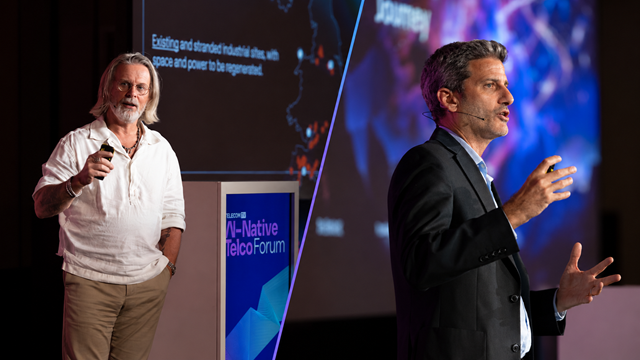
During this session, Era4’s Karl Havard explored a more sustainable and cost-efficient approach to AI infrastructure, including generating power from waste management sites, repurposing brownfield land and using neo-cloud partnerships to reduce the capital risk for telcos.
Amdocs Networks’ Ron Porter then shared execution evidence of agentic AI, from CSP-specific ontologies and agent-to-agent operations to digital twins and an agent control tower designed to govern autonomy while keeping humans in the loop.
Broadcast live Sept 2026
Participants

Karl Havard
CCO, Era4

Ron Porter
Head of Product Marketing, Amdocs Networks