To embed our video on your website copy and paste the code below:
<iframe src="https://www.youtube.com/embed/xOhHgvwA98E?modestbranding=1&rel=0" width="970" height="546" frameborder="0" scrolling="auto" allowfullscreen></iframe>
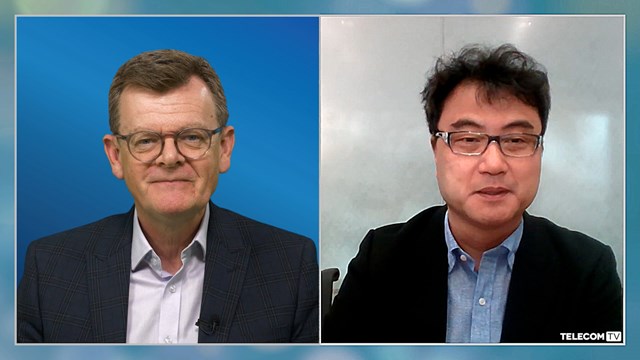
Hello, you're watching TelecomTV. I'm Guy Daniels, and today we're asking how the industry can tell real 6G progress from the hype and what operators should be doing now to get ready for what comes next. And joining me on the programme is YoungHan Nam, who's Senior Director, Standards and Mobility Innovation Team at Samsung Research America. Very good to meet you, YoungHan. Now, there's a lot of 6G talk across the industry right now. Interest in this is really picking up, but what differentiates genuine progress from mere hype?
YoungHan Nam, Samsung Research America (00:45):
We believe true technology progresses can be achieved through rigorous testing, not only in the lab, but also in real-world conditions. We take a collaborative approach for that. We develop critical 6G technologies first, and then we partner closely with top operators to run real-world test and trials. With these strategic partnerships, we are proud to lead the industry towards the next wave of connectivity. For example, just in the past year, we've signed agreements with three major Korean operators, SK Telecom, KT and LG U+ to test and validate 6G technologies like ISAC, integrated communication and sensing, 6G frequency and AI-RAN. For ISAC, we are already ahead of the curve. We recently completed a successful trial with Verizon during the major global sports event this August. For 6G carrier frequency, we completed a downlink test with KDDI at 7 gigahertz, demonstrating extreme MIMO technology and 1024 QAM modulation.
(02:18):
The main challenge of the carrier frequency is a higher propagation loss. Our field trial shows that we can overcome the challenge. Finally, for AI-RAN, we demonstrated AI-based optimisation with DOCOMO earlier this year. We expect we can enable networks to autonomously recognise user context and service requirements and deliver optimal quality of experiences to end users. And we believe these are all tangible real-world examples more than just a hype.
Guy Daniels, TelecomTV (03:03):
Now you mentioned operator agreements and trials there. So I'd like to ask you, why does Samsung place so much emphasis on operator collaboration at the research stage?
YoungHan Nam, Samsung Research America (03:15):
Yeah, we recognise that the best technologies must perform as expected in complex real-world environment. Operator collaboration enables early validation and allow us to identify and address the challenges like network congestion, interference, user behaviour, and so on we will experience in real commercial network. This ensures our 6G technologies are robust, scalable, and ready for deployment. Testing on live networks provides invaluable insight on how the technology performs under real-world conditions. Leveraging the lessons learned, we will be able to ensure consistent and high-quality performance. This approach guarantees that Samsung's software-driven solutions are adaptable and effective across diverse environments.
Guy Daniels, TelecomTV (04:19):
So YoungHan, what role does Samsung play in shaping global 6G standards beyond testing?
YoungHan Nam, Samsung Research America (04:27):
Samsung plays a significant role in shaping global 6G standards, spanning the full standard pipeline from early research and technology roadmaps to formal specification and commercialisation. We have leadership positions in key bodies like 3GPP, ITU-R, O-RAN Alliance and AI-RAN Alliance. This allows us to be deeply involved in both technical direction and eventual 6G specifications. Our research teams contribute to technologies and proposals and we also coordinate requirements, architectures and radio standards through the standard leadership. This multi-level involvement positions Samsung as an important player to the development of 6G standardisation.
Guy Daniels, TelecomTV (05:29):
And as you say, Samsung is already deeply involved in early 6G work. So as operators prepare for 6G, what can they do now to ensure that they're optimised for the future?
YoungHan Nam, Samsung Research America (05:43):
We believe that they need to have a right platform for 6G. With the right software-driven platform, the transition to 6G doesn't have to be a big jump, but it can be just a continuation. A software-centric, AI-native foundation like Samsung's virtualised RAN allows for evolution through only software upgrades without requiring hardware upgrades. Virtualised platforms offer optimised performance and reduce the costs. These cloud-native architectures also enable Edge AI, real-time adaptability, ultra-low latency and ultra-high reliability. With these architectures, 5G and 5G-Advanced networks can offer 6G-like experiences. We believe software-defined networks are essential for future-proofing infrastructure by embracing Samsung's virtualised RAN platforms now with the ability to integrate CPUs or GPUs for a variety of AI workloads. Operators can accommodate today's evolving 5G technologies as well as tomorrow's 6G.
Guy Daniels, TelecomTV (07:08):
Some great insights there, but we must leave it there for now. YoungHan, good talking with you and thanks so much for sharing your views with us today.
YoungHan Nam, Samsung Research America (07:15):
Thank you very much.
Please note that video transcripts are provided for reference only – content may vary from the published video or contain inaccuracies.
YoungHan Nam, Sr. Director, Standards and Mobility Innovation Team, Samsung Research America
YoungHan Nam, Sr. Director, Standards and Mobility Innovation Team at Samsung Research America, discusses how to tell genuine 6G progress from hype through real-world testing and trials, the operator agreements and trials behind technologies such as ISAC, 6G frequency and AI-RAN, why Samsung emphasises operator collaboration at the research stage, its role in shaping global 6G standards, and what operators can do now with a software-driven, AI-native platform to prepare for 6G, and much more.
Recorded October 2026
Email Newsletters
Sign up to receive TelecomTV's top news and videos, plus exclusive subscriber-only content direct to your inbox.