To embed our video on your website copy and paste the code below:
<iframe src="https://www.youtube.com/embed/frWSSQjlHGg?modestbranding=1&rel=0" width="970" height="546" frameborder="0" scrolling="auto" allowfullscreen></iframe>
We're at Future Net World 2024 in London. We're getting towards the end of the two-day event. I'm here with Andrew Collinson. He is founder and principal at Connective Insight and co-founder of the Unthinkable Series with Dean Bubley. Great to see you, Andrew. Thanks so much for joining us.
Andrew Collinson, Connective Insight (00:20):
Thank you. Very nice to see you.
Ray Le Maistre, TelecomTV (00:22):
So you have agreed to let me pick your brains about some of your key takeaways from the last two days. There's been a lot of tracks, a lot of sessions, a lot of conversations out on the show floor. The main focus of this event is the use and impact of AI in the telecom sector, especially around automated networks. Is there any sense that we're getting real world stories now or is it still all just theory and thought?
Andrew Collinson, Connective Insight (00:53):
Yes and no, is my answer to that. So my highest level observation would be I haven't seen a lot of evidence. I haven't seen numbers showing performance or cost or—
Ray Le Maistre, TelecomTV (01:10):
Automated networks in particular, is it?
Andrew Collinson, Connective Insight (01:12):
About automated networks, about AI in general.
Ray Le Maistre, TelecomTV (01:15):
Okay.
Andrew Collinson, Connective Insight (01:15):
It's generally what I'm feeling about what I've seen and heard out of the conference. Now, I can't see every session, but there was a bit of a lack of it. Now there have been points. There have been points of evidence, which have been great and very useful. And it's partly, I think, a reflection of the panel format. So there's not so many slides. This is more discussion. But overall, and I think Mark Newman, who's the chief analyst at TM Forum, said, "Well, I think we're making progress. We can say we're making progress." He said, "But it hasn't really flowed through to the bottom line." And I think that's probably true, but it's also interesting. Nobody put up any numbers. Nobody showed any numbers to say what is happening or not. So I think evidence for change. The caveats to that are what I have seen evidence of is evidence of significant thinking and action in the space of data.
(02:16):
So I've seen really intelligent and kind of evidence stories about how people are changing the way they look at data. And it's starting to make sense the way they're talking about it. So I was on a panel and we were talking about how you compare data across silos. And what's important about it isn't just that you've got a piece of data, but you know the context of the data and the intent of the data. And I'm starting to hear practitioners talking at that level and that's making me think, okay, there's reality going on in sorting the foundations out. And you're also hearing people like Carol Kennedy from Telenor saying, "Yeah, we're going for level four. We're trying to get a town going in Finland." You're seeing some of that. And obviously the Chinese are reportedly further ahead in those areas.
(03:10):
So you're seeing evidence at an operational level, but not yet so much at a commercial level. Although again, there were some interesting stories, for example, from Telus about the sovereign AI factory and they got that up and running in six months and sold out. And what they're doing is they've sort of found a window of opportunity or they identified a window of opportunity and they've done it. And kudos to them. They saw an opportunity and they've taken it. And that's kind of, I wouldn't say a rare exception, but certainly one of the clearer exceptions I've seen of evidence of stuff happening.
Ray Le Maistre, TelecomTV (03:46):
I think that seems very market specific because you mentioned Telenor there with their plan for the automated network, real world trial in Finland, but they've also developed an AI factory and they've done it on a demand driven basis and very small, not these enormous things. And I think that's a good model. And I think maybe Norway, not overrun with hyperscaler data centres, Canada, probably sovereignty for some reason might be quite strong there, that marketing push. So it's interesting to see where these things are happening. But these are pockets, aren't they?
Andrew Collinson, Connective Insight (04:39):
Well, you can look at those pockets, but I think what usually happens in changes like this is you get pockets or examples of domains or things that start to show evidence of it. So going back to the original point about evidence, the evidence is there, but it's partial and it's patchy at the moment. But I suppose the first observation was how little evidence had been presented, but as I say, that may reflect the format of being panel oriented, but I think stuff is happening, but it's more operational still than it is commercial. And I suppose what that leads me onto is AI. One of the odd feelings that I've had, it's probably better to describe it as that than anything, is AI is like jelly at the moment. It's like everybody knows that jelly exists. They know it's a dish that you can make and then you can have and they like it.
(05:40):
But when you get jelly at a party, it gets messy. All the kids chuck it everywhere. It comes out, it squeezes when you squash it. And it feels like every conversation you have about it, it flips in a new direction. It goes into a... Yes, but the thing about AI is it's very unreliable or the thing about AI is it's very insecure and you need guardrails. Oh, but the guardrails are written by AI. Ah, so what do we need? And so you're always chasing the jelly at the moment, I think, with AI.
Ray Le Maistre, TelecomTV (06:13):
Maybe it needs to be in a telecom trifle with different layers above and below it.
Andrew Collinson, Connective Insight (06:18):
That's shocking, right? The telecom trifle. I'm not going to work on that. I think jelly is enough today, but you see what I mean? It just feels like it's going in all directions all the time. But I also think that reveals the sort of fundamental element here, which is the stakeholder element. There's a lot of fear of AI as well as optimism about AI. And there are a lot of unspoken dynamics. I mean, everybody's thinking, "Is it going to take my job?" Or, "What about my kids' jobs?" Or, "What about the economy?" And if they're not, they're not really paying attention, is my view. And it's very difficult at an industry conference like this to address that or articulate it. And I've been thinking about it a bit with respect to telecoms and I think, well, do I care if... I mean, Carol was talking about taking a network and saying, "Why can't we run a network with 20 people?
(07:14):
You can run a car factory with 20 people. Why can't we..." Listen, okay, well, I don't see why that's a bad thing to think like that. I think the issues, and to some extent, this is not an industry issue. It's a more societal issue. The industry's doing the right things. It's trying to make itself more efficient. It's trying to make itself more customer centric. It's trying to simplify the stuff that's made really complicated and horrible, tick, tick, tick all the boxes. The problem is, who's benefiting from that appears to be on a societal level, a very small minority of people, and everyone else is thinking, "Hell, what about me?" And I think, while that's unresolved, you're going to have these underlying... And I'm not even sure how you resolve... I mean, if I did know that question, I'm sure I would be doing some wonderful job somewhere, but we're going to have this sort of undercurrent of fear and the sort of unspoken stuff that goes around in the conversations.
(08:12):
And I think it was encapsulated for me quite well by... I apologise, I forgot the name... Aaron from Colt who said, "It's only those brave enough to try agentic AI that can benefit from it." And I thought, actually, that's quite a good way of putting it. It's quite a nice way of saying, and the way I think about it in a way is that turn towards the change, and in some ways it's turn towards the fear, because you can't undo this, you can't stop it. You need to work out how you are going to be a part of it, and what the outcomes are going to be for you as a person or your organisation. And it's very complicated, very complicated.
Ray Le Maistre, TelecomTV (08:56):
On that point, there was a question raised yesterday about, there was a panel, and it was tier one operators were represented on the panel, and there was a question about, well, what does all of this mean for the smaller operators, maybe the ones that don't have a large CTO office or CIO office, and don't have as many resources. At the same time, a lot of people talk about the democratisation that AI brings. Do you have any thoughts about whether the tier three operator in Kazakhstan has as much chance of deploying and trialling agentic AI as the multinational tier one? Are we at that stage or are we not at that stage of democratisation?
Andrew Collinson, Connective Insight (09:48):
I'm going to skip the democratisation part of that for the moment, but the analogy I would draw is, look at Ukraine. Ukraine didn't want to be the world centre of AI and robotic autonomous warfare, but it is because it had to be. And I think sometimes, and goodness sake, I'm not saying this is a good thing, I'm saying sometimes the circumstances dictate the nature of the actions that people take and the organisations take. And what's quite interesting is some places where you've seen technologies taken up much more quickly have been places that haven't been encumbered by a great legacy argument. They've had legacies where they've just got rid of them really quickly because they didn't need them or they didn't want, or they had less of it. They'd built less on top of it and they were able to jump quicker to a new thing.
(10:45):
So I don't think it's the case that just because you're the smaller player, that you can't do it. And I think you may have less access to some of the things at the moment, but reality at the moment is that the successes are done on a piece by piece basis. And another great piece of advice, same guy actually, Aaron O'Connor said, "If you're going to do AI, just do one thing well." Because he said it takes a long time to get to the end and to get it right and to make it work. And I think that's really good. I think it's very easy to get very distracted and have lots of different things going on. And I mean, I know just at a personal level, I've found that it's much better if I focus on doing one thing better with AI, not try and learn how to do all the rest of the things and follow all the rabbit holes that you can go down with it.
(11:30):
So I think it's a little bit of... I go back to the jelly analogy. It is a bit everywhere and the way to deal with it is to find your priority, either for your organisation or for you as a person and focus on that and actually try and see it through and that may help you. And I think when it comes to the broader questions of our children and ourselves and what it means for us, I think that's the same answer. Focus on one thing that you can do really well with it and do that because it will be those who are brave enough to embrace it that benefit from it. And there's a lot of other unanswered questions, but I can't answer those now. You asked me what I thought about the last couple of days, so that's what I've been thinking about right now.
Ray Le Maistre, TelecomTV (12:17):
That's great. Well, great points. I love the fact you brought jelly into it. That's fantastic. I don't think we've had that in one of these conversations before, so I applaud you for that. Andrew, thanks so much for joining us and sharing your thoughts.
Andrew Collinson, Connective Insight (12:28):
Thanks a lot, Ray.
Please note that video transcripts are provided for reference only – content may vary from the published video or contain inaccuracies.
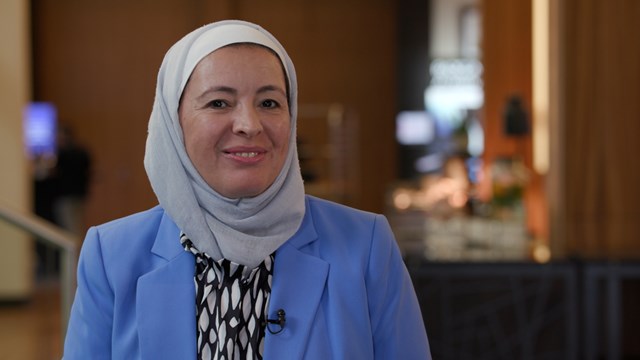
Andrew Collinson, Founder & Principal, Connective Insight
Reflecting on the key takeaways from the recent FutureNet World event in London, Andrew Collinson, founder and principal at Connective Insight, explains why AI is like jelly (or Jell-O, if you’re in the US), highlights advances in telco data management strategies, and identifies examples of progress in AI-native deployments. Overall, though, Collinson says the telco sector is still lacking much in the way of quantifiable evidence that AI is having a positive impact (yet) on the industry.
Recorded April 2026
Email Newsletters
Sign up to receive TelecomTV's top news and videos, plus exclusive subscriber-only content direct to your inbox.