To embed our video on your website copy and paste the code below:
<iframe src="https://www.youtube.com/embed/sT_zaW16MMs?modestbranding=1&rel=0" width="970" height="546" frameborder="0" scrolling="auto" allowfullscreen></iframe>
James Pearce, TelecomTV (00:04):
Hello, and welcome to TelecomTV. Satellite has rapidly moved from being a niche part of the communications landscape to one of the industry's hottest topics. As demand grows for truly ubiquitous connectivity, advances in direct to device technology and new partnerships between satellite providers and mobile network operators are reshaping how and where people can stay connected. To discuss what's driving this renewed momentum and what it means for the future of the telecom industry, I'm joined by Parth Trivedi, who's the CEO and co-founder of Skylo. Parth, thank you so much for joining us today. Let's start with an introduction to Skylo and your role there.
Parth Trivedi, Skylo (00:46):
First of all, thank you, James, for having me on your platform. Pleasure to be here and speak with you and your audience. Skylo is a company that has built the critical network layer that turns satellites into cell towers. It renders a standardised cell network through multiple different types of satellite constellations, allowing you the end user to have access to coverage and connectivity where you least expected it. And all of this is taking part in the broader landscape of what's called direct-to-device communications, direct-to-device connectivity, allowing every cell phone on the planet to effectively now become a satellite phone.
James Pearce, TelecomTV (01:34):
So let's build on what Skylo's position in the satellite market is, and maybe you can tell us a bit about what your ambitions are.
Parth Trivedi, Skylo (01:42):
Sure, James. It's a bit counterintuitive that when we started this company, we realised that the bottleneck was not the launch of new satellites into space. And that's coming from someone who's an aerospace engineer having actually launched satellites with my founding team in the past. We realised that the bottleneck in this industry was standardisation, orchestration, and convergence of customer experience between terrestrial network, which had never previously interacted with satellite in a seamless fashion, and with a mobile hardware industry, including chip sets, modules, devices that had previously never factored satellite into account, at least not in a standardised way. So our job was to effectively stitch together many different constituents in this industry, create a common language for everyone to participate without changes in silicon, without massive changes in hardware, if any, and allow carriers to speak the language of telecom and mobile connectivity that they have been familiar with all throughout, which is based on the 3GPP standard.
(03:02):
It's an approach that we have come to call the standardised sky, and one that we are very proud to have championed over the past several years, resulting in Skylo being commercially live now in 41 countries with more than 20 million devices on our network and counting across more than 90% of the cellular industry having achieved Skylo certification and us having integrated with more than two dozen carriers around the world.
James Pearce, TelecomTV (03:34):
So if we look at the wider market a little bit, we've obviously seen a resurgence in satellite in recent years. What do you think have been the main drivers behind that?
Parth Trivedi, Skylo (03:46):
I would say that first of all, the standards itself is a mechanism to align everyone on the same playing field. And the evolution of what's now called Release 17 all the way up to 19 and 20 of the 3GPP standard has created this category of non-terrestrial networks that is aligning people. We're an active contributor to the standard as well, that is allowing people to gather around a common language faster than individual companies building proprietary standards. I think the satellite industry for too long has remained niche with respect to device compatibility simply because of different fragmented proprietary protocols that had emerged out of the history of the satellite industry. So that is one big theme. And now of course you've got individual companies who have put in remarkable amounts of investments to enable their own version of this capability.
(04:56):
Whether you're an iOS user, whether you're an Android user, chances are that the phone that's in your pocket is now compatible with satellite. And of course, Skylo has had a big role to play in that working with the likes of Google Pixel, working with the likes of Qualcomm, working with our partners at Samsung and others in enabling that capability on standard consumer devices. And once that happened, that capability then cascaded to enterprise devices. We are now live across several IoT use cases ranging from cattle tracking all the way to logistics and utilities monitoring. Automotive is another emergent use case. Of course, every car needs to have access to 24 by seven reliable connectivity wherever it goes. Same applies to trucks, vessels, and fleets. And so you should think about this as consumer being the biggest forcing function with satellite starting to be introduced in mobile devices.
(06:05):
I would say in just the past 24 months, most devices now on the market, at least the ones being sold in the US here, are satellite compatible by default. And James, I'd say that that is a very rapid timeline for the industry to have moved on. So I would say that those are the biggest shifts that have happened. And of course you have the largest IPO that has happened this year with SpaceX, and that has caused the retail audience to take cognisance of the import of this capability where previously the awareness was limited to certain OEMs and MNO audiences and so on. It is now something that has much better widespread awareness. And so these are all the tailwinds feeding into why this industry is converging.
James Pearce, TelecomTV (07:04):
You talked a little bit about direct to device, which is obviously a very hot topic at the moment. What are some of the benefits or opportunities that this brings both for the end user, so the kind of customer on the ground, but also for our audience, which is the telecom operators?
Parth Trivedi, Skylo (07:20):
Absolutely. And I would view this in two phases. The first phase, which is something that we have now solved for, I would say at scale, as demonstrated by both our integrations and our user base, is giving you a connection where you did not have one previously. Where if you were to go completely outside of the realms of terrestrial connectivity, you would have no bars and therefore no coverage. Your device is now capable of switching to satellite mode and engaging with our network. And we give you access to lifesaving capability. For instance, our services have been called into action in remotest parts of the US, national parks, in inclement weather conditions. We've done everything from helping a technician prevent a forest fire in Oregon to helping a family rescue a six-year-old missing girl in the woods. And just to share a spectrum of different ways in which this network was invoked.
(08:33):
As far as public safety is concerned, it obviously provided a huge shift in perspective where the everyday consumer can now take for granted that they will have a signal wherever they go. Even if that signal is something that is constrained on what can be done with respect to the network, it is still a signal that can save your life where you previously didn't have a signal before. So that is the one, I'd call that the first phase in what this industry and what Skylo has achieved. Then the second was, of course, expanding to more general purpose use cases, including texting, location sharing and things like that. And as we move into what I'm excited about is not just giving you access in a zero bar scenario, but also giving you the ability to up-level your everyday connectivity experience. Even if you're down to one bar or two bars on your terrestrial mobile network, the mobile operator should have the confidence to switch between cellular and satellite, allowing you, the end user, to have simply a better network experience.
(09:48):
Even if that's in Mountain View where I physically am located right now. In fact, I live in Palo Alto where I don't have good coverage in my own neighbourhood. And if I were to go from my home to my office, there are many places where I can't initiate even an audio call. That's an example of where satellite will be invoked to allow a seamless user experience where you can start a call on cellular, continue it on satellite, and we can eliminate that one bar problem globally. So not just about connectivity where there is none, but rather connectivity that you can take for granted no matter where you are.
James Pearce, TelecomTV (10:36):
A little bit earlier you mentioned the SpaceX IPO, which obviously is one of the big news stories of this year, but some of the kind of speculation around that has been whether Starlink might become a competitor for US telcos directly. If we look at that relationship a little bit more, should the terrestrial telcos see satellite providers as a potential threat or as a potential ally?
Parth Trivedi, Skylo (11:00):
Our perspective is that the telcos should view satellite as an important tool in their toolkit to affect the end user experience that they are in pursuit of mobility, of continuity and seamlessness. And they should view satellite as perhaps augmenting terrestrial cellular connectivity in ways that might help them avoid CapEx. As an example, if you have a geography where subscriber density simply does not create an economic proposition to set up a cell site, you don't have to. You can rely on satellite all in. And there will be cases where actually the industry, the telcos have spent hundreds of billions now collectively in setting up fibre, in setting up backhaul and terrestrial cell sites. It makes sense to augment those rather than replace those. So I don't view satellite as being a replacement for what the telcos have built. Rather, I would encourage telcos to think about satellite as an important tool in their toolkit for up-levelling the connectivity experience of their end users.
James Pearce, TelecomTV (12:16):
Just kind of building on that a little bit, is there a situation at all where you could see satellite coverage ever replacing terrestrial networks?
Parth Trivedi, Skylo (12:25):
You see, is it theoretically possible? Yes. I would say that the physics and the economics of that would be more challenging than not. And it also doesn't make sense to rip and replace all the investments that have gone into fibre. For instance, the economics and frankly, the physics of fibre are hard to beat, impossible to beat from space. That's just how it works. And so it would not make sense for us as perhaps take a civilisation perspective on this. We already have built a dense network where population centres are. It makes sense to understand where those fall short, where existing coverage gaps, or perhaps even low coverage areas exist where there is user frustration that is building up, where the experience is less than perfect. And as we dive very quickly into a world where the way in which we consume internet is changing thanks to AI, thanks to the agentic modes that we use in our daily workflows, different types of devices, et cetera.
(13:44):
We are going to need more connectivity, better connectivity, not less. So that's my take on it.
James Pearce, TelecomTV (13:52):
It's a really interesting take. If we look forward a little bit, what has Skylo got coming up in the next six months that we should look out for?
Parth Trivedi, Skylo (14:00):
So I alluded to us working closely with the carriers in creating this customer experience. That is definitely something that you should keep an eye on, on how, again, Skylo working with the industry brings that service experience into the hands of users worldwide. You should expect to see in the next six months more commercial engagement from Skylo. In fact, just in the past week, we announced commercial availability of the service in Japan with our partner, Soracom. We are now live, as I mentioned, in 41 countries. So you should expect to see both the breadth in terms of countries, coverage, partnerships from a carrier standpoint. And you should now also start seeing depth in terms of network features, functionalities, all designed to help arm the carriers and OEMs around the world with the tools they need to provide the best network experience possible to their end users.
James Pearce, TelecomTV (15:09):
Well, that's really interesting. Parth, thank you very much for joining us today.
Parth Trivedi, Skylo (15:13):
Thank you, James. Pleasure to be on your platform.
James Pearce, TelecomTV (15:15):
As we've discussed, satellite is playing an increasingly important role in the telecom ecosystem. From extending coverage into previously unserved areas, to enabling new direct to device services, it's becoming clear that satellite and terrestrial networks will work hand in hand to deliver the next generation of connectivity. Thank you for watching. For more interviews, analysis, and the latest news from across the global telecoms industry, please stay tuned to TelecomTV.
Hello, and welcome to TelecomTV. Satellite has rapidly moved from being a niche part of the communications landscape to one of the industry's hottest topics. As demand grows for truly ubiquitous connectivity, advances in direct to device technology and new partnerships between satellite providers and mobile network operators are reshaping how and where people can stay connected. To discuss what's driving this renewed momentum and what it means for the future of the telecom industry, I'm joined by Parth Trivedi, who's the CEO and co-founder of Skylo. Parth, thank you so much for joining us today. Let's start with an introduction to Skylo and your role there.
Parth Trivedi, Skylo (00:46):
First of all, thank you, James, for having me on your platform. Pleasure to be here and speak with you and your audience. Skylo is a company that has built the critical network layer that turns satellites into cell towers. It renders a standardised cell network through multiple different types of satellite constellations, allowing you the end user to have access to coverage and connectivity where you least expected it. And all of this is taking part in the broader landscape of what's called direct-to-device communications, direct-to-device connectivity, allowing every cell phone on the planet to effectively now become a satellite phone.
James Pearce, TelecomTV (01:34):
So let's build on what Skylo's position in the satellite market is, and maybe you can tell us a bit about what your ambitions are.
Parth Trivedi, Skylo (01:42):
Sure, James. It's a bit counterintuitive that when we started this company, we realised that the bottleneck was not the launch of new satellites into space. And that's coming from someone who's an aerospace engineer having actually launched satellites with my founding team in the past. We realised that the bottleneck in this industry was standardisation, orchestration, and convergence of customer experience between terrestrial network, which had never previously interacted with satellite in a seamless fashion, and with a mobile hardware industry, including chip sets, modules, devices that had previously never factored satellite into account, at least not in a standardised way. So our job was to effectively stitch together many different constituents in this industry, create a common language for everyone to participate without changes in silicon, without massive changes in hardware, if any, and allow carriers to speak the language of telecom and mobile connectivity that they have been familiar with all throughout, which is based on the 3GPP standard.
(03:02):
It's an approach that we have come to call the standardised sky, and one that we are very proud to have championed over the past several years, resulting in Skylo being commercially live now in 41 countries with more than 20 million devices on our network and counting across more than 90% of the cellular industry having achieved Skylo certification and us having integrated with more than two dozen carriers around the world.
James Pearce, TelecomTV (03:34):
So if we look at the wider market a little bit, we've obviously seen a resurgence in satellite in recent years. What do you think have been the main drivers behind that?
Parth Trivedi, Skylo (03:46):
I would say that first of all, the standards itself is a mechanism to align everyone on the same playing field. And the evolution of what's now called Release 17 all the way up to 19 and 20 of the 3GPP standard has created this category of non-terrestrial networks that is aligning people. We're an active contributor to the standard as well, that is allowing people to gather around a common language faster than individual companies building proprietary standards. I think the satellite industry for too long has remained niche with respect to device compatibility simply because of different fragmented proprietary protocols that had emerged out of the history of the satellite industry. So that is one big theme. And now of course you've got individual companies who have put in remarkable amounts of investments to enable their own version of this capability.
(04:56):
Whether you're an iOS user, whether you're an Android user, chances are that the phone that's in your pocket is now compatible with satellite. And of course, Skylo has had a big role to play in that working with the likes of Google Pixel, working with the likes of Qualcomm, working with our partners at Samsung and others in enabling that capability on standard consumer devices. And once that happened, that capability then cascaded to enterprise devices. We are now live across several IoT use cases ranging from cattle tracking all the way to logistics and utilities monitoring. Automotive is another emergent use case. Of course, every car needs to have access to 24 by seven reliable connectivity wherever it goes. Same applies to trucks, vessels, and fleets. And so you should think about this as consumer being the biggest forcing function with satellite starting to be introduced in mobile devices.
(06:05):
I would say in just the past 24 months, most devices now on the market, at least the ones being sold in the US here, are satellite compatible by default. And James, I'd say that that is a very rapid timeline for the industry to have moved on. So I would say that those are the biggest shifts that have happened. And of course you have the largest IPO that has happened this year with SpaceX, and that has caused the retail audience to take cognisance of the import of this capability where previously the awareness was limited to certain OEMs and MNO audiences and so on. It is now something that has much better widespread awareness. And so these are all the tailwinds feeding into why this industry is converging.
James Pearce, TelecomTV (07:04):
You talked a little bit about direct to device, which is obviously a very hot topic at the moment. What are some of the benefits or opportunities that this brings both for the end user, so the kind of customer on the ground, but also for our audience, which is the telecom operators?
Parth Trivedi, Skylo (07:20):
Absolutely. And I would view this in two phases. The first phase, which is something that we have now solved for, I would say at scale, as demonstrated by both our integrations and our user base, is giving you a connection where you did not have one previously. Where if you were to go completely outside of the realms of terrestrial connectivity, you would have no bars and therefore no coverage. Your device is now capable of switching to satellite mode and engaging with our network. And we give you access to lifesaving capability. For instance, our services have been called into action in remotest parts of the US, national parks, in inclement weather conditions. We've done everything from helping a technician prevent a forest fire in Oregon to helping a family rescue a six-year-old missing girl in the woods. And just to share a spectrum of different ways in which this network was invoked.
(08:33):
As far as public safety is concerned, it obviously provided a huge shift in perspective where the everyday consumer can now take for granted that they will have a signal wherever they go. Even if that signal is something that is constrained on what can be done with respect to the network, it is still a signal that can save your life where you previously didn't have a signal before. So that is the one, I'd call that the first phase in what this industry and what Skylo has achieved. Then the second was, of course, expanding to more general purpose use cases, including texting, location sharing and things like that. And as we move into what I'm excited about is not just giving you access in a zero bar scenario, but also giving you the ability to up-level your everyday connectivity experience. Even if you're down to one bar or two bars on your terrestrial mobile network, the mobile operator should have the confidence to switch between cellular and satellite, allowing you, the end user, to have simply a better network experience.
(09:48):
Even if that's in Mountain View where I physically am located right now. In fact, I live in Palo Alto where I don't have good coverage in my own neighbourhood. And if I were to go from my home to my office, there are many places where I can't initiate even an audio call. That's an example of where satellite will be invoked to allow a seamless user experience where you can start a call on cellular, continue it on satellite, and we can eliminate that one bar problem globally. So not just about connectivity where there is none, but rather connectivity that you can take for granted no matter where you are.
James Pearce, TelecomTV (10:36):
A little bit earlier you mentioned the SpaceX IPO, which obviously is one of the big news stories of this year, but some of the kind of speculation around that has been whether Starlink might become a competitor for US telcos directly. If we look at that relationship a little bit more, should the terrestrial telcos see satellite providers as a potential threat or as a potential ally?
Parth Trivedi, Skylo (11:00):
Our perspective is that the telcos should view satellite as an important tool in their toolkit to affect the end user experience that they are in pursuit of mobility, of continuity and seamlessness. And they should view satellite as perhaps augmenting terrestrial cellular connectivity in ways that might help them avoid CapEx. As an example, if you have a geography where subscriber density simply does not create an economic proposition to set up a cell site, you don't have to. You can rely on satellite all in. And there will be cases where actually the industry, the telcos have spent hundreds of billions now collectively in setting up fibre, in setting up backhaul and terrestrial cell sites. It makes sense to augment those rather than replace those. So I don't view satellite as being a replacement for what the telcos have built. Rather, I would encourage telcos to think about satellite as an important tool in their toolkit for up-levelling the connectivity experience of their end users.
James Pearce, TelecomTV (12:16):
Just kind of building on that a little bit, is there a situation at all where you could see satellite coverage ever replacing terrestrial networks?
Parth Trivedi, Skylo (12:25):
You see, is it theoretically possible? Yes. I would say that the physics and the economics of that would be more challenging than not. And it also doesn't make sense to rip and replace all the investments that have gone into fibre. For instance, the economics and frankly, the physics of fibre are hard to beat, impossible to beat from space. That's just how it works. And so it would not make sense for us as perhaps take a civilisation perspective on this. We already have built a dense network where population centres are. It makes sense to understand where those fall short, where existing coverage gaps, or perhaps even low coverage areas exist where there is user frustration that is building up, where the experience is less than perfect. And as we dive very quickly into a world where the way in which we consume internet is changing thanks to AI, thanks to the agentic modes that we use in our daily workflows, different types of devices, et cetera.
(13:44):
We are going to need more connectivity, better connectivity, not less. So that's my take on it.
James Pearce, TelecomTV (13:52):
It's a really interesting take. If we look forward a little bit, what has Skylo got coming up in the next six months that we should look out for?
Parth Trivedi, Skylo (14:00):
So I alluded to us working closely with the carriers in creating this customer experience. That is definitely something that you should keep an eye on, on how, again, Skylo working with the industry brings that service experience into the hands of users worldwide. You should expect to see in the next six months more commercial engagement from Skylo. In fact, just in the past week, we announced commercial availability of the service in Japan with our partner, Soracom. We are now live, as I mentioned, in 41 countries. So you should expect to see both the breadth in terms of countries, coverage, partnerships from a carrier standpoint. And you should now also start seeing depth in terms of network features, functionalities, all designed to help arm the carriers and OEMs around the world with the tools they need to provide the best network experience possible to their end users.
James Pearce, TelecomTV (15:09):
Well, that's really interesting. Parth, thank you very much for joining us today.
Parth Trivedi, Skylo (15:13):
Thank you, James. Pleasure to be on your platform.
James Pearce, TelecomTV (15:15):
As we've discussed, satellite is playing an increasingly important role in the telecom ecosystem. From extending coverage into previously unserved areas, to enabling new direct to device services, it's becoming clear that satellite and terrestrial networks will work hand in hand to deliver the next generation of connectivity. Thank you for watching. For more interviews, analysis, and the latest news from across the global telecoms industry, please stay tuned to TelecomTV.
Please note that video transcripts are provided for reference only – content may vary from the published video or contain inaccuracies.
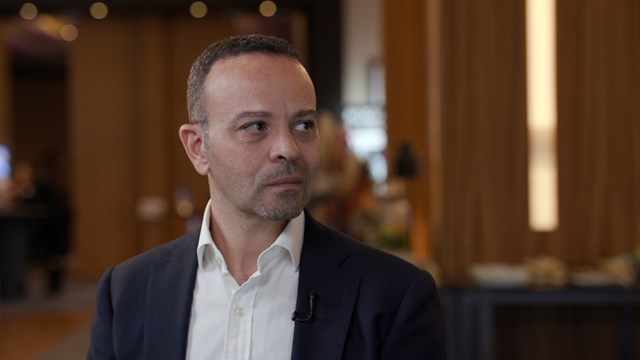
Parth Trivedi, Founder and CEO, Skylo
Skylo CEO Parth Trivedi discusses the resurgence of satellites, Skylo’s ambition to partner with telcos, and whether satcoms are friends or foe to terrestrial telecom operators.
Recorded July 2026
Email Newsletters
Sign up to receive TelecomTV's top news and videos, plus exclusive subscriber-only content direct to your inbox.