To embed our video on your website copy and paste the code below:
<iframe src="https://www.youtube.com/embed/mS6uhbmrl4k?modestbranding=1&rel=0" width="970" height="546" frameborder="0" scrolling="auto" allowfullscreen></iframe>
James Pearce, TelecomTV (00:08):
Welcome to TelecomTV. I'm James Pearce. I'm reporting from the AI Native Telco Forum in Düsseldorf, where I'm delighted to be joined today by Ahmed Hafez, who is from Deutsche Telekom. Thank you so much for joining us. Deutsche Telekom is a founding partner of the AI Native Telco Accelerator, and you yourself are on the ANTA Steering Board. Why is it important for you to be involved in ANTA and what does it bring to the industry?
Ahmed Hafez, Deutsche Telekom (00:32):
Hi, James. Actually, ANTA for us is a very good tool to benchmark not only what we do, but also what we communicate externally. We always strive to be leading, and to do that, you need always to measure yourself and understand, are you on the right track? Are you doing well? Are you doing enough? And ANTA actually gives us this. In a way, it's not really about competition between operators, but it helps you understand how the entire ecosystem is moving. And the details behind helps us a lot to understand, do we need to do more or do we need to communicate more or both? Because ANTA as a whole is reliant on external information only and they don't do any internal information. So it's all external. So it helps us to see these two perspectives in a good way. And so I actually look into it and I found it a very good idea.
(01:22):
And we also discussed, and that's why I'm part of the Steering Board. This actually should not become a competition, but rather to see where we are, how can we do better, and how can we even collaborate with different operators?
James Pearce, TelecomTV (01:34):
Obviously, you're well aware of the ANTA Index as well, which we've unveiled here in Düsseldorf. And it's clear from the index that telcos are moving into a monetisation phase when it comes to AI. What are the key business opportunities that Deutsche Telekom's identified using AI in its network?
Ahmed Hafez, Deutsche Telekom (01:51):
As we move into the era of AI, everything will have AI. This means that autonomous networks will have AI, products and services will have AI. Either this will augment the products and services or will become a product and service in its own right. So that becomes a lot of monetisation angles with this aspect. And in that manner, you can also consider very importantly that lowering the barrier of customer entry, making the services that we offer much easier to comprehend and understand and deal with, easier to configure, easier to understand towards customers, all that with the aid of AI will change how we serve customers. And with the evolution of AI to physical AI and beyond that, this will be even more needed and will become obviously one of the monetisation mechanisms.
James Pearce, TelecomTV (02:40):
So how are you measuring the success of your AI deployments?
Ahmed Hafez, Deutsche Telekom (02:43):
Basically, you have a starting point. When we start doing AI, we select the high-value use cases from the start on. So we don't really wait and say we try things and then we find out. So we try to tackle and point to where the impact would be big based on our estimates. But then how we measure that is that when we put things in operation, we can measure concretely has the estimated impact been realised or something close to that or the impact was unsatisfactory. So this is how we measure that. So we estimate, measure, and then see if the gap is big, small, or even we exceeded our expectations. So for example, for NG Guardian, we exceeded the expectations we had. We thought it's going to help us in, let's say 10 times, it helps us 100 times. That's a fact, that's a gain.
(03:31):
We are happy with that. But if we wanted to have 10 times and it was only two, then we can think if the cost is still justifiable or we should actually turn it off even. So we always do that. And the other factor that we measure that with in many other use cases and depend of course on the use case is the adoption of operations because I can build the best, most intelligent tool, but if it's not embedded in my processes, it didn't change my processes and my operation teams are not using it, then I failed because just running in parallel. And this is of course one major way that we measure the adoption and the adoption to measure the success of the AI.
James Pearce, TelecomTV (04:10):
I think that's really, really interesting. If we broaden it out a little bit, how do you think telcos should think about their own role in the AI ecosystem? What kind of industry collaborations are key to ensuring that the telecom sector is at the heart of the AI evolution?
Ahmed Hafez, Deutsche Telekom (04:25):
Excellent question. So basically let me explain a little bit how we see the ecosystem. So the ecosystem starts from the innovators like hyperscalers and AI-savvy companies like NVIDIA, Anthropic, OpenAI. And then you go into suppliers, suppliers that have morphed into more AI-capable suppliers, which are traditional suppliers and also new suppliers that are popping up. We also work with operators and exchange and have ideas exchanged like in the forum here, that's exactly what we're doing here. And then we also look into open source and we look into all, let's say new ideas that come from these communities and from the open source to be augmenting what we do. So you can see that in many cases we try to build some software that does certain function. You find it in open source. And finally, of course we go to the main standard bodies in order to also make sure that we provide inputs, but also take inputs from them.
(05:18):
So we make sure that this communication is happening very effectively. So this ecosystem needs to be flourished. So we need to keep an eye on it and we need to really feed into it and take from it always in order for us to go in into the value chain of AI. We also have many areas where the AI in the telco would be really stacking up. This starts from out deep into the networks, DIT, products and services, how we serve the customers, how we run our own network, how we verify things, how we protect the network. So basically, how we deliver new products that we have been not delivering in the past. Even if you look at these systems where we're actually delivering now the AI industrial factory, so we are also offering others the data centres that can use GPUs and others in a sovereign way in Germany.
(06:08):
And we continue to do that and we'll continue to find the right opportunities where we can actually take part in the ecosystem. And we have great opportunities. Telcos in general have great opportunities in that value chain.
James Pearce, TelecomTV (06:20):
I think that's such a positive message and we're going to end it there. So thank you so much for joining me today.
Ahmed Hafez, Deutsche Telekom (06:24):
Thanks for inviting me. Thank you very much.
Welcome to TelecomTV. I'm James Pearce. I'm reporting from the AI Native Telco Forum in Düsseldorf, where I'm delighted to be joined today by Ahmed Hafez, who is from Deutsche Telekom. Thank you so much for joining us. Deutsche Telekom is a founding partner of the AI Native Telco Accelerator, and you yourself are on the ANTA Steering Board. Why is it important for you to be involved in ANTA and what does it bring to the industry?
Ahmed Hafez, Deutsche Telekom (00:32):
Hi, James. Actually, ANTA for us is a very good tool to benchmark not only what we do, but also what we communicate externally. We always strive to be leading, and to do that, you need always to measure yourself and understand, are you on the right track? Are you doing well? Are you doing enough? And ANTA actually gives us this. In a way, it's not really about competition between operators, but it helps you understand how the entire ecosystem is moving. And the details behind helps us a lot to understand, do we need to do more or do we need to communicate more or both? Because ANTA as a whole is reliant on external information only and they don't do any internal information. So it's all external. So it helps us to see these two perspectives in a good way. And so I actually look into it and I found it a very good idea.
(01:22):
And we also discussed, and that's why I'm part of the Steering Board. This actually should not become a competition, but rather to see where we are, how can we do better, and how can we even collaborate with different operators?
James Pearce, TelecomTV (01:34):
Obviously, you're well aware of the ANTA Index as well, which we've unveiled here in Düsseldorf. And it's clear from the index that telcos are moving into a monetisation phase when it comes to AI. What are the key business opportunities that Deutsche Telekom's identified using AI in its network?
Ahmed Hafez, Deutsche Telekom (01:51):
As we move into the era of AI, everything will have AI. This means that autonomous networks will have AI, products and services will have AI. Either this will augment the products and services or will become a product and service in its own right. So that becomes a lot of monetisation angles with this aspect. And in that manner, you can also consider very importantly that lowering the barrier of customer entry, making the services that we offer much easier to comprehend and understand and deal with, easier to configure, easier to understand towards customers, all that with the aid of AI will change how we serve customers. And with the evolution of AI to physical AI and beyond that, this will be even more needed and will become obviously one of the monetisation mechanisms.
James Pearce, TelecomTV (02:40):
So how are you measuring the success of your AI deployments?
Ahmed Hafez, Deutsche Telekom (02:43):
Basically, you have a starting point. When we start doing AI, we select the high-value use cases from the start on. So we don't really wait and say we try things and then we find out. So we try to tackle and point to where the impact would be big based on our estimates. But then how we measure that is that when we put things in operation, we can measure concretely has the estimated impact been realised or something close to that or the impact was unsatisfactory. So this is how we measure that. So we estimate, measure, and then see if the gap is big, small, or even we exceeded our expectations. So for example, for NG Guardian, we exceeded the expectations we had. We thought it's going to help us in, let's say 10 times, it helps us 100 times. That's a fact, that's a gain.
(03:31):
We are happy with that. But if we wanted to have 10 times and it was only two, then we can think if the cost is still justifiable or we should actually turn it off even. So we always do that. And the other factor that we measure that with in many other use cases and depend of course on the use case is the adoption of operations because I can build the best, most intelligent tool, but if it's not embedded in my processes, it didn't change my processes and my operation teams are not using it, then I failed because just running in parallel. And this is of course one major way that we measure the adoption and the adoption to measure the success of the AI.
James Pearce, TelecomTV (04:10):
I think that's really, really interesting. If we broaden it out a little bit, how do you think telcos should think about their own role in the AI ecosystem? What kind of industry collaborations are key to ensuring that the telecom sector is at the heart of the AI evolution?
Ahmed Hafez, Deutsche Telekom (04:25):
Excellent question. So basically let me explain a little bit how we see the ecosystem. So the ecosystem starts from the innovators like hyperscalers and AI-savvy companies like NVIDIA, Anthropic, OpenAI. And then you go into suppliers, suppliers that have morphed into more AI-capable suppliers, which are traditional suppliers and also new suppliers that are popping up. We also work with operators and exchange and have ideas exchanged like in the forum here, that's exactly what we're doing here. And then we also look into open source and we look into all, let's say new ideas that come from these communities and from the open source to be augmenting what we do. So you can see that in many cases we try to build some software that does certain function. You find it in open source. And finally, of course we go to the main standard bodies in order to also make sure that we provide inputs, but also take inputs from them.
(05:18):
So we make sure that this communication is happening very effectively. So this ecosystem needs to be flourished. So we need to keep an eye on it and we need to really feed into it and take from it always in order for us to go in into the value chain of AI. We also have many areas where the AI in the telco would be really stacking up. This starts from out deep into the networks, DIT, products and services, how we serve the customers, how we run our own network, how we verify things, how we protect the network. So basically, how we deliver new products that we have been not delivering in the past. Even if you look at these systems where we're actually delivering now the AI industrial factory, so we are also offering others the data centres that can use GPUs and others in a sovereign way in Germany.
(06:08):
And we continue to do that and we'll continue to find the right opportunities where we can actually take part in the ecosystem. And we have great opportunities. Telcos in general have great opportunities in that value chain.
James Pearce, TelecomTV (06:20):
I think that's such a positive message and we're going to end it there. So thank you so much for joining me today.
Ahmed Hafez, Deutsche Telekom (06:24):
Thanks for inviting me. Thank you very much.
Please note that video transcripts are provided for reference only – content may vary from the published video or contain inaccuracies.
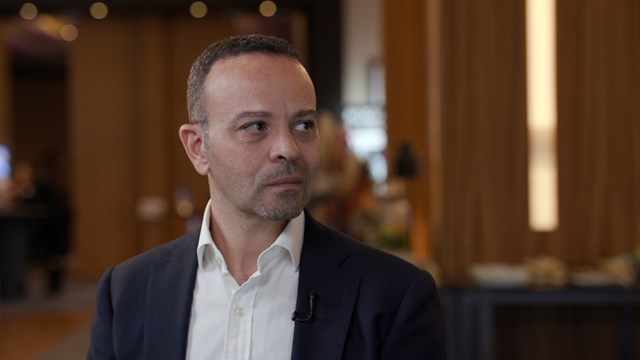
Ahmed Hafez, SVP Network Strategy and Data & AI in Networks, Deutsche Telekom
Ahmed Hafez, SVP of network strategy and data & AI in networks at Deutsche Telekom, discusses the monetisation opportunities emerging as AI advances rapidly, reveals how the operator selects high-value use cases and measures the impact of their adoption, and explains why Deutsche Telekom joined the ANTA Steering Board.
Recorded September 2026
Email Newsletters
Sign up to receive TelecomTV's top news and videos, plus exclusive subscriber-only content direct to your inbox.