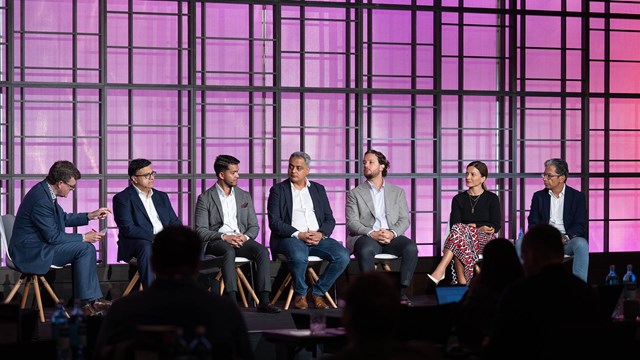
TIM builds automation into 5G standalone for enterprise scalability

By James Pearce
Jul 30, 2026
To embed our video on your website copy and paste the code below:
<iframe src="https://www.youtube.com/embed/FHCyutcN6MM?modestbranding=1&rel=0" width="970" height="546" frameborder="0" scrolling="auto" allowfullscreen></iframe>
I'm delighted to be joined today by Alessandro De Vincentis, who is Head of Network Data Layer and Automation at TIM. Thank you so much for joining us today, Alessandro. Maybe you could start by explaining how you're evolving TIM's core network for future growth and efficient operations.
Alessandro De Vincentis, TIM (00:21):
Okay, thank you, good to be here. Yes, of course. Our strategy is built on two tracks. On one track, of course, we are introducing new cloud-native architecture, which also means more complexity, more data to be analyzed, and more operational activities to be managed. For this reason, there is also a second track that is to change our operational model by simplifying internal processes, by consolidating the tools that are used, and by also step-by-step introducing a more data-driven decision-making in order to create the environment for AI. These two tracks must go hand in hand. Otherwise, we cannot address the efficiency gains that we target with network transformation.
James Pearce, TelecomTV (01:28):
So you mentioned automation. Can you talk us through how you are thinking about automation, but not just as a tool to manage network complexity, but also as a strategic capability to transform the way that you operate and compete?
Alessandro De Vincentis, TIM (01:44):
Of course. Typically, automation has been considered a sort of back-office efficiency tool. Now we should make a step forward because it is, in my understanding, a core operational enabler. When we talk about 5G Standalone monetization, we especially focus on network slicing as we have heard during today's presentation, but a network slice is not only a product you sell. A network slice is an operational commitment towards several hundred different enterprise customers that need to be managed for its entire lifecycle, and it is simply impossible doing it manually. So this is the reason why I guess that automation is not something that could be added on top of 5G Standalone; it has to be built in. Otherwise, the business of 5G Standalone will not scale.
James Pearce, TelecomTV (02:53):
That's really interesting. So talk us through your network evolution, how it's becoming a driver for your overall business transformation rather than just an enabler of it.
Alessandro De Vincentis, TIM (03:03):
Currently, there is a sort of a shift in mindset that we are speaking on internally because traditionally the network has been considered a sort of foundation. You first create the network and then separately you try to monetize it. Now the investment, but also the operational cost related to the new technology, needs a change in mindset as I said. And I'm from a technical department, and we now are aware of the fact that the way we design, we deliver, we manage the network—again, automation, orchestration—is something that directly shapes what we can provide to the market and how fast we can provide to the market. But we also need to realize a clear accountability model internally so that, especially when we speak about enterprise customers, new services have a clear accountability and can be associated with a clear business plan, revenue, and cost.
(04:17) This is the only way to have the network being the point where differentiation starts and not where it ends.
James Pearce, TelecomTV (04:25):
Of course, we're in the AI era. So talk me through how AI is impacting your business.
Alessandro De Vincentis, TIM (04:31):
AI is impacting our business on two parallel dimensions, let me say. On one side, of course, we are consumers of AI because we are introducing AI in our processes in the network in order to transform our operating model to be more effective and so on. On the other hand, the explosion of AI-driven services makes a big differentiation in terms of traffic patterns, customer requirements in terms of reliability, and so on. So in that case, we are the enabler of AI, consumed by our customers. And we have these two dimensions to manage at the same time, and this is a key strategic challenge that we need to face.
James Pearce, TelecomTV (05:30):
Sticking with AI, how do you see it evolving in your network operations over the next few years? But also maybe you can talk us through some of the biggest challenges that you're facing.
Alessandro De Vincentis, TIM (05:42):
We are seeing AI increasingly manage a lot of different tasks currently performed by humans, especially when speaking about operations, from assisting humans to substituting humans. The main challenge is not a technological challenge. The main challenges are the quality of data that we can provide to AI—so the data fragmentation—and skills, because you can use the most sophisticated AI model, the best agent in the world, but if you don't have a team trained to manage an agent, you will fail. And so these are the main challenges, and at the end, the governance framework, because we need to transform our people from executors to supervisors of what AI is doing.
James Pearce, TelecomTV (06:44):
Alessandro, that's brilliant. Thank you so much for joining me today.
Alessandro De Vincentis, TIM (06:47):
Thank you.
Please note that video transcripts are provided for reference only – content may vary from the published video or contain inaccuracies.
Alessandro De Vincentis, Head of Network Data Layer and Automation, TIM
Alessandro De Vincentis, head of network data layer and automation at TIM, explains how the Italian operator is pursuing network transformation through two parallel tracks – introducing cloud-native architecture while simultaneously changing operational models – and emphasises that automation must be built into 5G standalone rather than added later, as network slicing requires managing operational commitments to hundreds of enterprise customers throughout their lifecycle.
Recorded May 2026
Email Newsletters
Sign up to receive TelecomTV's top news and videos, plus exclusive subscriber-only content direct to your inbox.