Sunrise exec lifts the lid on demand-driven networks and agentic AI

By James Pearce
Apr 28, 2026
To embed our video on your website copy and paste the code below:
<iframe src="https://www.youtube.com/embed/Rp47LFjQ16I?modestbranding=1&rel=0" width="970" height="546" frameborder="0" scrolling="auto" allowfullscreen></iframe>
James Pearce, TelecomTV (00:05):
Hello and welcome to TelecomTV. I'm James Pearce and I'm at FutureNet World in London. I'm delighted to be joined today by Fabrizio Campanale, who is the VP of Network Operations, TV, and In-Home Engineering at Sunrise. Welcome, Fabrizio. Thank you so much for coming along.
Fabrizio Campanale, Sunrise (00:21):
Thank you very much. Thanks for having me.
James Pearce, TelecomTV (00:23):
Let's dive straight in by looking at demand-driven networks and what they really mean for telcos from a network operations perspective. What needs to be in place for this scenario to become a reality for the industry?
Fabrizio Campanale, Sunrise (00:38):
Look, when the industry talks about demand-driven networks, it thinks mainly in terms of commercial, and it's fair, it's valid — how to slice or sell, monetise speed tiers and so on. However, from where I see it, running the network day by day, when I think about demand-driven networks I think in terms of experience. I think in terms of what we can do for the network to respond to a demand for quality of service from customers. So I start drifting and thinking — today with the power of analytics, AI and the agenda we have, we collect millions of data points, millions of technical parameters from the network, which in the past we were used to using to improve network performance. But today we can start answering this demand — demand for quality. So that is where, let's say, I think we can make a paradigm shift in terms of demand-driven networks.
(01:40):
I'm not dismissing the commercial aspect — that's the classical one. And there is another third aspect, which is that with the advent of AI, we see more and more uplink demand, which has been mentioned today. We still do not see this so strongly in Europe, but if you go to China, for instance, you see a lot of AI-driven applications pushing demand toward the uplink. And this will also shift the demand-driven network evolution somewhat. So these are the aspects. There is the commercial aspect. There is the change that the application layer is inducing in answering to this demand. But from my point of view, the demand that today we can answer is about quality of service, and we can use our capabilities plus AI to answer that demand. Now, what is needed — and whether we are ready today — also listening to colleagues from other operators, for me what is still missing, or is the bottleneck, is the data.
(02:45):
Again, from a network point of view, we have a lot of experience and a long history of collecting data points. However, these telemetry data points were used to improve network performance. So we had disaggregated data, and this data was used in every piece of the access part and the IP, the transport, the HFC or the XGS-PON or the set-top box. And it's good for that. But if we want to be ready for a massive improvement through AI, we need to break down the siloed data. Everybody's talking about this. And here I need to make a disclaimer — I'm not talking about data work through data lakes or data scientists or data engineering. I'm talking about network engineers being able to articulate and interpret the data that comes from telemetry, to make it ready for utilisation in the AI world, so to speak.
James Pearce, TelecomTV (03:47):
In the use of AI alongside real-time networks, as you touched upon there, is it improving the connection between network operations and the customer experience? Or if not, what needs to be done to improve that?
Fabrizio Campanale, Sunrise (04:02):
I believe yes, but it's a long journey. It's not something you do overnight. At Sunrise, we started years ago from an engineering point of view. So that was the beginning, where we started using all these data points from the home WiFi, or TV, or the coverage on the mobile network, and trying to correlate with customer feedback — NPS, CSAT, customer satisfaction. At that time it was done by humans, reading verbatim and trying to figure out from unstructured verbatim whether there was something we were not seeing on the network. And why engineering? Because it was not an incident — it was not operations. If you have a fibre cut, it's an incident, that's clear. But what about below-the-threshold degradation where customers are not calling, but they are not having the best quality? Now we started using machine learning a few years ago, when this became easier to access.
(05:02):
And from machine learning, we were able to structure this customer feedback into categories. And then we were using AI to find correlations that normal engineering cannot do. Now the point is — the point is that with this data that we need to make available and interpret, we still need subject matter experts to create this contextualised data. How can we then jump and move toward the customer? So these are, let's say, the three layers that I see. We went from level three engineering capabilities and troubleshooting. Now we are shifting this toward level two, where we start adopting these capabilities and tools for tickets coming from the frontline, from customer service. However, one day we want to reduce the tickets — not only reduce the backlog — so that we are able preventively and proactively to solve issues before the customer gets into trouble and starts calling.
(06:05):
And that is really the jump to the future. That is really, for me, the future-looking utilisation of the data we have from the network, to become usable for the customer experience.
James Pearce, TelecomTV (06:19):
So let's talk agentic AI. In your opinion, is it ready for deployment in telco networks? How can telcos adopt AI agents in a way that's safe, secure, predictable — all of the things that are really important to make it work for the industry?
Fabrizio Campanale, Sunrise (06:37):
So as I said, we started with machine learning, analytics, advanced analytics. You need a meta-level data interpretation layer. Then we use AI to start creating correlations. Now we talk about agentic, and that's the right journey. But honestly, if I look at where we are and where colleagues from other operators are, we are not yet there. And it is the decision layer of the agentic that is not trusted today. It's a little bit like the journey we saw with customer service and AI. At the beginning, we didn't want to expose customers to a virtual AI bot until we were sure it was reliable. And today it's the same. We can move ahead and having a squad of agents is happening today to do faster and better work than network engineers or network operations teams — assuming the data underneath is trustable. Again, we go back to the point — how do you make sure the data is trustable? It's because it's produced by an interpretation layer sitting in the network.
(07:55):
But then, let's say, you still want to have a human orchestrator today before the agentic squad takes a decision. The agentic squad can prepare for the decision, but you don't want them to act autonomously today — especially in incident management, for instance, a change that could have a massive configuration impact on millions of customers. You still want to have an orchestrator, which is human. And again, this orchestrator, and the kill switch, the guardrail, needs to be defined. This governance needs to be defined. And it's not the same governance as for security or privacy in other domains where AI is applicable today in the company. But in the network there is this layer of mission critical where you cannot delegate to an agent today. This decision layer will come — but not yet. And let me say one thing because it was part of the recurring topics in the panels today, which is the digital twin.
(08:56):
I'm a true believer in the digital twin. I'm pushing for digital twins and we are piloting, because the network digital twin is the next step — today and tomorrow — to facilitate network operation teams in having better assurance, better mean time to resolution, better root cause analysis, and intelligent fault filtering. However, if we are serious about agentic, one day — and I know this sounds contradictory, but it's not — we are not ready today. So the digital twin is good today. But one day, the graphical representation of the network is not needed for an artificial agent — it's needed for a human. So the real future, looking further ahead, is that agentic adoption goes beyond the digital twin, which is the right step today. So the journey needs to go through this passage — it needs to have all the capabilities offered by digital twins, the AI, the agentic squads, but still with the human orchestrator — to then reach a point where you will no longer need this meta-layer, and the agentic can take decisions throughout the different layers of data in the network infrastructure.
James Pearce, TelecomTV (10:19):
You spoke really well there on the kind of passage and the journey that the industry has been on. I just want to dig a little deeper into where Sunrise is specifically. The type of AI that you're deploying, the way you're deploying it at the moment — is it cloud-based, or are there some functions that are embedded directly in the network? AI in voice is one area that some of your competitors or colleagues are talking about.
Fabrizio Campanale, Sunrise (10:47):
In this regard, I see two dimensions. There is an infrastructure dimension and there is more of an organisational element. On the infrastructure dimension — where this AI is sitting — I don't see it as either all on-prem or all on the cloud. I see it more as use case by use case. There are certain AI capabilities which are embedded in some platforms. Just think about our TV platform — TV products that have embedded AI capability for personalised recommendations, for instance. Or for instance, from a network operations and network assurance point of view, in that case you need to have AI data analytics close to where the data points are. So you need to be closer to real time. However, where the application runs — where, let's say, the agent runs, for instance, a personalised interaction toward the customer — this could easily be moved to the cloud.
(11:58):
The other aspect is the organisational one. It's about whether you move toward a central AI office versus keeping it more in the domain. And I think this is something where we are very much aligned with our competitors and all operators. It is not either-or — it is use case by use case. So it depends, it's layered. In certain cases, for instance, the data interpretation — how you use the analytics, how you decide which parameters are relevant or not, what the decision layers are, what the governance is — the what and the why needs to stay in the domain. Whereas the talent, the algorithms, the applications, the standards, the procedures — those need to be centralised and harmonised throughout the organisation in order to have a unified and more powerful, efficient way to deploy.
James Pearce, TelecomTV (12:59):
Let's talk about the broader ecosystem. As somebody looking after this from a telco perspective, what do you need from the ecosystem to help you achieve an automated network and hit your operational goals?
Fabrizio Campanale, Sunrise (13:14):
I think many things, but two in my mind are fundamental. The first thing, as I was saying before — I still believe we built up the OSS and the network data structure in a non-homogeneous way, and this comes from the partners. So it would be great if the partners — who are ultimately the same partners that want to provide AI capabilities — start thinking about data compatibility by design. That would make adoption much easier later on. Today, you know, there are a lot of AI tools, products, capabilities — mainly shown by demo, perfect demos running on perfect data — and then they crash unavoidably on the dirty data, which is not compatible. So the data discovery phase is still left to us as operators, which is much more troublesome than the AI algorithm itself.
(14:30):
And don't forget, the operator still needs to maintain business continuity — you cannot just switch over in a single day. So the data work, and making sure of data compatibility, goes beyond the API, goes beyond having a data discovery tool. It's better to have data harmonised from the start. Maybe it's a dream, but it would make life much simpler. The other thing is, from an operator point of view, if we want to accelerate — we are still in the baby steps here. We still have the POCs, the pilots, et cetera. And there is the wishful thinking that we jump straight to return on investment after these investments, but these investments are huge. And the vendors and partners, if they want to pave the way and enable us to buy these kinds of capabilities, need to make our life easier in these baby steps.
(15:26):
If the baby steps are complicated and already expensive — if they want to monetise on the pilot or on the POC — then it becomes very difficult to find the business case for the big transformation. And we will not do the big transformation. We will anyway need to demonstrate the capabilities through small steps layered over existing infrastructure and existing KPIs. So for me, that would be a synergistic way to work together. If they enter our ecosystem in a symbiotic, partnership-based way — showing the capabilities on real data, dirty data, without charging for every step along the way — then we will close this gap faster. And then we can say, okay, now we can invest in this, because we see the OPEX efficiency from network operations, we see the potential to monetise from customer service, quality, et cetera. Let's do it.
James Pearce, TelecomTV (16:31):
Fabrizio, that's wonderful. Thank you so much for joining us today on TelecomTV.
Fabrizio Campanale, Sunrise (16:35):
Thank you for having me.
Hello and welcome to TelecomTV. I'm James Pearce and I'm at FutureNet World in London. I'm delighted to be joined today by Fabrizio Campanale, who is the VP of Network Operations, TV, and In-Home Engineering at Sunrise. Welcome, Fabrizio. Thank you so much for coming along.
Fabrizio Campanale, Sunrise (00:21):
Thank you very much. Thanks for having me.
James Pearce, TelecomTV (00:23):
Let's dive straight in by looking at demand-driven networks and what they really mean for telcos from a network operations perspective. What needs to be in place for this scenario to become a reality for the industry?
Fabrizio Campanale, Sunrise (00:38):
Look, when the industry talks about demand-driven networks, it thinks mainly in terms of commercial, and it's fair, it's valid — how to slice or sell, monetise speed tiers and so on. However, from where I see it, running the network day by day, when I think about demand-driven networks I think in terms of experience. I think in terms of what we can do for the network to respond to a demand for quality of service from customers. So I start drifting and thinking — today with the power of analytics, AI and the agenda we have, we collect millions of data points, millions of technical parameters from the network, which in the past we were used to using to improve network performance. But today we can start answering this demand — demand for quality. So that is where, let's say, I think we can make a paradigm shift in terms of demand-driven networks.
(01:40):
I'm not dismissing the commercial aspect — that's the classical one. And there is another third aspect, which is that with the advent of AI, we see more and more uplink demand, which has been mentioned today. We still do not see this so strongly in Europe, but if you go to China, for instance, you see a lot of AI-driven applications pushing demand toward the uplink. And this will also shift the demand-driven network evolution somewhat. So these are the aspects. There is the commercial aspect. There is the change that the application layer is inducing in answering to this demand. But from my point of view, the demand that today we can answer is about quality of service, and we can use our capabilities plus AI to answer that demand. Now, what is needed — and whether we are ready today — also listening to colleagues from other operators, for me what is still missing, or is the bottleneck, is the data.
(02:45):
Again, from a network point of view, we have a lot of experience and a long history of collecting data points. However, these telemetry data points were used to improve network performance. So we had disaggregated data, and this data was used in every piece of the access part and the IP, the transport, the HFC or the XGS-PON or the set-top box. And it's good for that. But if we want to be ready for a massive improvement through AI, we need to break down the siloed data. Everybody's talking about this. And here I need to make a disclaimer — I'm not talking about data work through data lakes or data scientists or data engineering. I'm talking about network engineers being able to articulate and interpret the data that comes from telemetry, to make it ready for utilisation in the AI world, so to speak.
James Pearce, TelecomTV (03:47):
In the use of AI alongside real-time networks, as you touched upon there, is it improving the connection between network operations and the customer experience? Or if not, what needs to be done to improve that?
Fabrizio Campanale, Sunrise (04:02):
I believe yes, but it's a long journey. It's not something you do overnight. At Sunrise, we started years ago from an engineering point of view. So that was the beginning, where we started using all these data points from the home WiFi, or TV, or the coverage on the mobile network, and trying to correlate with customer feedback — NPS, CSAT, customer satisfaction. At that time it was done by humans, reading verbatim and trying to figure out from unstructured verbatim whether there was something we were not seeing on the network. And why engineering? Because it was not an incident — it was not operations. If you have a fibre cut, it's an incident, that's clear. But what about below-the-threshold degradation where customers are not calling, but they are not having the best quality? Now we started using machine learning a few years ago, when this became easier to access.
(05:02):
And from machine learning, we were able to structure this customer feedback into categories. And then we were using AI to find correlations that normal engineering cannot do. Now the point is — the point is that with this data that we need to make available and interpret, we still need subject matter experts to create this contextualised data. How can we then jump and move toward the customer? So these are, let's say, the three layers that I see. We went from level three engineering capabilities and troubleshooting. Now we are shifting this toward level two, where we start adopting these capabilities and tools for tickets coming from the frontline, from customer service. However, one day we want to reduce the tickets — not only reduce the backlog — so that we are able preventively and proactively to solve issues before the customer gets into trouble and starts calling.
(06:05):
And that is really the jump to the future. That is really, for me, the future-looking utilisation of the data we have from the network, to become usable for the customer experience.
James Pearce, TelecomTV (06:19):
So let's talk agentic AI. In your opinion, is it ready for deployment in telco networks? How can telcos adopt AI agents in a way that's safe, secure, predictable — all of the things that are really important to make it work for the industry?
Fabrizio Campanale, Sunrise (06:37):
So as I said, we started with machine learning, analytics, advanced analytics. You need a meta-level data interpretation layer. Then we use AI to start creating correlations. Now we talk about agentic, and that's the right journey. But honestly, if I look at where we are and where colleagues from other operators are, we are not yet there. And it is the decision layer of the agentic that is not trusted today. It's a little bit like the journey we saw with customer service and AI. At the beginning, we didn't want to expose customers to a virtual AI bot until we were sure it was reliable. And today it's the same. We can move ahead and having a squad of agents is happening today to do faster and better work than network engineers or network operations teams — assuming the data underneath is trustable. Again, we go back to the point — how do you make sure the data is trustable? It's because it's produced by an interpretation layer sitting in the network.
(07:55):
But then, let's say, you still want to have a human orchestrator today before the agentic squad takes a decision. The agentic squad can prepare for the decision, but you don't want them to act autonomously today — especially in incident management, for instance, a change that could have a massive configuration impact on millions of customers. You still want to have an orchestrator, which is human. And again, this orchestrator, and the kill switch, the guardrail, needs to be defined. This governance needs to be defined. And it's not the same governance as for security or privacy in other domains where AI is applicable today in the company. But in the network there is this layer of mission critical where you cannot delegate to an agent today. This decision layer will come — but not yet. And let me say one thing because it was part of the recurring topics in the panels today, which is the digital twin.
(08:56):
I'm a true believer in the digital twin. I'm pushing for digital twins and we are piloting, because the network digital twin is the next step — today and tomorrow — to facilitate network operation teams in having better assurance, better mean time to resolution, better root cause analysis, and intelligent fault filtering. However, if we are serious about agentic, one day — and I know this sounds contradictory, but it's not — we are not ready today. So the digital twin is good today. But one day, the graphical representation of the network is not needed for an artificial agent — it's needed for a human. So the real future, looking further ahead, is that agentic adoption goes beyond the digital twin, which is the right step today. So the journey needs to go through this passage — it needs to have all the capabilities offered by digital twins, the AI, the agentic squads, but still with the human orchestrator — to then reach a point where you will no longer need this meta-layer, and the agentic can take decisions throughout the different layers of data in the network infrastructure.
James Pearce, TelecomTV (10:19):
You spoke really well there on the kind of passage and the journey that the industry has been on. I just want to dig a little deeper into where Sunrise is specifically. The type of AI that you're deploying, the way you're deploying it at the moment — is it cloud-based, or are there some functions that are embedded directly in the network? AI in voice is one area that some of your competitors or colleagues are talking about.
Fabrizio Campanale, Sunrise (10:47):
In this regard, I see two dimensions. There is an infrastructure dimension and there is more of an organisational element. On the infrastructure dimension — where this AI is sitting — I don't see it as either all on-prem or all on the cloud. I see it more as use case by use case. There are certain AI capabilities which are embedded in some platforms. Just think about our TV platform — TV products that have embedded AI capability for personalised recommendations, for instance. Or for instance, from a network operations and network assurance point of view, in that case you need to have AI data analytics close to where the data points are. So you need to be closer to real time. However, where the application runs — where, let's say, the agent runs, for instance, a personalised interaction toward the customer — this could easily be moved to the cloud.
(11:58):
The other aspect is the organisational one. It's about whether you move toward a central AI office versus keeping it more in the domain. And I think this is something where we are very much aligned with our competitors and all operators. It is not either-or — it is use case by use case. So it depends, it's layered. In certain cases, for instance, the data interpretation — how you use the analytics, how you decide which parameters are relevant or not, what the decision layers are, what the governance is — the what and the why needs to stay in the domain. Whereas the talent, the algorithms, the applications, the standards, the procedures — those need to be centralised and harmonised throughout the organisation in order to have a unified and more powerful, efficient way to deploy.
James Pearce, TelecomTV (12:59):
Let's talk about the broader ecosystem. As somebody looking after this from a telco perspective, what do you need from the ecosystem to help you achieve an automated network and hit your operational goals?
Fabrizio Campanale, Sunrise (13:14):
I think many things, but two in my mind are fundamental. The first thing, as I was saying before — I still believe we built up the OSS and the network data structure in a non-homogeneous way, and this comes from the partners. So it would be great if the partners — who are ultimately the same partners that want to provide AI capabilities — start thinking about data compatibility by design. That would make adoption much easier later on. Today, you know, there are a lot of AI tools, products, capabilities — mainly shown by demo, perfect demos running on perfect data — and then they crash unavoidably on the dirty data, which is not compatible. So the data discovery phase is still left to us as operators, which is much more troublesome than the AI algorithm itself.
(14:30):
And don't forget, the operator still needs to maintain business continuity — you cannot just switch over in a single day. So the data work, and making sure of data compatibility, goes beyond the API, goes beyond having a data discovery tool. It's better to have data harmonised from the start. Maybe it's a dream, but it would make life much simpler. The other thing is, from an operator point of view, if we want to accelerate — we are still in the baby steps here. We still have the POCs, the pilots, et cetera. And there is the wishful thinking that we jump straight to return on investment after these investments, but these investments are huge. And the vendors and partners, if they want to pave the way and enable us to buy these kinds of capabilities, need to make our life easier in these baby steps.
(15:26):
If the baby steps are complicated and already expensive — if they want to monetise on the pilot or on the POC — then it becomes very difficult to find the business case for the big transformation. And we will not do the big transformation. We will anyway need to demonstrate the capabilities through small steps layered over existing infrastructure and existing KPIs. So for me, that would be a synergistic way to work together. If they enter our ecosystem in a symbiotic, partnership-based way — showing the capabilities on real data, dirty data, without charging for every step along the way — then we will close this gap faster. And then we can say, okay, now we can invest in this, because we see the OPEX efficiency from network operations, we see the potential to monetise from customer service, quality, et cetera. Let's do it.
James Pearce, TelecomTV (16:31):
Fabrizio, that's wonderful. Thank you so much for joining us today on TelecomTV.
Fabrizio Campanale, Sunrise (16:35):
Thank you for having me.
Please note that video transcripts are provided for reference only – content may vary from the published video or contain inaccuracies.
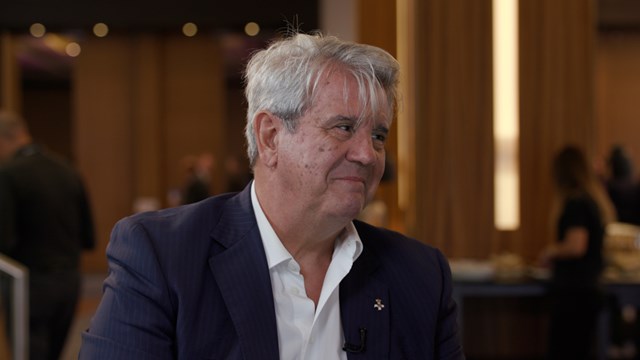
Fabrizio Campanale, VP Network Operations, TV & In-Home Engineering, Sunrise
Talking to TelecomTV at the recent FutureNet World 2026 event in London, Fabrizio Campanale, VP of network operations for TV and in-home engineering at Sunrise, discusses the potential of demand-driven networks, the fruitful combination of AI and telemetry data, the current state of agentic AI in telecom operations and more.
Recorded April 2026
Email Newsletters
Sign up to receive TelecomTV's top news and videos, plus exclusive subscriber-only content direct to your inbox.