Rakuten Mobile’s AI chief talks data, automation and ANTA

By Ray Le Maistre
Jun 26, 2026
To embed our video on your website copy and paste the code below:
<iframe src="https://www.youtube.com/embed/LxOPqH0k-nk?modestbranding=1&rel=0" width="970" height="546" frameborder="0" scrolling="auto" allowfullscreen></iframe>
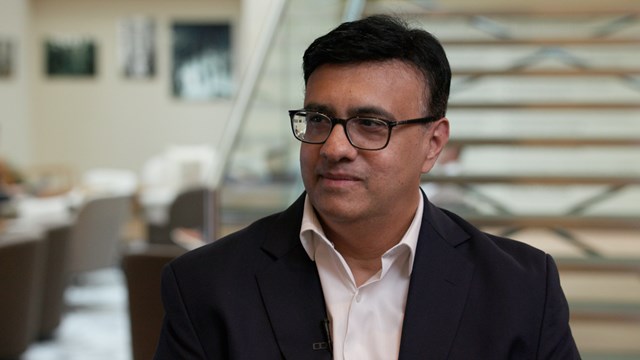
We're in Copenhagen at DTW Ignite 2026. I'm here with Sachin Verma. He is Chief Data and AI Officer at Rakuten Mobile. Sachin, thanks so much for joining us today. Great to see you. Now, before we get into the topic of AI, data, et cetera, can you just tell us about your role at Rakuten Mobile? What exactly are you responsible for on a day-to-day basis?
Sachin Verma, Rakuten Mobile (00:31):
So within Rakuten Mobile, it's more of an ecosystem play that we have. We have a larger responsibility in how we make use of data and AI for the benefit of the business. I think that's what I'm here to ensure — how we can make use of data and the insight from it to drive meaningful business outcomes and create value for our customers.
Ray Le Maistre, TelecomTV (00:52):
Now, using data at a group level has always been a very big thing for Rakuten and Rakuten Mobile. And of course, Rakuten Mobile is in an almost unique position in the industry as a major recent greenfield operator. Does this mean you've had machine learning embedded in all of your operations right from the very beginning?
Sachin Verma, Rakuten Mobile (01:13):
Being the last entrant in the market, we didn't have any baggage unlike existing operators. So we started off as a pure player — a 4G, 5G player — and we had an opportunity to pick up a stack which is completely software-based. And that means that once you have a software stack embedded into it, AI comes as a default. And that helps you to drive a lot of efficiency and operational ease for us to go and drive those autonomous networks as we talk of. A lot of the other players in the telecom domain see Rakuten as a mobile player — while that's true, that's the last business that we entered into. We have 70-plus businesses across all facets of people's lives, starting from e-commerce, fintech, travel, securities, payments, and communications as a piece.
(02:11):
So that brings us that entire ecosystem value which we can drive. And with the mobile insight, it makes a lot more meaningful sense for us.
Ray Le Maistre, TelecomTV (02:15):
Okay. So it's almost like a horizontal approach across the group then — data and everything working together. Is that how you look at it?
Sachin Verma, Rakuten Mobile (02:23):
That's true. So I think if we look at the value that e-commerce brings, Rakuten has almost 45 to 46 million monthly active users every month. And we have first-party data for those customers. And when you marry this first-party data with mobile data, there's a lot of richness which comes into it. And that richness drives a lot of personalisation and, I should say, targeted benefits which we are able to offer to our customers. So I think that's the value that we bring in by combining the power of mobile with the ecosystem services that we talk about.
Ray Le Maistre, TelecomTV (03:05):
Now, you mentioned the autonomous network briefly, and that is a really big topic in the industry and here at DTW. To what extent do you think autonomous network operations are a reality? Is it really possible? A lot of operators are talking about operations with limited human intervention — Level 4. They talk about it a lot, but few are talking about completely zero-touch operations, which is a sort of Level 5 according to the TM Forum's guidelines. What do you think is actually possible in telecom networks?
Sachin Verma, Rakuten Mobile (03:46):
So before I answer the question on the level of autonomy, let's first look at the market reality today where we sit. As telecom operators become more of a utility, the margins are shrinking, the cost base is going up, and revenues are almost flat, with reducing ARPU in some of the markets that we see — at least in the established markets. So for them to become more profitable with each passing year, they need to bring some efficiency, and AI is the right sweet spot which helps you to drive that. We've been working on autonomous networks and operations for quite some time, and very recently we have filed a nomination for some of those categories, and we are close to Level 4 at this stage.
(04:43):
I think reaching Level 4 and eventually moving to Level 5 is not something which is an option. This is a need of the market and the need of the industry at this stage.
Sachin Verma, Rakuten Mobile (04:47):
If you need to improve your margins and improve profitability, you need to reduce costs — and how do you do it? This comes in very handy. So that's the first point. The second question that you asked specifically — on whether it is feasible — it is definitely doable at this stage. And what we've experienced is that with a small amount of human-in-the-loop, and as confidence in the technology grows, this can definitely move towards a fully autonomous state. But that's a journey that you have to travel. So you start from whatever maturity level you sit at and then eventually move towards the Level 5 state. So it's something which is very much achievable. A lot of telecom companies are well on their path to achieve that state, perhaps at different maturity levels based on their network and their past history.
Ray Le Maistre, TelecomTV (05:33):
Yeah. And I'm sure we'll hear a lot about it over the next few days as well. And another thing we'll hear a lot about is data and data management. And of course that's at the heart of all of this. How does Rakuten Mobile decide which data is useful and how it's processed to make the most of it?
Sachin Verma, Rakuten Mobile (05:56):
So I think when we look at data, there are two pieces which are very important to us. One is the consent and the privacy of the customers. So how do we go and build the framework wherein the data is handled with the utmost priority and utmost care, so that we don't have any leakage or any exposure of customer data from a privacy perspective. So we have a very strong framework of consent management and data handling — who has access to what. So that's one portion of it. The second portion is that, given the enormity of data and the type of data that we get on the network, we make a decision as to what extent it can be combined with other sources of information to derive meaningful insight.
(06:46):
For example, let me give you one example. We have a business called Rakuten Pay. Rakuten Pay has a payment wallet system, and at an aggregated level we identified which areas within Japan are being served, and where mobile payment from a competitor is heavily used but there is no usage of Rakuten Pay. Combining this information and passing it on to the payments team so that they can reach out to those areas and improve usage of Rakuten Pay is one example. While we take care of all the privacy and consent of the customer, nothing is identified at an individual customer level — it is all at an aggregated and anonymised level. So that helps us drive decisions. There are many similar examples across e-commerce, insurance, and card fraud, which happens on the banking and card side.
(07:41):
At a network level, you're able to identify the early signatures of fraud far more quickly than on the bank side. So our ability to detect and then avoid and reduce fraud is something that we make decisions on. It is largely based on customer data, consent, and the business use case it supports. So that helps us to drive and process the data.
Ray Le Maistre, TelecomTV (08:04):
I mean, there must be so much data at your fingertips coming from lots of different sources. Are different groups within Rakuten Mobile and even the wider Rakuten Group using different types of data in different ways? Are there lots of different ways for data to be analysed, selected, and used within the group?
Sachin Verma, Rakuten Mobile (08:30):
Yeah, so that's how it happens. There's a separate team who has access to their own data. Within Mobile, my team has access to the mobile data and then we generate those insights, which are then consumed to identify targeted use cases. Yes, we get enormous volumes of data — I believe we have almost 20 petabytes of data, and we have the highest consumption from a customer perspective. Data per user — we are almost by far the highest among the three leading operators. So obviously we get a huge digital footprint from our customers, which helps us to bring out more value for them and give them differentiated service offerings from the group companies as well.
Ray Le Maistre, TelecomTV (09:11):
Now, you've already mentioned a couple of different parts of the Rakuten Group in addition to Rakuten Mobile. And I know a big focus of the group is customer loyalty and enabling a digital lifestyle. How does that approach and that overarching strategy impact your AI strategy and your AI plans? Does it make it very different from, do you think, the way that other mobile operators are thinking about AI and their data management strategies?
Sachin Verma, Rakuten Mobile (09:40):
So I think that gives us a huge responsibility to generate meaningful insights for the group companies so that they can derive value from that. So obviously it adds a layer of extra responsibility to us, and hence our strategy is also aligned accordingly. While we are highly focused on making mobile make use of this data and become successful, we are equally focused on ensuring that growth happens not only at the mobile layer but at the group ecosystem level. What we've seen is that customers who join Rakuten because of the loyalty programme and then consume two or more services — the GMS actually increases from 1x to 5x if you consume two services, and if you consume three services, it moves to 10x and more. So that's the value that we see being driven. So it definitely adds a lot of business value for us to ensure that whatever insights are extracted from the data have a meaningful impact on the business of the group as well.
Ray Le Maistre, TelecomTV (10:47):
Okay. And sorry, what was that metric? Did you say GMS?
Sachin Verma, Rakuten Mobile (10:51):
Yes — the gross merchandising revenue that we are talking about.
Ray Le Maistre, TelecomTV (10:55):
Okay. And the more services people are using, the faster the return is growing on each one?
Sachin Verma, Rakuten Mobile (11:05):
Absolutely. So it helps us in two ways, actually. One, it helps the group to generate more revenue from existing customers. It also helps us to bring churn down from a mobile perspective. So if you are a mobile customer and you are also subscribed to, let's say, a card, a payment service, or e-commerce, the loyalty points that you earn can be used to pay your bill. As a result, churn also dramatically reduces if the customer is consuming more of the ecosystem services.
Ray Le Maistre, TelecomTV (11:32):
Okay, interesting. Now, of course there's a great deal of focus right now across all sectors and across the world on the security of AI, especially with recent developments around some new LLMs that have been tried and tested. So the security of AI is a really big deal. Do you think AI can be used in a totally secure way? Is it possible to create an environment where you can truly say this is going to be secure? I mean, the guardrails must be really difficult to put in place because AI is changing so quickly.
Sachin Verma, Rakuten Mobile (12:18):
Absolutely. So I think this is the right point and the right question that you asked. If you look at both the attackers and the defenders, they have these algorithms available at their disposal. So who wins the race? It is machine versus machine competing. Now in this case, while an attacker may look for only one single opportunity to breach, there's a bigger responsibility for the defender because he has to protect not one thing but the entire infrastructure, data, access, and everything else. And obviously both of them are making use of the technology to detect. So yes, it's an area that one should be focused on, but I feel there's an edge which a defender has to his advantage because he owns the infrastructure, he has access to the access controls, privileges, and identities that we are talking of, and he has access to the policies.
(13:12):
So I think there's better control with the defender. Now the question is, as you marry this information — from infrastructure footprint to logs, telemetry, and the traffic patterns which come in — how well you are able to make use of AI to identify the signatures, because these attack profiles are dramatically shrinking in timeframe, from days to hours and hours to minutes.
(13:36):
So how well you are able to adapt to this changing landscape — and that's where AI comes in, and that's where I said algorithm versus algorithm, it's a fair competition. So if we are able to adapt to these learnings, the newer sets of data streams which come through, and then protect accordingly, there's a way forward for us to make meaningful use of AI.
Ray Le Maistre, TelecomTV (13:56):
So it's really about having the right plan, process, and strategy in place — and I guess everybody knowing about it.
Sachin Verma, Rakuten Mobile (14:02):
Yes. But it is also about how you adapt to these pieces in the changing times — with all the telemetry, logs, and data that you have — and then identify those signatures beforehand and take preventive and protective action for the infrastructure and for access to our data.
Sachin Verma, Rakuten Mobile (14:18):
If you say that just because security and the technology is evolving one should be conservative and not make use of it, I think you'll be left behind. So it's better to have a cautious approach, but with eyes open and ears open, and get adapted to the changes of the time.
Ray Le Maistre, TelecomTV (14:36):
Now, obviously security is just one thing to think about in terms of AI, and the telecom sector right now has a lot of things to consider across various strategies. Because of that, we've seen the launch of ANTA — the AI-Native Telco Accelerator — and Rakuten Mobile is one of the founding operator partners at ANTA, along with Deutsche Telekom, Orange, Axiata, and other industry players. Why do you think this initiative is important, and how can ANTA help the industry? Is this all about collaboration and insight, and can ANTA help to improve that process and help to share information?
Sachin Verma, Rakuten Mobile (15:32):
Absolutely. So I think we strongly believe there has to be a body which governs the collective knowledge of what individual operators are doing. And we, being an open, cloud-native leading provider — specifically with the complete software-based architecture that we've deployed and our ability to consume these capabilities — believe we are much further ahead than other operators, and that the learnings could be equally shared with the rest of the industry for them to see and equally learn from what others are doing differently. So I think this framework and this consortium help us to collectively share the knowledge and experience from individual markets across the globe and then see how those best practices can be applied. So I think this is a very good forum for making, sharing, and learning — and then improving the state not just for us, but for all others as well.
(16:26):
And what we've deployed as a platform and a software stack at Rakuten Mobile is also coming through Rakuten Symphony for other operators to consume — what we have deployed, proven, and is running in our own environment.
Ray Le Maistre, TelecomTV (16:42):
Okay, excellent. Well, we're very glad to have Rakuten Mobile on board as a founding operator partner — great insights. And of course the more companies come together, the better the knowledge base will be, and that'll be very much exponential. We're already seeing a lot more interest from the industry even in the first 24 to 48 hours. So thanks to all our founding partners. And Sachin, thanks very much for joining us today here at TelecomTV. Great to talk to you.
Sachin Verma, Rakuten Mobile (17:10):
Thank you, Ray.
Please note that video transcripts are provided for reference only – content may vary from the published video or contain inaccuracies.
Sachin Verma, Chief Data and AI Officer, Rakuten Mobile
Speaking at DTW Ignite 2026 in Copenhagen, Sachin Verma, chief data and AI officer at Rakuten Mobile, explains how the Japanese operator fits into, and engages with, the broader Rakuten Group digital portfolio, the road to Level 4 autonomous networks and the security considerations associated with AI. He also discusses the important role that the recently launched AI-Native Telco Accelerator (ANTA) initiative, in which Rakuten Mobile is a founding operator partner, will play in the telecom sector.
Recorded June 2026
Email Newsletters
Sign up to receive TelecomTV's top news and videos, plus exclusive subscriber-only content direct to your inbox.