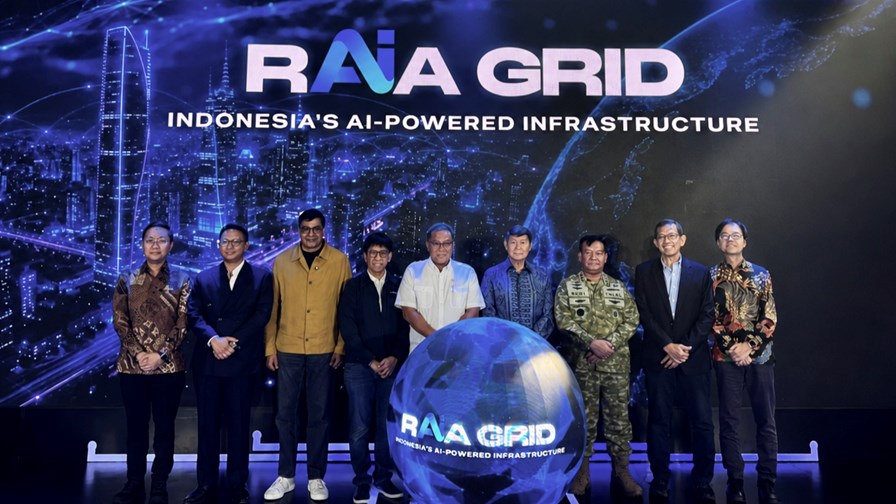
Industry executives including IOH's president and CEO Vikram Sinha (third from the left) line up to launch the RAIA Grid.
- Indonesia has a new AI-powered national fibre network
- Telefónica lines up insurance arm sale
- Elon Musk’s SpaceX to use Nvidia CPUs on earth and in space
In today’s industry news roundup: The RAIA Grid will act as a wholesale fibre backbone across Indonesia, with IOH as its anchor customer; the divestment of non-core operations looks to be continuing at Telefónica; SpaceX is to use Nvidia’s chips for AI workloads on the ground and, according to Elon Musk, in orbiting datacentres from as soon as next year; and much more!
PT Infra Fiber Teknologi (IFT), the 86,000 kms wholesale fibre network operation formed earlier this year by Indosat Ooredoo Hutchison (IOH) and Arsari Group, has dubbed its infrastructure operation RAIA Grid as it aims to meet the next-generation digital networking needs of the world’s fourth largest country (by population). IOH spun out its subsea and long-distance fibre assets into IFT in return for 11.7tn rupiah ($660m), which it is investing in its 5G and AI infrastructure rollouts – including its AI factory joint venture, Zankore – but it’s clear that the RAIA Grid will play a key role in connecting IOH’s fixed, cellular and datacentre assets as the operator pushes ahead with its AI-native telco plans, which include the deployment of AI-RAN infrastructure and the adoption of the ‘AI grid’ architecture being pitched by Nvidia. RAIA Grid is being pitched as a “digital superhighway for Indonesia,” offering wholesale national (and international) connectivity services to radio access network, fibre-to-the-home (FTTH) and datacentre operators, as well as enterprises. “RAIA Grid’s role extends beyond moving data from one point to another. By connecting data centers, cloud platforms, businesses and AI infrastructure, it creates the pathways for digital capabilities to interact and scale across Indonesia,” the wholesaler noted, adding that it is adopting an AI-native approach by “embedding machine learning, artificial intelligence and agentic AI into how its infrastructure is planned, deployed and operated, making it an AI-powered infrastructure platform by design.” IOH’s president and CEO Vikram Sinha stated: “The opportunity ahead is bigger than connectivity… By bringing together RAIA Grid, Indosat and Zankore, we are connecting the critical layers needed to make AI more real, scalable and accessible across Indonesia. This convergence allows us to move beyond connecting infrastructure to connecting intelligence, creating new opportunities for businesses, industries and people.”
Telefónica has opened talks with potential buyers over a €100m deal for its insurance business, as part of the Spanish telco’s efforts to simplify its operations. Spanish news group El Economista is reporting that German insurance giant Allianz has emerged as a potential buyer for Telefónica Seguros, with the likes of AXA, Generali and Zurich also being linked to a potential deal. Seguros, which was launched in 2004, offers insurance cover for mobile phones and other devices through Telefónica’s operations in Spain, Germany and the UK. Headquartered in Spain, the insurance operation already works with Allianz to offer home insurance to its customers (they also both have a stake in German fibre company UGG). As part of its ongoing rationalisation strategy, the Spanish telco has already offloaded several units in Latin America, raising billions of euros that has been used to reduce the size of its debt pile.
SpaceX is partnering with Nvidia to deploy the chipmaker’s Vera CPUs to power its next generation of agentic AI applications. SpaceXAI – the AI division of the space company that also owns Starlink – said it will expand the infrastructure of its AI chatbot Grok using Nvidia Vera Rubin, the chipmaker’s next-generation datacentre platform. But it also revealed plans to extend the partnership as part of SpaceX's plans to launch datacentres in space to handle AI workloads. An optimised version of Nvidia Vera Rubin NVL72 will be used in SpaceX’s first Starmind AI satellite, according to this Nvidia announcement. It comes as SpaceX founder Elon Musk made more bold claims about the company’s ambitions. Not content with pledging to dominate the US telecommunications market, Musk posted an update to X, the social media platform he also owns, to reveal plans to deploy “up to” 1 million orbital datacentres that will manage AI workloads, promising launches as early as the fourth quarter of 2027. "SpaceX, in partnership with Nvidia, has designed a space-optimized Vera Rubin NVL72 system for launch to orbit in Q4 next year, with significant scale in 2028," noted Musk.
Huawei has struck a global patent cross-licensing agreement with PC-maker HP that covers a number of technologies, including licenses for the Chinese vendor’s Wi-Fi patents. Neither firm disclosed financial terms for the agreement, which comes after the two companies resolved a patent dispute over wireless networks IP last year. The multi-year global agreement is a “standard-essential patent license covering Wi-Fi technology, is not new, [and] does not represent a broader strategic or commercial relationship, partnership, or collaboration with Huawei,” HP noted in a statement reported by CNBC, and does not represent a broader strategic relationship. Huawei has been blacklisted by the US since 2019, which has limited its ability to work with US suppliers. It follows legal action heard by Europe's Unified Patent Court over access to a pool of more than 2,000 patents related to wireless network connectivity that involved both HP and Huawei, through its involvement in joint licensing platform Sisvel WiFi 6. The latest global cross-licensing agreement includes “valuable reciprocal patent rights from HP,” lawyer Steven Geiszler, who represented Huawei in the negotiations, said in a statement.
The US National Telecommunications and Information Administration (NTIA) has approved its last Broadband Equity, Access, and Deployment (BEAD) Program Final Proposal, “completing approval of all 56 state and territorial BEAD Final Proposals – a major achievement in ensuring broadband availability across the country,” it announced. BEAD is the $42.45bn federal grant program that “aims to connect every American to high-speed internet by funding partnerships to build infrastructure”. Arielle Roth, assistant secretary of commerce for communications and information and NTIA administrator, stated: “BEAD’s core mission is to ensure universal broadband availability across our country. With all 56 Final Proposals now approved, we are achieving Congress’s vision of closing the digital divide once and for all,” she added. Now the authorities in the 50 US states, five US territories and Washington DC need to strike deals with the ISPs that will build the access networks.
Vivo, the Brazilian arm of Telefónica, has launched what it calls an Agentic SOC (security operations centre) underpinned by Cortex XSIAM technology provided by Palo Alto Networks, the operator noted in this press release (in Portuguese). “The initiative integrates artificial intelligence agents into the company's operations to enhance threat prevention, detection, and response capabilities amidst a landscape characterized by the increasing sophistication of cyberattacks and the complexity of digital environments,” noted Vivo. “The new model combines Vivo’s expertise in managing cybersecurity services – which currently protect over 130,000 corporate clients – with advanced technologies such as Managed Detection and Response (Unit 42 MDR), Extended Detection and Response (Cortex XDR), and Threat Intelligence. It also incorporates automation and agentic response capabilities driven by Cortex XSIAM, along with comprehensive cloud security features from Cortex Cloud and the full capabilities of the Palo Alto Networks portfolio,” added the operator.
Only days after announcing a strategic partnership with Tata Consultancy Services (TCS), Vodafone Business (the enterprise services arm of UK telco VodafoneThree) has unveiled a partnership with another major systems integrator, Tech Mahindra, to “help UK organisations accelerate digital transformation and adopt emerging technologies.” The partnership “combines Vodafone Business’s enterprise and digital infrastructure with Tech Mahindra’s AI-led transformation, integration, engineering and managed services expertise,” noted the operator.
– The staff, TelecomTV
Email Newsletters
Sign up to receive TelecomTV's top news and videos, plus exclusive subscriber-only content direct to your inbox.