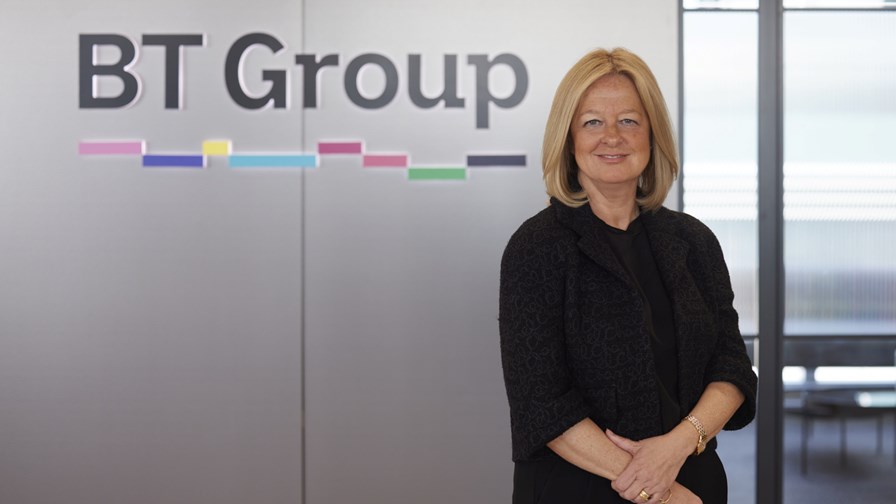
BT Group CEO Allison Kirkby © BT Group.
- BT plots low-cost mobile brand
- VodafoneThree merger delivering ‘tangible benefits’
- Nokia to modernise E.ON’s network in Germany
In today’s industry news roundup: In a bid to challenge rising competition from MVNOs, BT is reportedly planning to launch a low-cost mobile brand; early network sharing between Vodafone and Three is already improving connectivity in the UK and is expected to boost coverage and 5G experience significantly for both user bases; Nokia secures a five-year deal to modernise E.ON’s German telecom network, improving automation, efficiency and sustainability, with plans to extend the model across Europe; and much more!
UK-based telco BT returned to the mobile services market back in 2016 when it completed the acquisition of EE in a £12.5bn deal. Since then, it has turned EE into its flagship consumer brand, while the BT brand does the heavy lifting in the business-to-business (B2B) segment and Openreach concentrates on building infrastructure. The group also operates a “value brand” in the form of Plusnet, although the latter now only provides no-frills broadband services after it axed its mobile offering. That leaves EE as the group’s only mobile brand, with a focus on the premium segment. According to a report in the Financial Times (subscription required), BT is now exploring the launch of a low-cost mobile brand in order to combat the growing number of new mobile virtual network operators (MVNO), including Revolut and Monzo. BT rivals Virgin Media O2 (VMO2) and VodafoneThree already offer low-cost mobile services via sub-brands, such as O2’s Giffgaff, Vodafone’s VOXI and Three’s Smarty. Citing sources close to the matter, the FT said BT is understood to be considering options including creating a new brand or buying an existing MVNO. Notably, BT CEO Allison Kirkby has indicated that she favours a multi-brand approach in order to target customers with tailored service propositions. The FT report added that BT consumer chief Claire Gillies and others also believe BT must compete in all segments of the market to remain competitive. In May, Kirkby also confirmed that the BT brand “will be reinvigorated”. It’s understood that the older, more traditional brand will be increasingly used to drive consumer broadband sales among customers unimpressed by upstart brands such as EE.
Meanwhile, the UK market has certainly undergone significant structural change following the formation of VMO2 in 2021 and the recent merger of Three and Vodafone. A new report from network analytics company Opensignal has provided some analysis of VodafoneThree’s network integration efforts thus far, and has found that early network sharing is already bringing “tangible benefits for millions of users – from broader reach to faster, more reliable connectivity”. According to Opensignal’s data, once full integration is completed, Three users are expected to see around a 13% improvement in ‘coverage experience’, while Vodafone users will see a 7% increase. “For 5G coverage experience, the uplift is projected to be much greater – a 92% improvement for Vodafone users and 7% for Three users”, the company said. Opensignal attributes much of the improvements to the deployment of multi-operator core network (MOCN) technology, which it notes allows customers of both operators to connect automatically to whichever mast provides the stronger signal. “This means that in parts of the network where MOCN is enabled, users gain access to additional network resources, immediately improving coverage and reliability”, it explains.
Highlighting the growing importance of enterprise deals for vendors as well as telcos, Nokia has won what it describes as a “strategic contract” with European energy group E.ON. The five-year agreement starts in Germany and will see the Finland-based vendor modernise E.ON’s “mission-critical communications infrastructure”. The aim is to create an “optimised, highly automated telecommunications network for distribution system operators (DSO)” that is designed to reduce energy consumption by up to 50% compared to current network usage. Nokia notes that E.ON’s distribution grid in Germany connects 1.4 million renewable energy plants, “hence making the performance, flexibility and sustainability of its communications infrastructure critical. A key pillar, among others, is the IP, optical and fixed access part of its DSO telecommunications network”. Nokia will provide next-generation networking solutions to E.ON, including IP routing and switching, optical transport, fixed broadband access (XGS-PON) and network automation solutions. The plan is also to use the Germany model for other E.ON affiliates in Europe. Lars Ramelow, head of supply chain, grid communication infrastructure at E.ON Group, said modernising the network and “harmonising our technical infrastructure is a crucial move to ensure E.ON Group continues to deliver secure, reliable and energy-efficient services across Europe. We’re investing in a next-generation telecommunications network that is ready for future demands operationally, technologically and environmentally. Nokia is a trusted long-term supplier, and its ability to support our network makes it the right choice as we scale our digital transformation”.
Staying in Germany, it is being reported that Deutsche Telekom (DT) and AI technology giant Nvidia are preparing to announce previously touted plans for a €1.2bn datacentre in the country. According to Bloomberg (subscription required), the facility will be based in Munich and software giant SAP is being lined up as a first major customer. DT has already signalled its intention to play a major role in developing an AI Gigafactory in Germany to “support industrial AI workloads for European manufacturers”. Nvidia has become a key partner for DT in fields such as AI and the sovereign cloud, and has wider aims to become an indispensable vendor and partner to the telecom network operator community. At Gamescom 2025, DT announced plans to launch a new 5G+ gaming offering with Nvidia from autumn 2025.
Speaking of AI infrastructure, Qualcomm has announced a collaboration with Humain, the new Saudi AI infrastructure and services company launched in May this year. The aim of the agreement is to deploy “advanced AI infrastructure in Saudi Arabia” in order to offer “global AI inferencing services and be the world’s first fully optimised edge-to-cloud hybrid AI”. The initiative is said to be a follow up of an announcement made by the two companies at the US-Saudi Investment Forum in May. Starting in 2026, Humain is targeting 200 megawatts of Qualcomm AI200 and AI250 rack solutions, “to deliver high-performance AI inference services in the Kingdom of Saudi Arabia and globally”. Tareq Amin, the former CEO of Rakuten Mobile and its cloud platform and Open RAN-focused vendor offshoot Rakuten Symphony, was appointed CEO of Humain in December 2024 after a brief stint at Aramco Digital. He declared that combining Humain’s regional insight and full AI stack capabilities with Qualcomm’s semiconductors technology “will enable Saudi Arabia to lead the next wave of global AI and semiconductors innovation”. That’s quite some claim. Cristiano Amon, president and CEO at Qualcomm, added that the establishment of advanced AI datacentres will help Saudi Arabia to “create a technology ecosystem that will accelerate its AI ambitions of becoming a hub of intelligent computing”. For more details, see this press release.
– The staff, TelecomTV
Email Newsletters
Sign up to receive TelecomTV's top news and videos, plus exclusive subscriber-only content direct to your inbox.