T-Mobile US covers its broadband bases, invests $2.7bn in fibre JVs

By Ray Le Maistre
Apr 29, 2026
- T-Mobile US is expanding its broadband reach
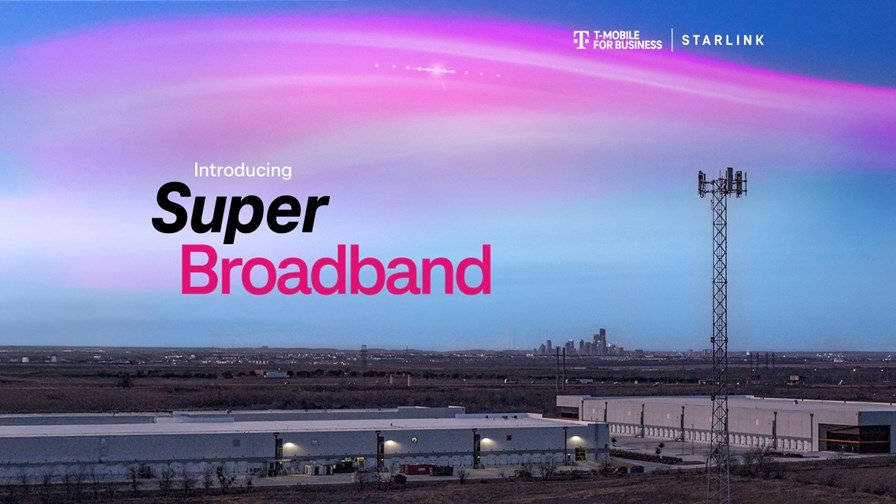
- It is offering a new ‘SuperBroadband’ service to business customers that combines 5G FWA and Starlink satellite connectivity
- It is investing $2.7bn in fibre-to-the-premises joint ventures
- The news comes as the ‘un-carrier’ announces first-quarter results
T-Mobile US is continuing its expanded reach into the broadband infrastructure and services sector with a number of key initiatives that aim to give it more fibre infrastructure firepower, courtesy of $2.7bn in joint venture investments, and make it a more attractive option to American businesses that need assured internet connectivity wherever they’re located.
For the enterprise sector, T-Mobile US has leveraged its existing relationship with low-earth orbit (LEO) satellite operator Starlink to launch SuperBroadband, a service that combines the telco’s fixed wireless access (FWA) broadband connectivity enabled by its 5G-Advanced network with the satellite broadband connectivity delivered via Starlink’s constellation.
The idea is that if either service is unavailable, then the other one will be, enabling round-the-clock broadband connectivity to any number of locations anywhere in the US through one contract and with “defined service levels, a financially backed 99.99% uptime guarantee and end-to-end support from T-Mobile for Business.”
T-Mobile US claims that SuperBroadband is “the first nationwide broadband solution to reach every ZIP code in the US” by providing businesses with “the ultimate redundancy [of] two independent pathways – 5G and Starlink – [that] work together to keep organisations online through virtually all outages and disruptions.”
It’s a smart pitch, as it combines a well regarded and already popular FWA service with a satellite broadband option that is receiving plaudits for its availability of data throughput (this isn’t the flakey and expensive satellite broadband of old).
T-Mobile US is also further developing its fibre broadband portfolio, for which it uses the brand T-Fiber, with the formation of two fibre-to-the-premises (FTTP) joint ventures that will boost the operator’s fibre broadband reach through a series of acquisitions.
The telco is investing $2bn to take a 50% stake in a joint venture with private equity firm Oak Hill Capital, with the deal set to be completed during the first half of 2027. That joint venture will take control of two of Oak Hill’s existing FTTP portfolio companies, GoNetspeed and Greenlight. These fibre internet service providers (ISPs) have operations across the northeastern US, with a current presence in states including Connecticut, Maine, Maryland, Massachusetts, New Jersey, New York, Pennsylvania and Rhode Island. Between them, GoNetspeed and Greenlight are expected to reach more than 1.3 million homes with their fibre access networks by the end of this year.
In addition, the telco is pumping $700m into a joint venture with infrastructure investment firm Wren House, with the deal set to close in the second half of this year. Once completed, the JV will take control of i3 Broadband (currently owned by Wren House), an ISP that is building out its network in Missouri, Illinois and Rhode Island and which is set to reach about 500,000 premises by the end of this year.
André Almeida, chief broadband, enterprise and emerging business officer at T-Mobile US, stated: “These partnerships are about expanding access to high-performance fibre for more customers. We’ve built strong momentum in fibre, and these JVs allow us to scale faster by combining leading fibre operators with T-Mobile’s brand, distribution and customer experience to meet growing demand for fast connectivity options.”
These latest moves build on last year’s acquisition of fibre broadband operator Metronet, another deal conducted by a joint venture, on that occasion between T-Mobile US and private equity giant KKR.
All of this activity came as T-Mobile US reported its first-quarter financials. The operator reported an 11% year-on-year increase in service revenues to $18.8bn while its adjusted earnings before interest, taxes, depreciation and amortisation (EBITDA) grew by 12% to $9.2bn.
The company noted in its first-quarter commentary that it added about 500,000 broadband customers during the quarter, which would take its total to about 8.5 million.
- Ray Le Maistre, Editorial Director, TelecomTV
Email Newsletters
Sign up to receive TelecomTV's top news and videos, plus exclusive subscriber-only content direct to your inbox.