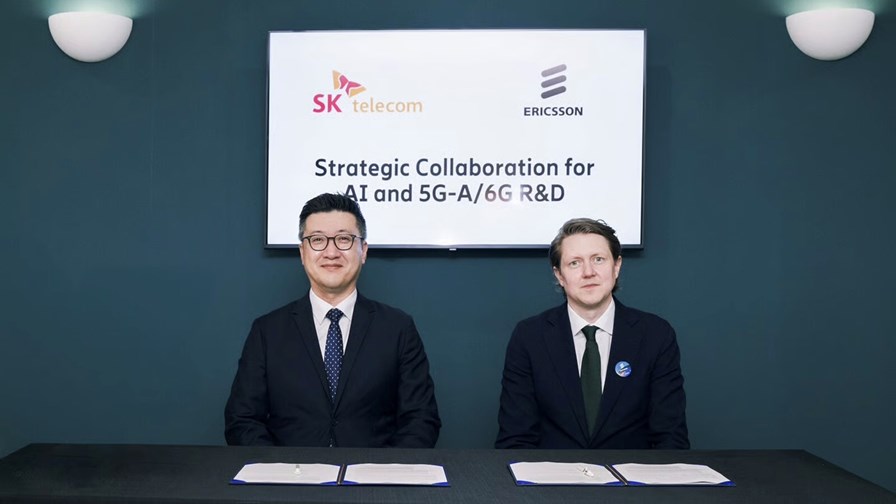
SK Telecom's Yu Takki (left) and Ericsson's Mårten Lerner wait for the ink to dry on their MoU.
- SK Telecom recently outlined its 6G aspirations in a pre-MWC26 whitepaper
- Ericsson rocked up to the Barcelona event with claims of a 6G world first
- Now the two have teamed up to collaborate on making 5G better and paving the way for secure, open and AI-powered 6G
The telecom sector’s big hitters are getting ever more serious about their 6G aspirations and forging key relationships in the run-up to what is likely to be a mad rush for industry ‘firsts’ over the next few years.
MWC26 witnessed a number of significant 6G-related announcements and now comes the news that SK Telecom and Ericsson, which has already boasted a 6G world first, have agreed to collaborate on the best way to make the most of 5G and pave the way to a smooth introduction of 6G using AI-enabled, open tech systems.
The companies have signed a memorandum of understanding (MoU) that will see them focus on “joint exploration, validation and potential commercialisation of cutting-edge network technologies” over the next five years. That final element could prove interesting – will we see the companies take co-branded networking technologies to market or even strike exclusive patent deals?
The companies say they will collaborate across a number of “key technology areas”, namely:
5G advancements: No detail here, just a plan to try to “unlock new business opportunities and enable next-generation services,” which is surely what every single operator around the world is trying to do. SK Telecom, you might recall, has been quite vocal in the past about how 5G has failed to live up to its promises.
AI-powered radio access network (RAN): The duo will aim to “enhance performance, security and energy efficiency by autonomously learning, predicting and optimising channel conditions, as well as managing resources more efficiently”. That’s vague enough that it could cover almost any aspect of AI in the RAN. It’s worth noting, though, that both Ericsson and SK Telecom are executive members of the AI-RAN Alliance, the industry body that was launched two years ago.
Open and autonomous networks: The aspiration stated here is to “improve productivity and operational efficiency, aiming to enhance productivity and operational efficiency in multi-vendor environments.”
End-to-end security: This is a topic that is very raw for SK Telecom, which is still recovering from the impact of the major cybersecurity breach that was unveiled last year and led to a change of CEO, though it is showing signs of recovery. The aspiration here is to develop capabilities “built on zero-trust architecture and continuous monitoring, providing stronger protection and real-time threat response across both 5G-Advanced and 6G environments.”
6G standardisation and future technologies: This includes “spectrum strategy, extreme MIMO evolution, energy efficiency, and integrated sensing and communication (ISAC). Through joint research, SKT and Ericsson aim to strengthen their global collaboration framework and secure a leading position in the 6G technology ecosystem, driving the evolution of next-generation AI-powered networks.”
All of this ties in with the 6G aspirations laid out by SK Telecom only weeks ago in its latest 6G whitepaper, which it dubbed ATHENA (AI native, Trust, Hyper-connectivity, opeN, Agility) – see SKT envisages 6G era AI-native telco operations.
SK Telecom’s head of network technology office, Yu Takki, stated: “Our collaboration with Ericsson will be a core engine propelling the evolution of AI-powered networks, paving the way toward 6G. Through research focused on global standardisation and real-world validation, we aim to secure world-class technological leadership in AI-powered network evolution and 6G.”
Mårten Lerner, head of networks strategy and product management at Ericsson, added: “We’re pleased to deepen our partnership with SK Telecom to accelerate AI‑powered RAN, 5G monetisation, open autonomous networks and zero‑trust security, while laying the groundwork for AI‑native 6G. Together, we’ll move rapidly from standards and trials to commercial solutions that boost performance, energy efficiency and security – strengthening South Korea’s leadership in next‑generation connectivity.”
The current momentum behind 6G-related developments suggests that we’re likely to see a great deal of activity ahead of 2030, when 3GPP specifications-based technology is set to be commercially available. Ericsson and SK Telecom say their joint efforts will result in “potential 6G commercialisation through 2031”, which can be interpreted any number of ways. Don’t be surprised if we see ‘6G deployments’ well ahead of 2030 and talk of pre-standards deployments ahead of July 2028, which happens to be when the Summer Olympics are due to be hosted in Los Angeles.
You can keep up to speed with key 6G developments in TelecomTV’s Defining 6G channel.
- Ray Le Maistre, Editorial Director, TelecomTV
Email Newsletters
Sign up to receive TelecomTV's top news and videos, plus exclusive subscriber-only content direct to your inbox.