To embed our video on your website copy and paste the code below:
<iframe src="https://www.youtube.com/embed/jaxezGlbXMw?modestbranding=1&rel=0" width="970" height="546" frameborder="0" scrolling="auto" allowfullscreen></iframe>
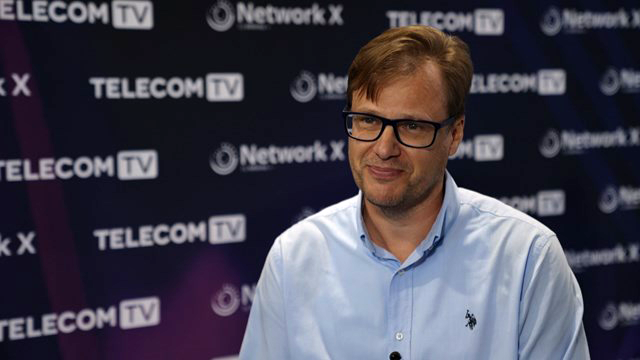
Welcome to TelecomTV. I'm James Pearce and I'm at DTW Ignite in Copenhagen. I'm delighted to be joined today by Refik Üstok, who is the Senior Architect for DOCOMO Euro-Labs. Thank you so much for joining us today.
Refik Üstok, DOCOMO Euro-Labs (00:17):
Thank you.
James Pearce, TelecomTV (00:18):
Why don't we start off by you giving us a breakdown about your role at DOCOMO Euro-Labs?
Refik Üstok, DOCOMO Euro-Labs (00:22):
Sure. I'm a Senior Architect as you said, and I'm representing DOCOMO Euro-Labs in the O-RAN Alliance and 3GPP SA5 as their standards delegate. I'm mainly focusing on network management and automation. I see my role as a bridge that is connecting the needs of our operations teams and Suzuki-san's teams to the required changes that we have to have in the standardisation. So pretty much a bridge that needs to handle the needs of our operations and address them in the standardisation.
James Pearce, TelecomTV (00:53):
Sounds like a really important role. Maybe you could talk us through how AI can be included in industry specifications, specifically when you consider how fast the technology is changing — how do we make sure standards can keep up with that?
Refik Üstok, DOCOMO Euro-Labs (01:06):
It's a very good question. I think it's important not to standardise the AI model itself, but the standardisation role should be enabling the required foundations, the frameworks, the required interfaces to enable the management of AI models — to make them interoperable, to make them trustworthy and governable by the operators, which we are hearing on the floor today all the time. I think the main role of standardisation is to enable the required tools to enable the management of AI at scale, to make them trustworthy, and also to enable innovation — not to stop or slow down innovation, but to enable innovation itself.
James Pearce, TelecomTV (01:48):
So let's talk about Open RAN. Maybe you could talk us through some of the major developments in O-RAN and also what the industry needs from groups like the O-RAN Alliance.
Refik Üstok, DOCOMO Euro-Labs (01:58):
I think we are seeing a lot of progress in the O-RAN Alliance lately. And also, as you know with Open RAN, it's still very important to have open interfaces to enable interoperability in the multi-vendor environment that many operators have. So this is still a key issue for us, but it's not the only issue. Now with the start of the 6G study, we are seeing a lot of new use cases introduced by operators to address AI at scale — the management of AI, to make it more transparent, to make it explainable. Everything that we are seeing on the floor here, we also see in the standardisation. And I see that we are progressing quite well and I have good confidence that we will manage to enable the required tools for operators to reach the autonomous networks level.
James Pearce, TelecomTV (02:48):
It still terrifies me a little bit whenever somebody mentions 6G, but we are very much on the road to that. Maybe you can talk us through the main considerations right now for 6G developments for operators such as NTT DOCOMO.
Refik Üstok, DOCOMO Euro-Labs (03:00):
I think for operators, it's important to be able to change AI's role from more advisory to actually taking actions. And we are now seeing AI at scale — enabling AI to take actions in the infrastructure, which is really critical, that everybody's lives depend on. But to do that, we need to overcome a lot of challenges. We need to understand and be able to troubleshoot AI if something goes wrong. So these are the things that we need to address in the standardisation. We are also seeing AI become more and more proactive rather than reactive. I think I heard on the floor today that somebody said the network should heal itself before customers feel the network changes. I think that's a really important concept and we should enable that through standardisation.
James Pearce, TelecomTV (03:58):
Is there anything else that you think we should look out for that's being discussed here, or that you are dealing with at DOCOMO Euro-Labs?
Refik Üstok, DOCOMO Euro-Labs (04:04):
Apart from the topics that we are hearing today on the floor, I think the main important points are the new services that we will introduce with 6G — with integrated sensing and communication, and immersive communication. So these new 6G services should be addressed, and to address them and enable the automation to manage these new services, I think we need the full support of the whole industry to come together, work together, and create the required standardisation.
James Pearce, TelecomTV (04:34):
It sounds like a really exciting time for the industry. Thank you so much for joining us today on TelecomTV.
Refik Üstok, DOCOMO Euro-Labs (04:39):
Thank you very much. It's a pleasure.
Please note that video transcripts are provided for reference only – content may vary from the published video or contain inaccuracies.
Refik Üstok, Senior Network Architect, Docomo Euro-Labs
Speaking at the recent DTW Ignite event in Copenhagen, Refik Üstok, senior architect at Docomo Euro-Labs and standards delegate to the O-RAN Alliance and 3GPP SA5, sets out the role that standards and specifications bodies can play in enabling AI at scale as work by the 6G technical study group continues and Open RAN specifications evolve. He argues that standards bodies should provide the frameworks, interfaces and tools needed to make AI models interoperable, trustworthy and governable without constraining innovation so that AI’s role can evolve from being advisory to taking actions, and notes that this shift will be needed to enable autonomous networks and to introduce new 6G services, such as integrated sensing and communication (ISAC) and immersive communication.
Recorded June 2026
Email Newsletters
Sign up to receive TelecomTV's top news and videos, plus exclusive subscriber-only content direct to your inbox.