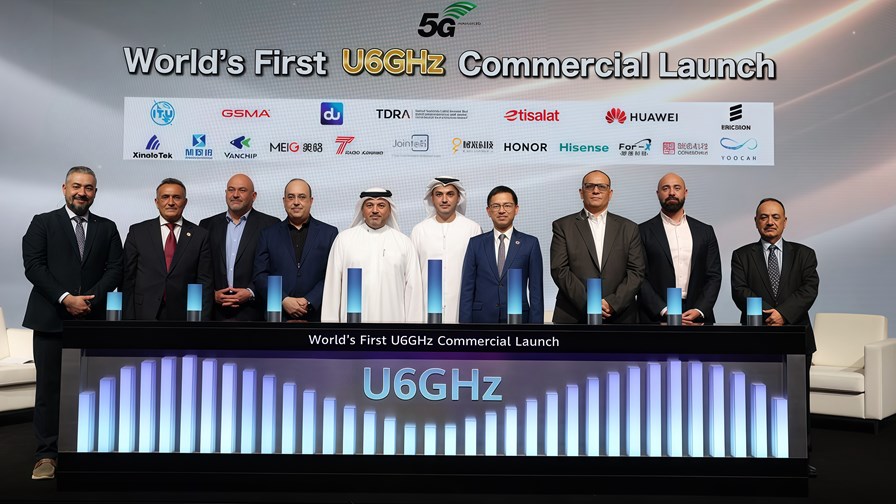
The Middle East is moving Upper 6GHz (U6GHz) from spectrum planning into commercial reality, with the UAE helping establish a model for how regulation, research and industry collaboration can accelerate mobile connectivity. The region’s first commercial U6GHz deployments are more than a milestone in network speed: they demonstrate how operators globally can leverage ultra-wide bandwidth and low-latency connectivity to support emerging digital services today while preparing for 6G.
For the Telecommunications and Digital Government Regulatory Authority (TDRA), the UAE’s progress reflects a coordinated approach to next-generation connectivity. Spectrum must be identified early to meet future connectivity demands; regulation must provide investment certainty; and research, operators and technology providers must work together to turn technical potential into networks. Upper 6GHz illustrates how these elements reinforce one another.
From Spectrum Policy to Deployment
The UAE laid the groundwork in November 2024, when TDRA’s updated National Frequency Plan included Upper 6GHz for International Mobile Telecommunications (IMT). The decision gave operators and technology providers a clearer framework for planning investment and developing advanced mobile capabilities. It built on the UAE’s role in supporting IMT identification at the 2023 World Radiocommunication Conference in Dubai.
The subsequent path has linked policy with engineering and commercial action. TDRA has worked with etisalat, du, Khalifa University and NYU Abu Dhabi on research and validation, while operators have tested U6GHz alongside existing C-band infrastructure. The objective is not simply to demonstrate headline speeds but to understand how the band can deliver high-bandwidth, low-latency connectivity in real-world networks.
The UAE’s first commercial U6GHz ecosystem marks a shift from technical exploration to implementation. etisalat announced a commercial network using 350 MHz of contiguous spectrum and advanced 256TRX RetinaMIMO technology, targeting peak downlink speeds of up to 10 Gbit/s. In a 6G MENA Summit pre-event article, etisalat said that this provides the high-throughput, low-latency foundation for AI-native network operations, autonomous industrial systems, and mission-critical applications. It also supports the UAE's digital economy agenda, as ultra-wide bandwidth and low-latency connectivity are essential to enabling AI-driven government services, smart cities and a digital-first economy.
du has also advanced live-network validation using existing site infrastructure. These developments provide a reference point for other markets considering their spectrum roadmaps.
Why U6GHz Matters
Demand for high-bandwidth mobile connectivity is rising as digital services become more data-intensive and AI applications expand. U6GHz offers a wide spectrum resource for 5G-Advanced, with the potential to support enhanced mobile broadband, high-performance fixed wireless access (FWA) and future AI-driven services. Its propagation characteristics are closer to existing C-band than millimetre-wave spectrum, making it attractive for urban deployments that require ultra-wide bandwidth, low latency and reliable connectivity.
UAE research and trials suggest U6GHz could be deployed alongside existing macro sites, rather than requiring an entirely separate network. Modelling by TDRA and academic partners found that, under the scenarios evaluated, outdoor coverage could remain within about 2–5% of 3.5 GHz C-band coverage. These findings highlight the potential for U6GHz to support high-bandwidth connectivity while leveraging existing mobile infrastructure. Actual results will depend on deployment conditions, spectrum assignments and device capabilities.
A Lesson for Operators Worldwide
Commercialising a new band requires more than allocating frequencies. Regulators need to provide clarity and predictable investment conditions; operators must match deployment to market demand; and the wider ecosystem.
In her keynote speech, Huawei Carrier Business CMO Judy Peng highlighted that the emergence of the Agentic Internet is fundamentally reshaping the requirements for communication networks. Traditional networks, designed for the mobile internet era, are no longer sufficient to support the demands of an AI-driven world.
Current mobile networks were built primarily to connect people. In contrast, Agentic Internet networks must simultaneously connect people, things, and billions of AI agents collaborating and interacting in real time. This shift is driving four fundamental transformations in communication networks:
Connected entities are expanding from people and things to people, things, and AI agents; network architecture is evolving from traffic-centric optimization to integrated computing-network orchestration; traffic patterns are shifting from predominantly downlink, north-south flows to AI-driven, uplink-intensive east-west interactions; and user expectations are advancing from best-effort connectivity to deterministic, end-to-end experience assurance.
This evolution is particularly significant for the Middle East, where ultra-large-scale AI campuses and digital economy initiatives are accelerating the demand for resilient, high-performance computing and network infrastructure to strengthen national competitiveness.
To address the requirements of the Agentic Internet era, the industry must build a new generation of AI-centric networks. Through continuous advancements in network technologies, capabilities, and architectures, mobile broadband (MBB), fixed broadband (FBB), and bearer networks will enable ubiquitous agent connectivity and seamless interconnection of computing resources, establishing the foundation for future communications infrastructure.
Among these innovations, U6GHz will play a pivotal role in MBB networks. With its ultra-wide bandwidth and low-latency characteristics, U6GHz is well positioned to support the explosive growth of Mobile AI services and unlock the next wave of intelligent connectivity.

Huawei’s contribution is part of this broader effort. Its U6GHz portfolio includes radio units using large antenna arrays and intelligent beamforming designed to enhance network performance and deliver high-bandwidth connectivity while seeking coverage comparable to C-band. Huawei is also working with Middle East operators on 5G-Advanced networks combining U6GHz with advanced antenna technologies and AI-centric network capabilities. These developments can help operators evolve existing infrastructure rather than treat each generation as a complete replacement.
In a panel discussion at the same summit, Eng. Saif Bin Ghalita, Executive Director of Technology Development Affairs at TDRA, stated, “In the case of Upper 6 gigahertz commercial knowledge, I would like to recognise an entity, Huawei Technologies, with whom the UAE has had more than 25 years of engagement. The company has always delivered on its commitments through R&D with equipment that is faster than others and all standards based. This kind of collaboration is the one that turns our missions into tangible progress.”
And the implications extend beyond the Gulf. Operators worldwide face the same questions: how to secure sufficient mid-band spectrum, deliver high-bandwidth, low-latency connectivity efficiently, support fixed wireless access (FWA) and AI-related traffic, and prepare for 6G. The UAE’s experience shows the value of connecting spectrum policy, research, commercial trials and ecosystem development in one roadmap.
U6GHz is not a standalone answer to every connectivity challenge. It is one element of a wider spectrum and network strategy – and a bridge from 5G-Advanced to 6G. By helping move the band into commercial service, the Middle East gives the global industry an early opportunity to learn what works, what must scale and how collaboration can turn spectrum potential into customer value.
Email Newsletters
Sign up to receive TelecomTV's top news and videos, plus exclusive subscriber-only content direct to your inbox.