Samsung boasts enhanced vRAN efficiency, targets 6G

By Ray Le Maistre
Jan 14, 2026
- Samsung is focused on making its virtual RAN (vRAN) deployments more efficient and less complex
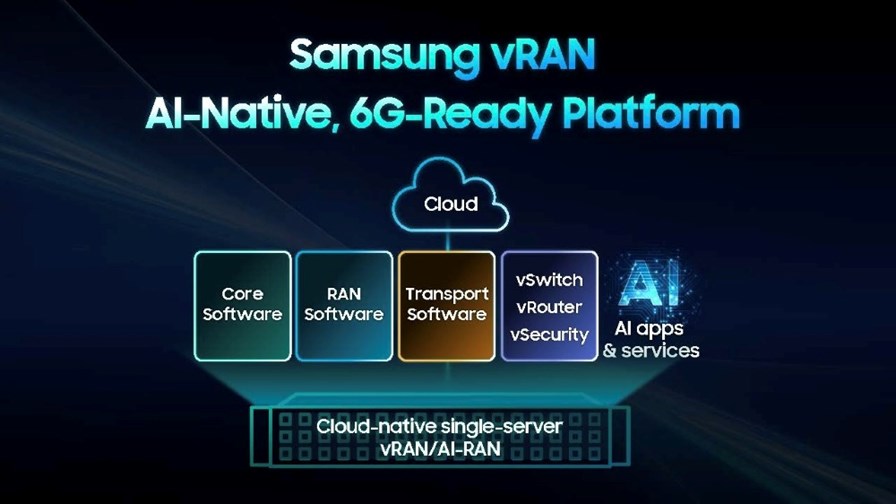
- It has used Intel’s latest SoC processor to enable a single server-based vRAN deployment for a major US telco customer
- The move is a further indication of the mobile network architectures that will support AI- and cloud-native 6G services
Samsung continues to position itself as a viable radio access network (RAN) infrastructure rival to market giants Ericsson, Huawei and Nokia with virtual RAN (vRAN) technology advances.
Conscious of outstanding questions related to the efficiency and complexity of server and cloud platform-based vRAN deployments, the South Korean vendor has announced the successful completion of a commercial call on a live, in-service Tier 1 US operator network. To do so, it used Samsung’s vRAN solution, running on a single HPE server powered by an Intel Xeon 6700P-B (6th generation Granite Rapids) system-on-chip (SoC) processor and Wind River’s cloud platform.
Specifically, the Intel Xeon 6 SoC boasts Intel Advanced Matrix Extensions (Intel AMX), Intel vRAN Boost and up to 72 cores, “delivering significant improvements in AI processing, memory bandwidth and energy efficiency compared to the previous generation,” noted Samsung.
“On a single server of Samsung’s AI-powered vRAN with enhanced processors, operators can consolidate software-driven network elements, such as mobile core, radio access, transport and security, which traditionally required multiple servers, significantly simplifying the management of complex site configuration,” noted the vendor, which boasts Verizon as its main US telco reference customer.
Cristina Rodriguez, VP and general manager of Intel’s Network & Edge division, noted: “With Intel Xeon 6 SoC, featuring higher core counts and built-in acceleration for AI and vRAN, operators get the compute foundation for AI-native, future-ready networks. This collaborative achievement with Samsung, HPE and Wind River enables greater consolidation of RAN and AI workloads, lowering power and total cost while speeding innovation.”
That “future-ready” element is important, as Samsung is looking ahead to the 6G era too with its latest RAN architecture developments.
June Moon, head of R&D at Samsung Electronics’ Networks Business, stated: “This breakthrough represents a major leap forward in network virtualisation and efficiency. It confirms the real-world readiness of this latest technology under live network conditions, demonstrating that single-server vRAN deployments can meet the stringent performance and reliability standards required by leading carriers. We are not only deploying more sustainable, cost-effective networks but also laying the foundation to fully utilise AI capabilities more easily and prepare for 6G with our end-to-end, software-driven network solutions.”
Experienced mobile infrastructure analyst Daryl Schoolar, director at Recon Analytics, noted: “This successful first call is an important milestone for the industry. By demonstrating multiple network functions running on next-generation processing technology, Samsung is showing what future networks look like – more cloud-native, more scalable and significantly more efficient. This achievement moves the industry beyond theoretical performance gains and into practical, deployable innovation that operators around the world can leverage to modernise their networks, accelerate automation and better support AI-driven use cases.”
- Ray Le Maistre, Editorial Director, TelecomTVis
Email Newsletters
Sign up to receive TelecomTV's top news and videos, plus exclusive subscriber-only content direct to your inbox.