To embed our video on your website copy and paste the code below:
<iframe src="https://www.youtube.com/embed/pi1sGvOT3ok?modestbranding=1&rel=0" width="970" height="546" frameborder="0" scrolling="auto" allowfullscreen></iframe>
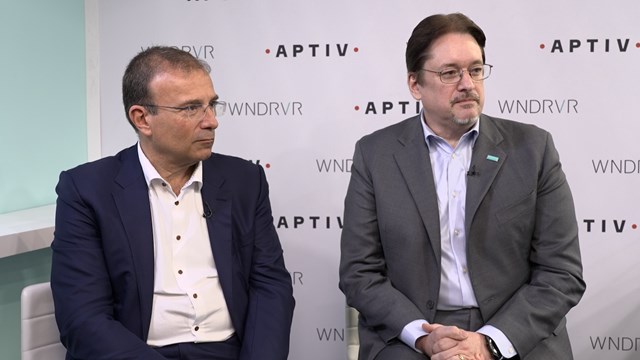
Thank you for joining us here in Barcelona for Mobile World Congress 2026, where we are going to discuss the collaboration between Vodafone and Wind River in light of recent announcements related to Spring 6 and general Open RAN deployment. We are joined today by Marco Zangani of Vodafone. Marco, you are Director of Network Strategy and Architecture, and Randy Cox of Wind River. Randy, you are Vice President of AI and Incubation at the company. Thank you for joining us.
Marco Zangani, Vodafone (00:39):
Thank you.
Charlotte Kan, TelecomTV (00:40):
Here in Barcelona. So first of all, Marco, Vodafone had the first Open RAN deployment in Europe. It was called a blueprint for success. And it means that Vodafone can now lift and shift it to other parts of its global footprint. And recently you announced your deployment in several European countries, starting with Germany, I believe. So tell us about the key drivers for this move.
Marco Zangani, Vodafone (01:08):
So Open RAN has been a strategic project that has been really developing in the company for many years. I think initially it was more to build an open ecosystem. So to have, let's say, plenty of suppliers, providing components of a very open architecture and having a wider ecosystem. But soon we saw that innovation was indeed a keyword in that because when you open interfaces, when you have an open system, you can tap into innovation from many companies. So creativity also coming from small companies, by ensuring that we have standardised interfaces so you can also avoid it. So it's a combination of opening the vendor ecosystem at the same time, tapping into innovation now on 4G and 5G. And in the future, it will be 6G that will benefit from that.
Charlotte Kan, TelecomTV (02:08):
And of course, Wind River played a key role in this deployment. Can you tell us a bit more about that and why you selected them again to work with you on this project?
Marco Zangani, Vodafone (02:17):
So absolutely. I think that having started very soon, we had also the time to test in our lab all the solutions end to end. We put a lot of focus on the container solution because for us it is key in determining automation and operational effectiveness. And of course we had a very good relationship with Wind River. Tests were very good. And also we ran a tender and they fared very well in the tender in a way that we selected them to be partners with other players. So Open RAN is an ecosystem. And when you deploy an Open RAN solution, you need to select vendors for the servers, the CaaS layer, the application. So it was a cooperative effort, Wind River partnered with other companies and they successfully got, let's say, the contract together with the others. So it is a mixture of good relationship and sound and solid testing campaign in the lab.
(03:22):
Also deployment in other countries, in other networks, massive deployment scale is very relevant and proving that the solution works in field in a scaled deployment was key. And also the fact that we have seen that they have a good roadmap for automation and operational effectiveness, which is key when you want to launch a new system with the new architecture.
Charlotte Kan, TelecomTV (03:51):
Yeah. Randy, give us your perspective on how you're supporting Vodafone in its Open RAN ambitions, let's say.
Randy Cox, Wind River (03:57):
Yeah. So first I just want to say thank you, Marco, for the business and being selected for Spring 6. It's a great honour to be part of your network. Yeah. So if I look at maybe why Vodafone, I share some of the thoughts around our collaboration with Vodafone. While you are our customer, you're also our partner and there's just been great collaboration. I think from our, what we're bringing to the table here for Vodafone is our maturity in the market. We have been commercial with our product in the field for five years now. We're up to about 100,000 cell sites globally where we're deployed with commercial traffic. And so the maturity in the product, I think is what Marco was expressing in terms of testing and validation, not only in their labs, but with our partners as well, with the partners or vendors that they had selected like Samsung, Dell and Intel.
(05:00):
We've done great work with them as well. And I think that has been advantageous to Vodafone.
Charlotte Kan, TelecomTV (05:08):
Well, let's have the perspective of the customers now, Marco. What will they gain from the network going to cloudified RAN in the next two, five, or even 10 years?
Marco Zangani, Vodafone (05:19):
Yeah. We expect to have a new, let's say, ecosystem being developed. So we have diversification on vendors. This is one of the objectives. The other very important is innovation. We know that when you have an open architecture with cloudified RAN, you can have new applications coming in the servers. And of course, with new applications and new, let's say, features being developed also in terms of optimisation and automation, you have, how can I say, a more efficient network. So energy saving or transmission components can be integrated, but also you have applications for optimisation based on AI. So AI will be a key feature for the future. So starting with machine learning for optimisation and in the future, having AI down into the network components for layer one. So link adaptation, we know that AI and machine learning apply to these processes at a low level. They can guarantee, they can allow the operators to have massive improvements in terms of capacity and performance.
(06:34):
And
Charlotte Kan, TelecomTV (06:35):
What about you, Randy? How do you expect the Open RAN deployment or market to evolve in the next two to 10 years?
Randy Cox, Wind River (06:42):
I think I share similar thoughts in that as the market and as we grow in this industry, I think for sure we're going to see fully virtualised networks over those 10 years. And I think what that's bringing to the market in terms of innovation, as you mentioned, Marco, we're going to be able to bring new capabilities to the far edge in a much faster way and a much simpler way. In addition to that, it brings in more innovation because we're able to bring that to market quicker, therefore that drives innovation into the network.
Charlotte Kan, TelecomTV (07:21):
Marco, finally, maybe to conclude this conversation, some advice you would share with your counterparts and other CSPs who are considering this cloud RAN technology move or big deployment.
Marco Zangani, Vodafone (07:34):
Yes. Clearly, I think it's important to focus on having a stable and high performance, high quality solution. So it needs to be operationalised in a way that it is the same level of performance and stability, operability as the traditional, let's say, radio products. And once you have done that, you can build on top of it to introduce new innovation, will be new applications, new features. In the future, it will be AI in the RAN, and this will be, let's say, also in preparation for 6G, where we know that the AI in RAN will play a big role. So it's like focus on opening a new ecosystem, industrialise that, so operationalise that in a way that it is very effective and in the way it is deployed and operated, and then preparing for the evolution, which will be 5G Advanced and 6G with a lot of AI integration.
Randy Cox, Wind River (08:37):
Yeah. I think as we look forward and we move forward in this space, I think the CSPs need to think about what that next generation network looks like. And as we move forward into fully virtualised networks, I look at it as what I call the three Ps for success. So product, process, and people. And all of those three things are going to have to transform as the network transforms. And so from my perspective, I think it's important for CSPs to get started as soon as possible because transforming those three Ps takes a while. And so why wait till 6G? Because we know that in 6G it's going to be a fully virtualised network. So now's the time to get started.
Charlotte Kan, TelecomTV (09:23):
Well, Randy, thanks to both of you for your insights and for telling us more about your collaboration and how it's helping accelerate Open RAN deployment. Many thanks to both of you, Marco and Randy.
Marco Zangani, Vodafone (09:36):
Thank you very much.
Please note that video transcripts are provided for reference only – content may vary from the published video or contain inaccuracies.
Marco Zangani, Vodafone Networks & Randy Cox, Wind River
At MWC26, Marco Zangani from Vodafone and Randy Cox from Wind River discuss their collaboration on Open RAN deployments, which aims to achieve a more open ecosystem that allows for the integration of AI in future network architectures. They examine the initial deployment in Europe, the selection process for partners, and the anticipated benefits of cloudified RAN for innovation, efficiency and performance in the telecom sector.
Featuring:
- Marco Zangani, Director of Network Strategy and Architecture, Vodafone Networks
- Randy Cox, Vice President, AI and Incubation, Wind River
Recorded March 2026
Email Newsletters
Sign up to receive TelecomTV's top news and videos, plus exclusive subscriber-only content direct to your inbox.