Private cloud returns to centre stage as AI and sovereignty drive IT strategy

By Charlotte Kan
Mar 20, 2026
To embed our video on your website copy and paste the code below:
<iframe src="https://www.youtube.com/embed/ucSbC1_isi4?modestbranding=1&rel=0" width="970" height="546" frameborder="0" scrolling="auto" allowfullscreen></iframe>
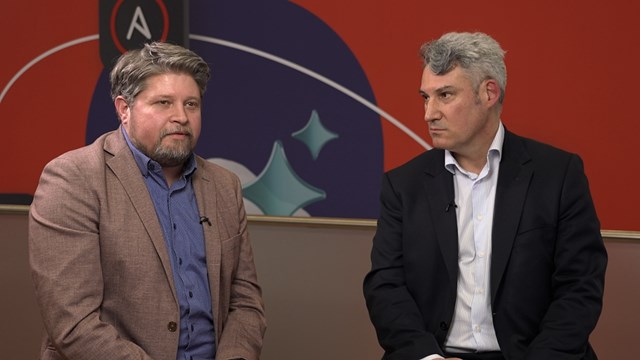
Hello and welcome to Mobile World Congress 2026. Today we are going to discuss a topic that is front of mind for CIOs and it is why private cloud is once again at the heart of IT strategy. To find out more, I am joined by Mike Barrett, Vice President and General Manager at Red Hat Hybrid Platforms, and Enrique Rodriguez, who is Vice President for Cloud in Iberia at Kyndryl. Many thanks to both of you for joining us.
Enrique Rodriguez, Kyndryl (00:36):
Thank you. Glad to be here.
Charlotte Kan, TelecomTV (00:37):
So tell us, and we will start with you, Mike. Why is private cloud once again becoming core and centre of IT strategy?
Mike Barrett, Red Hat Hybrid Platforms (00:45):
It is coming back. Like technology, it comes around for two main reasons. One is more exciting than the other. Let us start with the more exciting one: it is AI. When we are investigating AI, when we are incorporating it into our processes and our data, some of those processes and data need to be on-premises. They are private, they are intimate to how you make money as a business. So they want to hold that back out of the public clouds, out of multiple clouds, and they want it closer to themselves. So that is private cloud initiatives there. The other one is sovereignty. We have economies, we have businesses, we have governments, they are all reacting in a geopolitical way, which is really driving people to take their own digital identity back. We see a lot of people building data centres. We see a lot of people doing co-location.
(01:37):
We are at a telco conference. They are using a lot of the servers from their local telco provider to build out those infrastructures. So those are the two primary reasons, but this time around, it really is not a central data centre. It is edge. It is co-location. It is a variety of different things. So even though it is private cloud, it is still a hybrid cloud.
Charlotte Kan, TelecomTV (02:00):
Thank you, Mike. Enrique, modernising legacy systems is easier said than done, of course. So how do CIOs approach this without disrupting the business? How do you go about it?
Enrique Rodriguez, Kyndryl (02:11):
That is where hybrid cloud plays its role and becomes essential. Why? Because that way you can keep a dialogue between the legacy systems that you have on-premises with the applications you are moving to cloud. So maintaining that dialogue, applications talking to each other, and the recommended architecture is fundamentally to execute the migration without downtime and whilst keeping the performance and the reliability of the applications.
Charlotte Kan, TelecomTV (02:42):
That is a great metaphor, actually. Still talking the same language at some levels. Enrique, many telcos nevertheless are struggling with legacy virtualisation. So how does your partnership accelerate the exit?
Enrique Rodriguez, Kyndryl (02:55):
For us, it is the perfect combination between the deep knowledge, deep expertise of Kyndryl in technology, in consulting, in infrastructure services with Red Hat's leadership on open source platforms. So that combination works really well. The other thing is we do not just migrate everything. We start with automated processes, automated tools to determine which is the best destination for each application. Based on that, we decide either to retire the application, keep the application as it is today, or move it into the OpenShift environment.
Mike Barrett, Red Hat Hybrid Platforms (03:42):
It has been an interesting journey in the last five or six years with legacy virtualisation because I would say from 2020 to 2023, customers that were interested in getting off their existing legacy virtualisation wanted to do it in combination with containerisation. They admitted to themselves they would have more containers in the future than VMs, and they were very focused on that. 2023 hits and the world kind of decides that the price points they are getting from their legacy virtualisation just do not work with the economics of how they do business anymore. At that point, they wanted to aggressively migrate. So instead of modernise, they wanted to aggressively migrate. Right now, at the tail end of 2025 into 2026, we are going back to modernisation. So we are almost coming full circle in that journey. It has been quite a ride.
Charlotte Kan, TelecomTV (04:32):
I can imagine. Mike, earlier you alluded to the fact that with this fast development of AI that we are witnessing today, that changes the need and the need to switch to private clouds indeed. So how does a private cloud foundation enable telcos to move from AI-ready to AI-native?
Mike Barrett, Red Hat Hybrid Platforms (04:50):
I will tell a story. We are going through this ourselves because I have a product. I ship a product over the counter. You are a solution provider, system integrator. When we look at our product, we want to get agentic processes into that product. We are shipping to private data centres and public clouds, but it is not going to be the same AI infrastructure on every single cloud that we land on. Gemini will not be Azure. OpenAI will be different. Granite will be different. So we really needed to make sure the platform had the ability to work on any GPUs, house any model, have a world-class inference server in it. Having those features allowed us to then have agentic automations in the core of our product that would help you with observability, help you with the install, help you have a different, unique experience that is tailored to you through this AI interface.
(05:46):
So the answer is make sure that you are shipping a platform that has those components in it so that at any time you can take advantage of it.
Enrique Rodriguez, Kyndryl (05:53):
One thing we are using also in Kyndryl is we are using AI to manage the AI. For example, with Kyndryl Bridge, we are using advanced automation, advanced data through the AI to optimise the platform and always have the private infrastructure ready for heavy AI workloads.
Charlotte Kan, TelecomTV (06:17):
And Mike, as systems become more and more distributed, how do you maintain a consistent experience from the core to the cell tower?
Mike Barrett, Red Hat Hybrid Platforms (06:25):
It is a good one because this show is a lot about that. A lot of these stacks in the telco area are very vertical. You go and you get the top of the stack from the same vendor that is providing the hardware. A lot of our customers in this industry want to have a horizontal investment. They want to have multiple vendors living on the same infrastructure, and that is what Red Hat does. At this show, we announced a solution with Bell Canada, with Telefónica, with Vodafone Oman. They were all doing this concept of moving to a horizontal cloud.
Enrique Rodriguez, Kyndryl (07:03):
We are also helping the telcos to leverage that edge infrastructure by deploying third party applications in the same Red Hat infrastructure to help them to monetise the investment.
Charlotte Kan, TelecomTV (07:15):
To finish with, how about you telling us how you worked together to accelerate the adoption of private
Enrique Rodriguez, Kyndryl (07:20):
Cloud? I think the combination of technology plus knowledge on how to execute the transformation is the perfect combination for this.
Mike Barrett, Red Hat Hybrid Platforms (07:30):
Enrique is being modest. Kyndryl is, of all of our system integrators, probably has the greatest depth in all the vertical markets. So if you are talking pharmaceuticals, if you are talking telco, if you are talking manufacturing, we turn to somebody who understands those applications and we are not experts in those applications. We are experts in the technology stack and you do a great job on making sure that you are not taking down a pharmaceutical.
Enrique Rodriguez, Kyndryl (07:57):
Absolutely. The other thing is, this is also about operating model transformation. We need also to help the clients to move to the new infrastructure, to the new stack and help them to understand how to operate that infrastructure in the best way.
Charlotte Kan, TelecomTV (08:11):
Perfect. And finally, do you have a message for CIOs, something they should take away from this conversation?
Mike Barrett, Red Hat Hybrid Platforms (08:17):
I would say this show of all the shows reminds me of solutions or outcomes being the focus. I get tied into how do I get a Linux kernel to work on a GPU with a DPU network card. Once Concord could give media to 80 million new people that did not have access to it before. CIOs need to keep that in mind as they are building solutions, that it is a better world when we have technology involved.
Enrique Rodriguez, Kyndryl (08:43):
For me, I say select your partners properly to execute the modernisation and the combination of Kyndryl plus Red Hat can help you to modernise the applications, comply with regulatory requirements and future-proof your applications all at the same time.
Charlotte Kan, TelecomTV (09:04):
Many thanks to both of you for your insights. We wish you a very fruitful collaboration going forward. Thank you.
Please note that video transcripts are provided for reference only – content may vary from the published video or contain inaccuracies.
Enrique Rodriguez, Kyndryl & Mike Barrett, Red Hat Hybrid Platforms
At MWC26, Red Hat’s Mike Barrett and Kyndryl’s Enrique Rodriguez explore the resurgence of private cloud in enterprise IT strategy, driven by AI workloads and digital sovereignty requirements. They explore how hybrid cloud architectures enable seamless legacy system modernisation, the evolution from aggressive virtualisation migration to modernisation approaches, and how telcos can leverage edge infrastructure to monetise investments while maintaining consistent experiences from core to cell tower.
Featuring:
- Enrique Rodriguez, VP of Cloud in Iberia, Kyndryl
- Mike Barrett, VP and General Manager, Red Hat Hybrid Platforms
Recorded March 2026
Email Newsletters
Sign up to receive TelecomTV's top news and videos, plus exclusive subscriber-only content direct to your inbox.