Enabling safer roads with cellular vehicle-to-everything solutions

By Charlotte Kan
Mar 23, 2026
To embed our video on your website copy and paste the code below:
<iframe src="https://www.youtube.com/embed/gUGF8DU8eH0?modestbranding=1&rel=0" width="970" height="546" frameborder="0" scrolling="auto" allowfullscreen></iframe>
Charlotte Kan, TelecomTV (00:07):
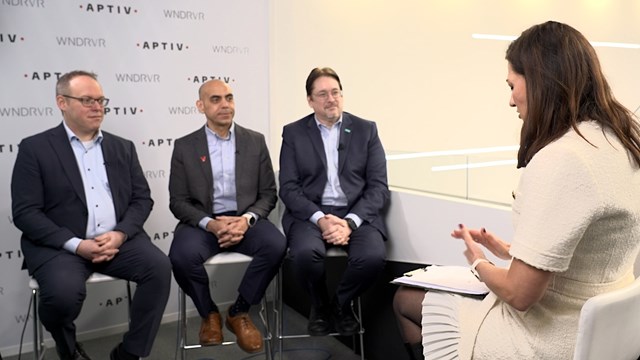
Thank you for joining us here at the Wind River booth for MWC 2026, where I am delighted to discuss the future of telecoms and the automotive industry through software-defined vehicles and intelligent systems. Our guests today are Paul Miller, CTO at Wind River; Mark Custodio, Associate Vice President for Cellular Connectivity at Verizon Business; and Craig Turner, Vice President of Solutions at Aptiv. Gentlemen, thank you for joining us. You have jointly made a significant announcement today here at MWC. It is related to C-V2X, that is your cellular vehicle-to-everything solution. Why should we be interested?
Paul Miller, Wind River (00:51):
Well, this is really exciting, and it is an industry first, we believe, where we have taken a 5G-connected vehicle, connected it to Verizon's ETX service, modified the in-vehicle software so that the radar, camera, and sensor information that is deriving information from the environment around the vehicle, that sensor information is being sent up to the Verizon service, where we have applications running in their multi-access edge compute, their edge cloud infrastructure, then deciding where that information should go, sending that to a second vehicle. That vehicle takes it into what we call a sensor fusion view, where it can see not only its own sensors, but the information coming from the cloud, from the 5G network, and use that to make decisions about how it is driving. In the use case example we have here, a pedestrian could walk out who would normally be obscured by a building. Now that second vehicle can actually know that that pedestrian is coming out because it is getting the information from the first car.
(01:45):
So as we look at more and more software-defined vehicles, they are becoming connected computers on a 5G network, and we can leverage that connectivity to share information between the vehicles and make driving safer and more convenient.
Charlotte Kan, TelecomTV (01:57):
Thank you. Craig, what about Aptiv's role in this project?
Craig Turner, Aptiv (02:01):
Right. So inside the vehicle, first of all, we have a lot of things going on. We are identifying, detecting objects, people, any kinds of things of interest really around the vehicle. Emergency vehicles are another example of things going by. We take that, we are able to bundle it inside the vehicle and, using Aptiv's Link SDV platform, communicate that out to the Verizon network, and then it goes out to the network back into another vehicle. And that is where you get the sensor fusion that Paul was talking about. So really we are providing all of the perception, the object classification, and then having identified the critical and important vulnerable road users, communicate them to the network and interact then in the other vehicle with what is being detected.
Charlotte Kan, TelecomTV (02:44):
Mark, give us the Verizon perspective on this.
Mark Custodio, Verizon Business (02:47):
Well, look, it is a worthy cause. Over six million accidents have happened in the United States alone, 44,000 deaths just last year. And when you think about the convenience, the congestion, we have a way of building a better environment for all road users and all pedestrians. Verizon's role, we build the network that moves all of these forward. If you think back to before your mobile phone was attached to you at all times, all the applications you have, all the environment, we have now built an infrastructure that will enable that for vehicles, for pedestrians, for departments of transportation all around the United States. And these types of partnerships create the innovative applications and integration to make it all work.
Charlotte Kan, TelecomTV (03:27):
Paul, you have mentioned some of the use cases. They are pretty clear. It is all around safety, road safety, but not just that. Is this paving the way or is it a key milestone towards this autonomous driving future?
Paul Miller, Wind River (03:39):
It certainly is. When you think about what the vehicles are becoming, they are moving from a legacy architecture to a more software-defined vehicle. And software has a heavy presence in the vehicle from ADAS, self-driving, camera and radar, machine learning that is running in the vehicle. So there is a tremendous amount of software in the vehicle. One of the interesting things about the demonstration that we are showing here this year, we have down on the show floor an actual car that has been equipped with this technology that we have had driving around in Detroit and other places demonstrating this, is that we made all those changes to the system and enabled this application without touching the hardware. It was a completely software-based change because the vehicle was already a connected vehicle and simply connecting it into the Verizon network and implementing a certain set of software functions enabled us to build this complete solution.
Charlotte Kan, TelecomTV (04:27):
Craig, do you want to tell us more about why this solution is significant for the industry?
Craig Turner, Aptiv (04:31):
So I think there are two key points that are really critical here. On one side, we cannot forget the C on V2X because the cellular capabilities of it using 5G and the services it provides lets us do this very fast. I am careful not to say real time, but very fast is what matters here because we want to provide timely and relevant local information from vehicle to vehicle. And then the other side that is significant. If you look at vehicle-to-vehicle, rather than just having a specific car maker being able to communicate between their vehicles, we are able to abstract that away and, leveraging again what Verizon is bringing to the table here, we can actually enable different vehicles that know nothing about each other, that have never been integrated with one another, still to use all of those software layers, do that communication, and get that very important, timely information into the vehicle to make relevant decisions for autonomous decisions, or even just for a regular driver who is given a visibility that they may not have looking around a corner, for example, to see something critical coming out.
(05:28):
One of
Paul Miller, Wind River (05:29):
The interesting things that has happened there, and really to key on what Craig just said, is that previously, and the concepts around V2X have been around for years, so why has it not happened, right? The real difference here with the cellular connectivity and the infrastructure that Verizon is providing is an automotive OEM can talk a standardised API to the cloud. They do not have to know that it is a different OEM's vehicle that they are talking to. That is what Craig is referring to. That means this is truly scalable because prior to that, you would have had to have each OEM work with each other to work the connectivity and interoperability. Now everyone can just talk to a service that is coming from a service provider like Verizon and the system scales to every OEM that wants to build it into their vehicle. So it is really the first time an architecture has been implemented that is truly scalable.
Mark Custodio, Verizon Business (06:12):
Yes, that is right, Paul. And furthermore, we have made this interoperable across all carriers. And so the connectivity that already exists in the car, whether that is on Verizon or not, is able to exchange. It is a standards-based approach. And when you look at the magic that brings us all together, it is not just the 5G cellular network. We have mobile edge compute, so you get that connection really close to the vehicle. Very fast response. And you have something called hyper-precise location. So now using GPS, using the network, there are algorithms that can get down to centimetre-level accuracy. So we even know what lane. Imagine a vehicle that is stuck on the side of the road, there is an officer who has maybe pulled over, that can alert the other vehicles to stay out of that right lane due to the accident and avoid some potential dangers.
Paul Miller, Wind River (06:58):
And that capability from the Verizon network is particularly critical because if you think about all these different vehicles, they are all looking at a pedestrian or a cyclist. We have to resolve geodetically location, velocity, exactly where that asset is. And if we do not have that level of accuracy, correlating all this information from multiple vehicles is very complex. So this is truly a system, right? What we are changing: the vehicle, the 5G infrastructure, the edge compute, it all comes together to build a truly feasible system.
Charlotte Kan, TelecomTV (07:28):
I was going to follow up on that actually. I think that this solution really showcases the power of leveraging full technological ecosystems in order to deliver seamless solutions. It is very impressive in detail.
Craig Turner, Aptiv (07:39):
That is absolutely right. And I think it is worth highlighting. We have been highlighting, we have been talking about a few key use cases here. There is a broad range of possible applications here, even just in the vehicle environment and beyond. One simple example I like to take, Aptiv's driver monitoring system is able to identify when a driver is having a health problem, when they are becoming non-responsive. And so I could easily imagine a use case where that information is communicated again through the same mechanisms to vehicles around, not necessarily as a replacement for a 999 call. I mean, that is a critical, important functionality giving those emergency services. But if you have someone driving at high speeds on a motorway and their vehicle is now taking them into a protective mode, it is entirely possible that you want to at least inform everybody in the vicinity,
Charlotte Kan, TelecomTV (08:27):
Be
Craig Turner, Aptiv (08:27):
Careful this vehicle is having a challenge, this driver is having a problem. Let us make sure that we are just making the roads a little bit safer for them.
Charlotte Kan, TelecomTV (08:34):
I can see so many potential use cases for so many different sectors. Government, you mentioned rescue services, health services, who knows, but also insurance. Yes. Of course, financial services. Very interesting indeed. Let us talk about the timing of this announcement. Why now? Why here at MWC? And what can we expect over the next couple of years, maybe three years?
Paul Miller, Wind River (08:57):
I think there have been a few things that have kind of created an intersection as we get through 2025 into 2026 that has enabled us to do this. One is you have the evolution in the vehicle, as we spoke a moment ago about software-defined vehicles. Prior to that, you did not have the compute and the software capacity in the vehicle to implement things like this. So you finally have the automotive platform becoming aware enough from a compute perspective that it can participate in this type of network. You also have, and as many people in the industry know, we provide the 5G infrastructure that Verizon uses to build their network. That is actually cloud-native. And so it is a completely cloud-based system where we can deploy these applications at the edge of the network as containerised applications. So you have the evolution of the service provider network through vRAN and Open RAN to a cloud-native infrastructure.
(09:43):
You have the software-defined vehicle coming together and enabling this. You finally have an intersection of technologies where when you have the right companies as partners together, you can actually build this. And so the timing is now because of that for the technology platform.
Charlotte Kan, TelecomTV (09:56):
Well, many thanks to all of you for sharing those insights with us today and congratulations on this announcement, of course, many thanks.
Thank you for joining us here at the Wind River booth for MWC 2026, where I am delighted to discuss the future of telecoms and the automotive industry through software-defined vehicles and intelligent systems. Our guests today are Paul Miller, CTO at Wind River; Mark Custodio, Associate Vice President for Cellular Connectivity at Verizon Business; and Craig Turner, Vice President of Solutions at Aptiv. Gentlemen, thank you for joining us. You have jointly made a significant announcement today here at MWC. It is related to C-V2X, that is your cellular vehicle-to-everything solution. Why should we be interested?
Paul Miller, Wind River (00:51):
Well, this is really exciting, and it is an industry first, we believe, where we have taken a 5G-connected vehicle, connected it to Verizon's ETX service, modified the in-vehicle software so that the radar, camera, and sensor information that is deriving information from the environment around the vehicle, that sensor information is being sent up to the Verizon service, where we have applications running in their multi-access edge compute, their edge cloud infrastructure, then deciding where that information should go, sending that to a second vehicle. That vehicle takes it into what we call a sensor fusion view, where it can see not only its own sensors, but the information coming from the cloud, from the 5G network, and use that to make decisions about how it is driving. In the use case example we have here, a pedestrian could walk out who would normally be obscured by a building. Now that second vehicle can actually know that that pedestrian is coming out because it is getting the information from the first car.
(01:45):
So as we look at more and more software-defined vehicles, they are becoming connected computers on a 5G network, and we can leverage that connectivity to share information between the vehicles and make driving safer and more convenient.
Charlotte Kan, TelecomTV (01:57):
Thank you. Craig, what about Aptiv's role in this project?
Craig Turner, Aptiv (02:01):
Right. So inside the vehicle, first of all, we have a lot of things going on. We are identifying, detecting objects, people, any kinds of things of interest really around the vehicle. Emergency vehicles are another example of things going by. We take that, we are able to bundle it inside the vehicle and, using Aptiv's Link SDV platform, communicate that out to the Verizon network, and then it goes out to the network back into another vehicle. And that is where you get the sensor fusion that Paul was talking about. So really we are providing all of the perception, the object classification, and then having identified the critical and important vulnerable road users, communicate them to the network and interact then in the other vehicle with what is being detected.
Charlotte Kan, TelecomTV (02:44):
Mark, give us the Verizon perspective on this.
Mark Custodio, Verizon Business (02:47):
Well, look, it is a worthy cause. Over six million accidents have happened in the United States alone, 44,000 deaths just last year. And when you think about the convenience, the congestion, we have a way of building a better environment for all road users and all pedestrians. Verizon's role, we build the network that moves all of these forward. If you think back to before your mobile phone was attached to you at all times, all the applications you have, all the environment, we have now built an infrastructure that will enable that for vehicles, for pedestrians, for departments of transportation all around the United States. And these types of partnerships create the innovative applications and integration to make it all work.
Charlotte Kan, TelecomTV (03:27):
Paul, you have mentioned some of the use cases. They are pretty clear. It is all around safety, road safety, but not just that. Is this paving the way or is it a key milestone towards this autonomous driving future?
Paul Miller, Wind River (03:39):
It certainly is. When you think about what the vehicles are becoming, they are moving from a legacy architecture to a more software-defined vehicle. And software has a heavy presence in the vehicle from ADAS, self-driving, camera and radar, machine learning that is running in the vehicle. So there is a tremendous amount of software in the vehicle. One of the interesting things about the demonstration that we are showing here this year, we have down on the show floor an actual car that has been equipped with this technology that we have had driving around in Detroit and other places demonstrating this, is that we made all those changes to the system and enabled this application without touching the hardware. It was a completely software-based change because the vehicle was already a connected vehicle and simply connecting it into the Verizon network and implementing a certain set of software functions enabled us to build this complete solution.
Charlotte Kan, TelecomTV (04:27):
Craig, do you want to tell us more about why this solution is significant for the industry?
Craig Turner, Aptiv (04:31):
So I think there are two key points that are really critical here. On one side, we cannot forget the C on V2X because the cellular capabilities of it using 5G and the services it provides lets us do this very fast. I am careful not to say real time, but very fast is what matters here because we want to provide timely and relevant local information from vehicle to vehicle. And then the other side that is significant. If you look at vehicle-to-vehicle, rather than just having a specific car maker being able to communicate between their vehicles, we are able to abstract that away and, leveraging again what Verizon is bringing to the table here, we can actually enable different vehicles that know nothing about each other, that have never been integrated with one another, still to use all of those software layers, do that communication, and get that very important, timely information into the vehicle to make relevant decisions for autonomous decisions, or even just for a regular driver who is given a visibility that they may not have looking around a corner, for example, to see something critical coming out.
(05:28):
One of
Paul Miller, Wind River (05:29):
The interesting things that has happened there, and really to key on what Craig just said, is that previously, and the concepts around V2X have been around for years, so why has it not happened, right? The real difference here with the cellular connectivity and the infrastructure that Verizon is providing is an automotive OEM can talk a standardised API to the cloud. They do not have to know that it is a different OEM's vehicle that they are talking to. That is what Craig is referring to. That means this is truly scalable because prior to that, you would have had to have each OEM work with each other to work the connectivity and interoperability. Now everyone can just talk to a service that is coming from a service provider like Verizon and the system scales to every OEM that wants to build it into their vehicle. So it is really the first time an architecture has been implemented that is truly scalable.
Mark Custodio, Verizon Business (06:12):
Yes, that is right, Paul. And furthermore, we have made this interoperable across all carriers. And so the connectivity that already exists in the car, whether that is on Verizon or not, is able to exchange. It is a standards-based approach. And when you look at the magic that brings us all together, it is not just the 5G cellular network. We have mobile edge compute, so you get that connection really close to the vehicle. Very fast response. And you have something called hyper-precise location. So now using GPS, using the network, there are algorithms that can get down to centimetre-level accuracy. So we even know what lane. Imagine a vehicle that is stuck on the side of the road, there is an officer who has maybe pulled over, that can alert the other vehicles to stay out of that right lane due to the accident and avoid some potential dangers.
Paul Miller, Wind River (06:58):
And that capability from the Verizon network is particularly critical because if you think about all these different vehicles, they are all looking at a pedestrian or a cyclist. We have to resolve geodetically location, velocity, exactly where that asset is. And if we do not have that level of accuracy, correlating all this information from multiple vehicles is very complex. So this is truly a system, right? What we are changing: the vehicle, the 5G infrastructure, the edge compute, it all comes together to build a truly feasible system.
Charlotte Kan, TelecomTV (07:28):
I was going to follow up on that actually. I think that this solution really showcases the power of leveraging full technological ecosystems in order to deliver seamless solutions. It is very impressive in detail.
Craig Turner, Aptiv (07:39):
That is absolutely right. And I think it is worth highlighting. We have been highlighting, we have been talking about a few key use cases here. There is a broad range of possible applications here, even just in the vehicle environment and beyond. One simple example I like to take, Aptiv's driver monitoring system is able to identify when a driver is having a health problem, when they are becoming non-responsive. And so I could easily imagine a use case where that information is communicated again through the same mechanisms to vehicles around, not necessarily as a replacement for a 999 call. I mean, that is a critical, important functionality giving those emergency services. But if you have someone driving at high speeds on a motorway and their vehicle is now taking them into a protective mode, it is entirely possible that you want to at least inform everybody in the vicinity,
Charlotte Kan, TelecomTV (08:27):
Be
Craig Turner, Aptiv (08:27):
Careful this vehicle is having a challenge, this driver is having a problem. Let us make sure that we are just making the roads a little bit safer for them.
Charlotte Kan, TelecomTV (08:34):
I can see so many potential use cases for so many different sectors. Government, you mentioned rescue services, health services, who knows, but also insurance. Yes. Of course, financial services. Very interesting indeed. Let us talk about the timing of this announcement. Why now? Why here at MWC? And what can we expect over the next couple of years, maybe three years?
Paul Miller, Wind River (08:57):
I think there have been a few things that have kind of created an intersection as we get through 2025 into 2026 that has enabled us to do this. One is you have the evolution in the vehicle, as we spoke a moment ago about software-defined vehicles. Prior to that, you did not have the compute and the software capacity in the vehicle to implement things like this. So you finally have the automotive platform becoming aware enough from a compute perspective that it can participate in this type of network. You also have, and as many people in the industry know, we provide the 5G infrastructure that Verizon uses to build their network. That is actually cloud-native. And so it is a completely cloud-based system where we can deploy these applications at the edge of the network as containerised applications. So you have the evolution of the service provider network through vRAN and Open RAN to a cloud-native infrastructure.
(09:43):
You have the software-defined vehicle coming together and enabling this. You finally have an intersection of technologies where when you have the right companies as partners together, you can actually build this. And so the timing is now because of that for the technology platform.
Charlotte Kan, TelecomTV (09:56):
Well, many thanks to all of you for sharing those insights with us today and congratulations on this announcement, of course, many thanks.
Please note that video transcripts are provided for reference only – content may vary from the published video or contain inaccuracies.
Aji Ed, Nokia & Paul Miller, Wind River
Wind River, Aptiv and Verizon discuss their joint C-V2X (cellular vehicle-to-everything) solution at MWC26, revealing how it enables 5G-connected vehicles to use edge computing and software-defined platforms for improved road safety and interoperability.
Featuring:
- Craig Turner, VP Solutions, APTIV
- Mark Custodio, Associate Vice President - Cellular Connectivity, Verizon Business
- Paul Miller, CTO, Wind River
Recorded March 2026
Email Newsletters
Sign up to receive TelecomTV's top news and videos, plus exclusive subscriber-only content direct to your inbox.