To embed our video on your website copy and paste the code below:
<iframe src="https://www.youtube.com/embed/vfD_cYKhjjQ?modestbranding=1&rel=0" width="970" height="546" frameborder="0" scrolling="auto" allowfullscreen></iframe>
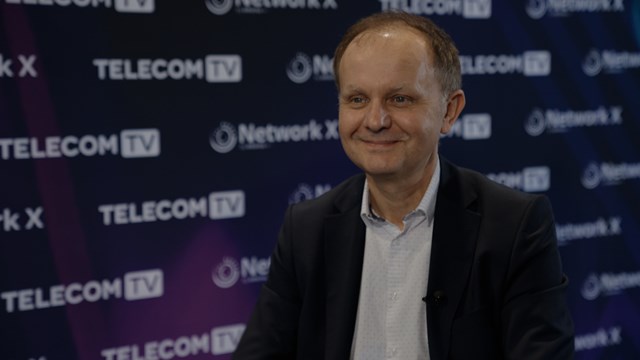
Hello and welcome to TelecomTV. I'm James Pearce and I'm in Vienna for Network X. And I'm delighted to be joined today by Laurent Leboucher, who's from Orange. Thank you so much for joining us. I was lucky enough to come along to Paris earlier in the year for the launch of Orange's new three-year strategy, which puts trust right at the heart of everything you do. How do you go about making sure that trust is central to all of the upgrades that you're making to Orange's network?
Laurent Leboucher, Orange (00:31):
Thank you for having me. Clearly, trust is really at the centre of everything we're doing on the network side. We need to think of it both in terms of protecting our networks, but also providing capabilities to protect our customers. For the first part, clearly we are looking at trust from different dimensions. We're looking at trust from, let's say, how we can protect our network against typical weather hazards. So we have a special programme dedicated to that in order to make our network more redundant in certain areas. Look also at batteries, which are extremely critical in some places. We are also extremely cautious on cybersecurity. On cybersecurity, as part of our network cybersecurity programme, we have one specific focus on the new cybersecurity threats coming from the new frontier models and the fact that hackers now, they can have access to extremely powerful tools. And in that respect, we are working in order to not only identify and be very efficient in detection, but also even more importantly, how we can mitigate and fix together with our vendors, our partners, how we can bring and ship patches very fast.
(02:11):
That triggers also the need to transform the way we operate the network from a software standpoint, really becoming much more software-driven, CI/CD and so on. And that really represents for us an important shift. For that, we are also leveraging our telco cloud capabilities and we have decided to bring together all our experts and cloud capacity in the same team, providing not only the telco cloud capabilities for the group and for the countries, but also providing the private cloud very secure, trustful capabilities for our customers. Last but not least, if I look now on the other side of the equation, I think we are focused on bringing trust to create new revenue opportunities. As an example, we have started to offer new APIs on the market. Number Verify is one of them and it's one way to create a very strong way for our customers to ensure they are the right person.
(03:37):
In the same vein, we are also introducing branded calling in different countries, starting with Spain, but that will come also in other countries very soon. We are also preparing the next step because the next step will be to protect our customers also in the agentic world. You know that it's not only humans who are trying to call you, but very often it's bots and tomorrow it will be agents.
(04:17):
If you want really to interact with agents, you need to be sure they are legitimate, they have the right mandate and so on. So clearly a fantastic opportunity also to bring trust in interaction for our customers between them, but also between them and the new agents of the world.
James Pearce, TelecomTV (04:43):
That's a really fascinating answer and you mentioned AI there. So if we keep in mind the trust and sovereignty elements that we just talked about, what role will AI play in transforming networks into making them more efficient, more resilient, money-making opportunities for you guys?
Laurent Leboucher, Orange (04:59):
Okay. So AI in the network plays an enormous role in different areas from planning to operations to efficiency of the NOC, the Network Operations Centre, but also in order to improve the user experience, in order also to improve the efficiency of field technicians. So we have a set of use cases and what we're doing also, we are bringing all our affiliates together in order to work on the same journey. Of course, taking into account their existing situation, but leveraging the capacity of the group, leveraging the same platforming journey. So we have several projects. We have, for instance, one very important project which is becoming quite successful to help network planners to better allocate CapEx and understand very precisely where they need to do the upgrades, do capacity or add, let's say new sites in a territory based also on the data that we have not only on the performance, the pure raw performance of the network, but also the data that we have from our customers and also what we call the user experience scoring.
(06:41):
So we have implemented what we call experience score and we train that model against real churn data information. Thanks to that, we're able to understand much more precisely how we can allocate and decide where to put the effort.
James Pearce, TelecomTV (07:06):
You mentioned the networks team that you have, and I know recently you got to spend some time with them out in the field. What were some of the most exciting projects you saw during those meetings?
Laurent Leboucher, Orange (07:16):
It's very difficult because when you work with your teams and we see in the labs all the innovation and creativity, it's very difficult to say who is the best. Clearly it's extremely difficult. I can say, I'm very enthusiastic, impressed by what we are capable to do, for instance, with sensing, both fibre sensing, but also radio sensing. Both of them are extremely promising for different kind of use cases. Some of them, for instance, with radio sensing, we can consider that we can deliver a true capacity for drone detection, which is of course extremely important, for instance, for safety of critical infrastructures. Fibre sensing also is extremely powerful and we can use it also to detect intrusion, to detect also leakage, for instance, for water supply companies. So there are many very compelling use cases. Maybe if I would add perhaps among the other topics, I think I mentioned quantum safe and our quantum key distribution solutions, always impressed.
(08:47):
Very impressed also by what we're doing in the context of private networks, how we can deliver mobile private networks, both in standalone mode, but also to address specific requirements and leveraging the capacity of the public network.
(09:10):
And of course the use of agents, how we can use all the power of agents for several use cases of operations. Now it's growing at full speed.
James Pearce, TelecomTV (09:25):
Some really interesting projects you've talked about there. And another project you're involved in is the NGMN. You guys have announced that you're working on an operator-driven roadmap for 6G. Can you tell us a little bit about that project, about the work you're doing on 6G?
Laurent Leboucher, Orange (09:39):
Okay. So in the context of 6G, we are extremely focused within NGMN because it's really a very important time because 3GPP before the end of the year will take an important decision to decide on options regarding 6G, regarding the core network, regarding also radio network, and also regarding the options to migrate our networks and to introduce 6G in the future. So it's really now that we need to understand precisely how we can come to an agreement. And I must say it's not easy because there are different views according to let's say operators in different geographies, also vendors. So the beauty of NGMN is that we can bring all the voices together in order to create a consensus, but even more than that, to make those important decisions, like what are the options to prepare migrations? How can we reduce it and also make those options extremely easy to understand at C-level in the companies, both telcos and also vendors.
(11:14):
It's really important because those decisions will have an impact on the P&L. They will have an impact. Think of, for instance, on the radio part, we need to look at whether we will use an important mechanism, which is called MRSS, which allows us to share the same band for 5G and 6G in a dynamic way. If we can implement that feature and provided that there is, let's say, not too much overhead, but we are optimistic and that the requirements on hardware is okay, assuming that, then it'll be much easier to do the migration because when you introduce Release 21, which is so-called 6G, you don't have to steal the spectrum which is used by 5G users, but you can benefit from the coverage that you already have. So this is really what we need and I think there is now a consensus. So we need to make sure that everyone understands those decisions.
James Pearce, TelecomTV (12:33):
Is there one particular thing on that that you think vendor partners in specific could do to help you guys simplify that journey?
Laurent Leboucher, Orange (12:41):
I think when we talk about the core network, we have intense debate in NGMN, but not only NGMN, GSMA, and of course 3GPP, should the core network be a completely new stuff, agentic by design from scratch, or should it leverage the existing service-based architecture? I think it's a fundamental question. We need to look at it deeply, and I think we need to come to an agreement because there are very strong reasons why we need to be prepared for the agentic behaviours, the agentic use cases. At the same time, we need to see how we can expose the capability of the network in a way which is not too disruptive and also which guarantees a certain level of determinism, at least on the basic capabilities. And last but not least, I think when we speak about standards, we shouldn't forget that standards cannot address the speed of innovation that we are now in, and especially in the context of the agentic world.
(14:10):
Standards need to define where they should stop and then how we can expose the right interface to some innovation which cannot be standardized, but which can benefit from the standards.
James Pearce, TelecomTV (14:27):
Brilliant. Laurent, thank you for joining us today.
Laurent Leboucher, Orange (14:29):
Welcome.
Please note that video transcripts are provided for reference only – content may vary from the published video or contain inaccuracies.
Laurent Leboucher, Group CTO and EVP Networks, Orange
Laurent Leboucher, group CTO and EVP of networks at Orange, explains how the French telco is placing trust at the centre of its network strategy, through resilience, cybersecurity and softwarisation; how AI can help Orange make money from sovereignty; how it is using fibre and radio sensing to create new use cases, such as drone detection; and discusses his work with the NGMN to create an operator-driven roadmap for 6G.
Recorded October 2026
Email Newsletters
Sign up to receive TelecomTV's top news and videos, plus exclusive subscriber-only content direct to your inbox.