- AT&T increases revenues, cuts spending plans
- Telenor taps F5 for sovereign AI service plane
- Qualcomm lines up job cuts
In today’s industry news roundup: AT&T reports a 5.3% year-on-year increase in Q3 revenues but, in a blow to the vendor community, has announced plans to spend less than previously planned in the coming few years; Telenor is to use service plane technology from F5 to help manage and control its sovereign AI traffic flows; wireless chip giant Qualcomm is set to cut an unspecified number of jobs before the end of the year; and much more!
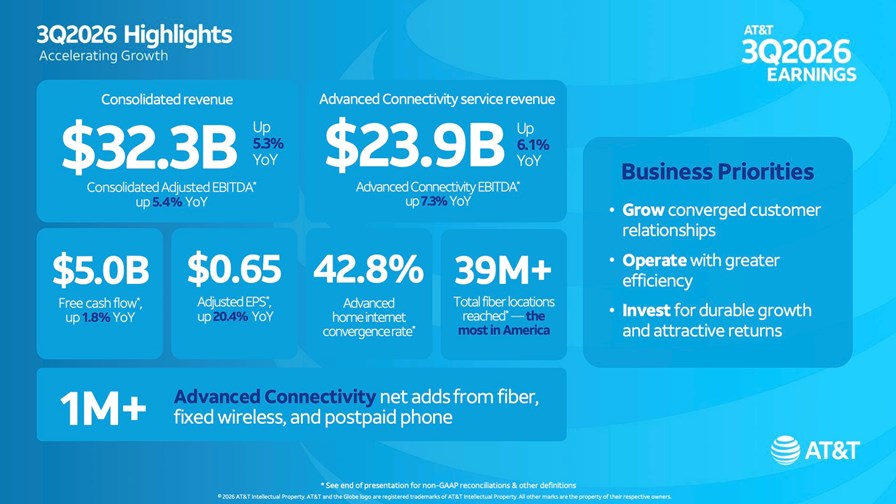
AT&T has reported third-quarter revenues of $32.3bn, up by 5.3% in part due to the inclusion of the recently acquired consumer fibre broadband operations from Lumen Technologies, though the rise was also due to the addition of 379,000 new postpaid mobile customers. AT&T ended September with 16.25 million fixed broadband customers, of which 13.31 million were fibre broadband connections and 2.94 million were fixed wireless access (FWA) customers, and 110.2 million mobile customers, of which 75.3 million were postpaid phone customers. Adjusted EBITDA (after one-time costs) for the quarter was $12.5bn, up by 5.4% year on year. The US telco also noted that it had reduced its forecast for capital investments (which includes capital expenditures on its networks and supporting systems plus its vendor financing commitments, which currently amount to about $500m per quarter): Its planned capital investment total for 2026 remains unchanged at between $23bn and $24bn, but instead of remaining at the same level for the following two years, AT&T says its capital investments for 2027 and 2028 are now expected to be between $22bn and $23bn (so, not good news for the vendor community).
Telenor has selected F5’s BIG-IP Next for Kubernetes as an intelligent AI service plane for its sovereign AI infrastructure, the secure networking tech specialist has announced. Telenor has been running its AI Factory platform for almost two years, helping Norwegian and European organisations to “access secure, high-performance AI services while maintaining control over where data is processed, stored and accessed,” stated F5, which noted that, as well as the relevant underlying hardware (in Telenor’s case, Nvidia GPUs) sovereign AI “requires an operational AI service plane that can govern where data flows, how tenants are isolated and how policy is enforced in real time”. It added: “Telenor AI Factory addresses growing European sovereignty requirements by combining Telenor’s national infrastructure and connectivity with Nvidia-powered AI infrastructure and F5’s intelligent traffic management, security and governance capabilities. WIth F5 BIG-IP Next for Kubernetes, Telenor can apply policy, visibility, tenant isolation and traffic control directly in the AI service path. In the future, Telenor also plans to leverage F5 technology to expand the service plane with token-aware governance and more advanced inference traffic optimisation as commercial AI services scale,” added the vendor, which has also recently secured a sovereign AI management deal with Indosat Ooredoo Hutchison (IOH) in Indonesia.
Qualcomm is to cut an unknown number of jobs, starting in November, in what was described in an internal memo written by CEO Cristiano Amon as a “performance-focused reduction” that will follow its annual employee review process, Reuters has reported. The job losses are part of an effort by Qualcomm, which has about 52,000 staff, to build “a stronger performance culture” and address situations where the company “has consistently fallen short of expectations”, noted the CEO, who stated in his memo that the changing business environment had meant a change in personnel requirements. “As we have expanded the business, so have the competencies and skills we require,” he wrote in the memo. “We must have the right people in the right roles so they can perform at their best and the company can continue to succeed.”
As well as working with Nokia and Nvidia on its AI-RAN strategy and trials – see Nvidia boasts greater AI-RAN and AI factory traction with telcos – T-Mobile US is also collaborating with Ericsson on the “new era” of wireless networking, which is about “making the network smarter” as well as adding more spectrum, sites and capacity. “That is what makes 5G-Advanced so important,” notes the US operator in this blog by chief network officer Ankur Kapoor. 5G-Advanced “is where we can put new intelligence to work today and prove the capabilities that will shape 6G. AI-RAN is a key part of that evolution, bringing AI directly into the radio network so it can learn from real-world conditions, make smarter decisions and adapt in real time,” adds Kapoor. He continues: “AI-RAN is a continuum, not a single product. Our north star is to use AI to make our network smarter and more efficient today, delivering tangible benefits for customers while building the foundation for an intelligent, distributed network that can power the next generation of AI applications. And we have made some great movement in this direction,” he adds, highlighting recent advances with Ericsson on AI-managed beamforming, now being used in “large-scale commercial trials using live network traffic. This is another major step in bringing practical AI deeper into the RAN, building on our earlier AI-RAN work with Ericsson, including AI-Native Link Adaptation, and continuing the network vision we laid out at Capital Markets Day in 2024.” According to T-Mobile US, AI-managed beamforming trials conducted in New York City achieved significant gains, especially during peak hours when customer demand is at its highest, with the operator achieving a 16% improvement in downlink user throughput, a 12% improvement in spectral efficiency and a 10% increase in downlink data volume.
NTT Docomo and its parent company, NTT Group, have developed a technology that “uses AI to optimally coordinate and control radio base station communications-processing workloads and the operation of distributed energy resources, including solar power generation and storage batteries”. In what it describes as a “world’s first demonstration at base stations using this technology,” NTT plans to “verify [its] effectiveness in increasing the use of renewable energy, supporting demand response (DR) during periods of tight electricity supply and demand, and improving communications service continuity during disasters.” The demo “will use workload shifting (WLS) technology, which moves communications processing workloads between base stations, together with Docomo’s energy management system (EMS) platform, which manages distributed energy resources such as solar power generation and storage batteries. Based on operating plans calculated by AI, NTT will control the communications load at each base station, while Docomo will control the storage batteries. This will enable the companies to coordinate and optimise communications and power equipment as an integrated system,” explained NTT.
Vodafone Spain, the Spanish operator owned by Zegona Communications, is using AI-based technology from Vigo, Spain-based Optare Solutions to predict likely problems in its fibre optic network infrastructure and remedy them before customer services are impacted. Using Optare’s AI system called Augura Tech, Vodafone Spain says it can analyse the service status of its fibre broadband customers and anticipate which customers are most likely to experience an outage, take preventative measures, and resolve the problem before the customer even notices it. In this announcement (in Spanish), the operator explained it deployed Optare’s solution in April, since when its “ability to anticipate and proactively address issues has contributed to a 25% reduction in customer equipment-related incidents, enabling a more stable connectivity experience and reducing the need for reactive interventions”. Julia Velasco, director of technology and operations at Vodafone Spain, stated: “Artificial intelligence is transforming the way we ensure the best customer experience. Thanks to this solution, we can analyse millions of signals from the network and customer devices to proactively identify situations that could lead to an incident and act before they occur.”
– The staff, TelecomTV
Email Newsletters
Sign up to receive TelecomTV's top news and videos, plus exclusive subscriber-only content direct to your inbox.