To embed our video on your website copy and paste the code below:
<iframe src="https://www.youtube.com/embed/2QyI169GLlE?modestbranding=1&rel=0" width="970" height="546" frameborder="0" scrolling="auto" allowfullscreen></iframe>
James Pearce, TelecomTV (00:05):
Hello and welcome to TelecomTV. I'm James Pearce. I'm in Vienna for Network X, and I'm delighted to be joined today by Dr. Yue Wang, who is the chief technologist at China Telecom. Thank you so much for joining us today. To start, could you tell us about some of the latest developments in AI in the industry that you're particularly excited about?
Dr. Yue Wang, China Telecom (00:24):
Yeah, sure. At the moment, I'm particularly interested in physical AI. I think there are some real opportunities for the operators. You know how traditionally AI lives in the cloud and our experience of using AI depends on the quality of the AI models. But as AI is moving to the physical world, think about drones, vehicles, robots, they are on the move and that requires not just the connectivity like we traditionally provide, but also compute resources and the orchestration capabilities on top of it. And it doesn't only depend on the quality of the models, but also depend on the capabilities that the operators can provide as a whole. So suddenly mobility matters, coverage matters, authorisation matters, registration, identity, security, that's all operators are good at. So I think there are some real opportunities there and that's what I'm particularly interested in at the moment.
James Pearce, TelecomTV (01:24):
Sounds very exciting. China's obviously leading the way in AI tokens. How important will tokenisation be for telecom operators in the AI future?
Dr. Yue Wang, China Telecom (01:36):
Right. I think it could be quite important. I think we need to distinguish a bit between token as a charging unit and the token as a representation of the operator's capability in the AI era. So I mean traditionally you know how we charge for voice minutes, we charge for the volume of data. So token in the AI era could just be seen as a representation of the capabilities and values that are provided by the operator for the AI services. So think about the case where a robot is running on the street, moving on the street and this is where the operators can provide the capabilities of the connectivity, the compute orchestration and the AI service platform. So this gives the operator the opportunities to change from just the connectivity provider to now become an AI service platform provider. So in that way, token could become a representation of the value of the operator services provided in the AI era.
(02:50):
And that gives the customers something that they can use and also they can meter. And so in the future, maybe the customers do not need to know which GPUs I need to use, where intelligence should run, and they could just use the abstracted service that the operators provide. So basically the operator orchestrates all those kind of complexity and the customers will just enjoy the service that is represented by the token.
James Pearce, TelecomTV (03:22):
That's really interesting stuff. So how do you envision AI-native networks transforming telecom operations in the coming years?
Dr. Yue Wang, China Telecom (03:29):
Sure. I mean everyone has a different interpretation of what AI-native is. To me when it comes to the operation, I think it means basically AI is embedded and deeply integrated into the operation system of the telco. And again, relating to the AI services, it's not just about operation of the network, but also about operation of the services and operation of the compute infrastructure, for example. And so think about the AI services. You need to know what does this service need and where does the intelligence, how do I place my compute resources? And those are all the operation capabilities that the operators need to provide. And when it comes to the network operations, I think we are talking about the different levels of automation. I mean we need to be careful when it comes to the full automation vision of the network operation. We still need to introduce that intelligence with care and with security.
(04:41):
So this full autonomy does not necessarily mean no human. It is about having AI to deal with the operation complexity while the human has oversight on the security, on the authorisation strategy, et cetera.
James Pearce, TelecomTV (04:57):
That's brilliant. That's really interesting. So thank you so much for joining us today on TelecomTV.
Dr. Yue Wang, China Telecom (05:02):
Thank you for having me.
Please note that video transcripts are provided for reference only – content may vary from the published video or contain inaccuracies.
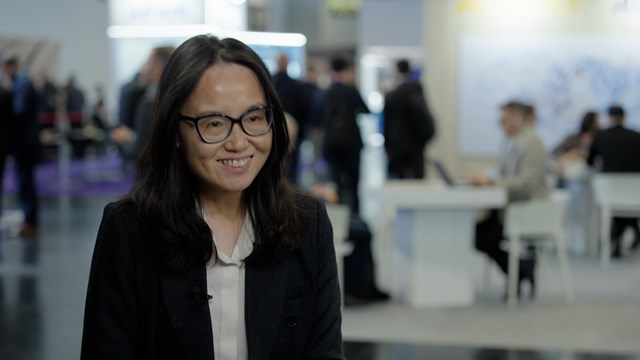
Dr. Yue Wang, Chief Technologist – Next-Gen ICT, China Telecom
Dr. Yue Wang, chief technologist for next-gen ICT at China Telecom, on the growth of physical AI, how operators can generate revenue from AI tokens, what it means to be an AI-native telco, how AI can transform not just the network but also the services on offer and much, much more.
Recorded October 2026
Email Newsletters
Sign up to receive TelecomTV's top news and videos, plus exclusive subscriber-only content direct to your inbox.