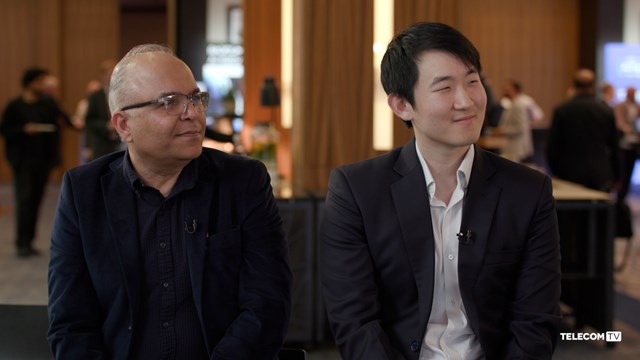
A1 Croatia lifts the lid on its 5G Core evolution

By James Pearce
Jun 23, 2026
To embed our video on your website copy and paste the code below:
<iframe src="https://www.youtube.com/embed/Sc2YkV3F5xM?modestbranding=1&rel=0" width="970" height="546" frameborder="0" scrolling="auto" allowfullscreen></iframe>
I'm delighted to be joined today by Andrej Pinak, who is Infrastructure and Services Director at A1 Croatia. Welcome, Andrej. Let's dive straight in. Maybe you could describe for us your journey to deploying Ericsson's cloud-native 5G core.
Andrej Pinak, A1 Croatia (00:18):
Yeah. So we've been a partner with Ericsson in our mobile core for a long time. We started the journey some years ago and we have it as a evolution, not a revolution. So we started with the proprietary hardware and legacy environment. Then we continue with the virtualized environment and now we are migrating and deploying the workload on Cloud Native Infrastructure.
James Pearce, TelecomTV (00:42):
Maybe you could talk us through some of the benefits that you've seen from running the core on Cloud Native Infrastructure so far.
Andrej Pinak, A1 Croatia (00:49):
Yeah, definitely there's a lot of benefits, but we wish that everything that we have runs already on the cloud-native environment, so we can fully utilize and leverage the benefits because currently we have still pretty diverse environment including the legacy platform. So it's still pretty complex. But one day when the cloud native will be fully deployed in operation with all the functions that we see this definitely the automation and the speed of deploying the new products and the services, as well as the operational benefits which comes from the cloud native as a huge benefit for us.
James Pearce, TelecomTV (01:31):
Let's talk about some concrete examples where network automation for the 5G core has improved your operation so far.
Andrej Pinak, A1 Croatia (01:38):
So far what we used on the cloud-native environment as the CNFs, we definitely see that we are much faster with deploying them once we need to deploy them on the different side, for example, or redeploy actually all CNF from the scratch or from the repository. We still haven't done the full closed loop for the deployment, but definitely some parts of this speed actually we can see even today. But on the other hand, we see also a lot of challenges still in front of us.
James Pearce, TelecomTV (02:13):
So how do you plan to bring an autonomous core to your networks and reach highly autonomous networks in the end?
Andrej Pinak, A1 Croatia (02:20):
As I said, we are somewhere in the middle of journey to deploy the cloud-native functions on our environment. This is for us the far future, I would say, not the short-term, even not the mid-term target to reach this Level 4 autonomous network. I would say we are in the very first phase to understand how this whole thing functions, how this environment actually is assembled together and what we should be aware of. So it's more for the learning journey, how to actually operate it. And then yes, step-by-step some automation, some scripts and maybe this closing one loop from identification to deployment will be done as well, but that's not our ultimate target right now.
James Pearce, TelecomTV (03:17):
Let's talk about new user services. Maybe you could describe some of the new services that you've launched or are planning to launch using this 5G Standalone network.
Andrej Pinak, A1 Croatia (03:28):
So we haven't deployed 5G Standalone yet, but we started with the reference environment which we have. And of course it depends on penetration of the devices and the market itself. But is the first use case which we would like to use on the Standalone would be the fixed viral access from 5G and campus networks. That's what we are designing and preparing.
James Pearce, TelecomTV (03:56):
Sounds really exciting. Thank you so much for joining us today.
Andrej Pinak, A1 Croatia (04:00):
Yeah, thank you.
Please note that video transcripts are provided for reference only – content may vary from the published video or contain inaccuracies.
Andrej Pinak, Infrastructure and Services Director, A1 Croatia
A1 Croatia is migrating from legacy hardware to Ericsson’s cloud-native 5G Core infrastructure as part of an evolutionary approach spanning several years. Infrastructure and services director Andrej Pinak explains how the operator has progressed from proprietary hardware through virtualised environments to cloud-native deployment. While still operating in a diverse environment that includes legacy platforms, A1 Croatia has observed faster deployment speeds for cloud-native functions and now plans to use 5G Standalone for fixed wireless access. Autonomous network capabilities remain a long-term objective requiring significant learning and development.
Recorded May 2026
Email Newsletters
Sign up to receive TelecomTV's top news and videos, plus exclusive subscriber-only content direct to your inbox.