Overcoming digital sovereignty and AI infrastructure hurdles

By Tony Poulos
Jun 3, 2026
To embed our video on your website copy and paste the code below:
<iframe src="https://www.youtube.com/embed/PdiZ7xAzE6M?modestbranding=1&rel=0" width="970" height="546" frameborder="0" scrolling="auto" allowfullscreen></iframe>
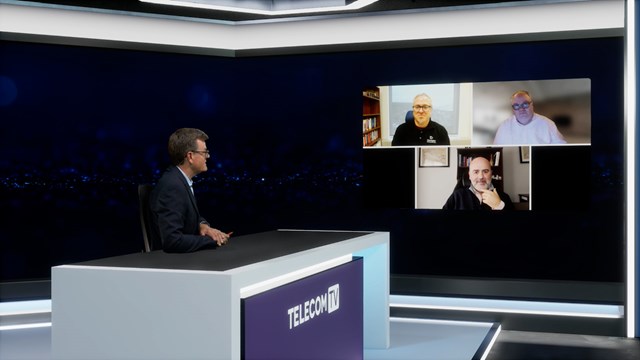
Welcome to the DSP Leaders World Forum 2024 Live from Windsor. I'm Tony Poulos and this is Extra Shot. And with me today, I've got a couple of hotshots. In fact, I've got three hotshots that are going to help me out with some issues. Talking about digital sovereignty that we all know is a big issue and a bit on building the AI backbone. First, I'm going to start off with introducing you, Camille Mendler, who of course is chief analyst and service provider enterprise at wholesale at Omdia. We also have Sophie Greaves, who is associate director of digital infrastructure at techUK and in the middle lucky man is Andy Linham, who is principal strategy manager at Vodafone. Camille, we'll start with you because it's right at the end. We're talking about digital sovereignty for a lot of time today, much time. What do you define as digital sovereignty?
(01:04):
Because everyone seems to have a different viewpoint where it is.
Camille Mendler, Omdia (01:07):
At a very, very high level, it's about control over your digital assets without undue influence or disruption by an external party.
Tony Poulos, TelecomTV (01:18):
Andy?
Andy Linham, Vodafone (01:19):
I think it's understanding when and where your data is, how it's accessed, who has access to it, and what the policies are that describe people can get access to when they get access.
Tony Poulos, TelecomTV (01:31):
And Sophie, with you, what do you think it is?
Sophie Greaves, techUK (01:34):
Yeah, I fully agree with Andy and what Camille have said. Resilience and control is part of it. I think we're thinking about it through the lens of confidence. So confident in what you can invest in, confidence and what you can govern. So that's our thinking there.
Tony Poulos, TelecomTV (01:48):
But what will define the true strength of a sovereign ready telecom network tomorrow? Control of infrastructure? Will it be control of data? Will it be control of trust between nations and ecosystems? Who wants to take that one on first?
Andy Linham, Vodafone (02:02):
I'm not sure we can really define who trusts who when it comes to nations these days. I think what we can control though is where we diversify our supply chains. So don't just buy from individual countries. Try and make sure you've got a wider kind of vendor ecosystem as possible so that if nations do deteriorate between certain countries, we've got the ability to pivot and to make sure we've got the controls in place to make sure we can still help our customers.
Camille Mendler, Omdia (02:26):
I think we need to correct ignorance of risk and a lot of that risk is in an area we don't talk about, which is the network. People think about sovereignty about location, but it's actually about the movement of digital assets and digital workloads. It's not just about where it resides, it's where it's moving.
Sophie Greaves, techUK (02:43):
I think something was missing from that conversation was skills. So do we have the skills to run sovereign networks? That's just something that I think is always missing in this conversation.
Tony Poulos, TelecomTV (02:54):
Do you think we can really achieve through data sovereignty others? It's a very difficult question, but can it really be achieved and do we really know where all our data is? Because I suspect it's sort of all over the place at the moment.
Andy Linham, Vodafone (03:08):
Yeah, it's a different question depending upon who you're talking to. So if you're a massive multinational corporation, they probably haven't got a clue where 10%, 15%, 20% of their data is. If you're a smaller SME type of customer, you probably do notice in two or three different cloud places. So it's a sliding scale depending upon volume, I think.
Tony Poulos, TelecomTV (03:25):
But it's a critical fact though that you can have sovereignty in the data foundation to know exactly where it is. Camille, what do you think about that?
Camille Mendler, Omdia (03:30):
I think it's the wrong question. You should be asking how much people are willing to pay for sovereignty, whether it's 5%, 10%, 15%, 20% or more. And we'll find that there are quite some large enterprises and public entities that will pay considerably more for certainty.
Tony Poulos, TelecomTV (03:46):
And
Sophie Greaves, techUK (03:47):
I agree 100% on cost. The more sovereign you want it to be, the more willing you have to be to probably invest a bit more.
Tony Poulos, TelecomTV (03:56):
And we're talking about cost, meaning the cost of infrastructure to store the data or the cost of infrastructure accessing the data? Or putting water around?
Camille Mendler, Omdia (04:02):
Do you want your data to meander around the public internet, taking whatever pretty route around whatever country? Or do you want it to be in one particular geographic location because you know it's safe and you can certify that it's not gone anywhere dodgy.
Tony Poulos, TelecomTV (04:18):
Now you and I have been in the business almost about the same time and I can remember we used to have leased lines to ensure that nobody got our data. It went from our place to the data centre. Now it's pretty much going everywhere around the internet before it reaches the end. How do we control that? Can telcos offer that guarantee?
Andy Linham, Vodafone (04:36):
It's difficult on the internet because if the minute it goes off my AS onto somebody else's AS, I lose all control and visibility.
Tony Poulos, TelecomTV (04:41):
Yep.
Andy Linham, Vodafone (04:42):
So it's very difficult. But I think just to go back to that point around cost, it's Sophie's point from before. It's around the skills. You've got to pay the people locally in that country and it might cost a lot more than someone in a 24 hour service centre somewhere else. So that's where a lot of the cost comes from.
Tony Poulos, TelecomTV (04:55):
One of the things that came up today was that customers will probably come to their DSP or their telco operator to achieve data sovereignty. Do you think that's true? Do you think people will come to a telco first or will they go to one of the hyperscalers thinking that they're going to offer them the ability to have data sovereignty?
Camille Mendler, Omdia (05:12):
I know for a fact that many enterprises, larger enterprises will go to a telco for one aspect, which is the network aspect. The question is whether they should be going to the telco for other aspects and whether telco can pass on a partner suggestion for other aspects of sovereignty.
Tony Poulos, TelecomTV (05:27):
So do you agree with that, that the network is operated as a player?
Sophie Greaves, techUK (05:30):
It's definitely an important part of it. And I know that obviously telcos are offering this a solution right now, but I think a customer is hopefully considering risk. Risk is the ultimate question to be asked, right? Where's my data? What kind of data is being stored where? What's the risk to me? What's the risk to me as a consumer of internet services or what's the risk to me as an enterprise or even just an SME?
Tony Poulos, TelecomTV (05:52):
I think that going over the last couple of years, the last 10 years, they've been going to best of breed for solutions and they've got bits and pieces to come out with a solution. Do you think they'll really come to a telco and say, will you do it all for me or will I go to somebody else to do that? Andy?
Andy Linham, Vodafone (06:08):
No, if it was me, I would have at least two different avenues of approach. I would talk to my telco by network, I would talk to my cloud provider for those workflows, I'd talk to maybe a security provider to sort it all out. We can do it all. We absolutely can, but we need to have that level of relationship with a certain type of customer to make it work. Most customers, I think, will be hedging their bets and saying, "Telco, you're really good at this. Cloud providers are really good at that. Security providers are really good. I want those three, I'll make them work together."
Tony Poulos, TelecomTV (06:32):
Are we going to see the telco operators teaming with cloud providers or data centre providers to do that offer a package deal, for example?
Andy Linham, Vodafone (06:41):
Yes. We launched a service with AWS in Germany just last week around sovereign cloud.
Andy Linham, Vodafone (06:45):
Now it's a hyperscaler provider platform so someone argue it's not fully sovereign, but we made it really clear this is what it does, this is how it works, but that's good enough for you.
Tony Poulos, TelecomTV (06:54):
So the solutions are out there now. We're able to do it, but to what degree is probably the question I presume the people are concerned about and will regulation start to change things? One of the interesting points that came up in the last session was what happens to the data that's going across boundaries, national boundaries, internet boundaries, et cetera, who can guarantee the data across those. There's sovereignty issues there presumably.
Andy Linham, Vodafone (07:18):
So the thing that I always think about that is what we start using low earth orbit satellite out of that they go across different boundaries. All of a sudden my brain can't quite compute the different complexities of it. I think when it comes to fixed networks, yes, we can use that deterministic network say, "I'm going to go from this router to this one to this one. I know where that goes." But as soon as you start to have a more kind of resilient, more dynamic overlay is really hard.
Tony Poulos, TelecomTV (07:42):
The second part or the second session today, the panel that we were just sitting through was talking about building the AI backbone and the conversation turned to how much traffic is AI going to generate across the network and will we need to build new networks, extra networks, or build onto our networks? So will network operators be able to keep up with the requirements of this new AI generated traffic? Camille, what do you think?
Camille Mendler, Omdia (08:05):
It's not just about capacity, it's the performance. The different AI models have different performance needs, requirements. So it's about whether they can deal with persistence of performance. It's not just about the capacity. Capacity is not the issue.
Tony Poulos, TelecomTV (08:20):
Really?
Camille Mendler, Omdia (08:21):
Yeah.
Tony Poulos, TelecomTV (08:21):
Even on the current network that we have-
Camille Mendler, Omdia (08:23):
Generative AI, very spiky traffic. Let's give some other examples. If we're talking about agentic AI, you need a very persistent flow, high quality, high availability.
Sophie Greaves, techUK (08:38):
I think that's why interconnect was brought up because you're talking about different parts of the network. It's not just one homogenous place. It's going to be increasingly important how data centres talk to each other, but for a consumer or a small company sending an AI prompt up to the network, again, to Camille's point, no demand or capacity alarm bells. We may see some interesting changes to uplink traffic, which has tended to be what I've heard a bit more on start wearing AI wearables or the physical AI, there's going to be a lot more traffic going up and down.
Tony Poulos, TelecomTV (09:14):
So if we're going to start guaranteeing traffic, are we going to be in breach of net neutrality rules that came in years ago that we couldn't offer better services to different customers or better high quality services? Can you that net neutrality used to bug us in the old days coming back?
Camille Mendler, Omdia (09:27):
And yet we know that consumers and actually businesses are willing to pay a bit more for quality of experience. That's what we need to push on. Quality of experience, quality of service really matters.
Tony Poulos, TelecomTV (09:39):
And that's what telcos can do then.
Camille Mendler, Omdia (09:41):
Well, if you're charging people on uptime, you're not speaking the right language to the customer.
Andy Linham, Vodafone (09:48):
So we've got a lot of people in our teams that are working on what's called quality of outcome. So we've gone from quality of service through quality of experience. We're on quality of outcome. It basically means if I'm sat at my home office working away, I can get a little dashboard that says, if I join a Teams call, I am 98% likely to have a really good experience. That type of stuff is going to be what customers are going to just buy our hands off for in the future.
Tony Poulos, TelecomTV (10:08):
Well, let's wrapping up on this particular one. Are telcos in a position where they're going to be big players in the AI world and have they got the money to invest in AI services and solutions that we think they should be offering? Everyone talked about offering those extra services in a wrap up. Camille, what do you think?
Camille Mendler, Omdia (10:28):
I think they need to partner with those who've got the money, like the hyperscalers who got scads of it.
Tony Poulos, TelecomTV (10:33):
That's the way to do it. Andy, what do you think?
Andy Linham, Vodafone (10:35):
Yeah, I agree. It's about partnering in the right way to optimise what we can do ourselves and balance it with what our partners can do.
Sophie Greaves, techUK (10:44):
It's about digital infrastructure being the enabler, I think. AI, it's got the funding that can deliver this service optimisation, but the infrastructure needs to be there for it to work.
Tony Poulos, TelecomTV (10:52):
Well, let's hope the telcos can get some of that money for their part of it as well. Sophie, Andy, and Camille, thank you so much for being with me today. I think we've covered quite a bit of the subject matter. Thanks again for being here today.
Please note that video transcripts are provided for reference only – content may vary from the published video or contain inaccuracies.
Extra Shot with Tony Poulos
In this Extra Shot discussion, experts examine the practical challenges of digital sovereignty, from controlling data movement to managing supply chain diversity. They explore whether true data sovereignty is achievable, the costs enterprises will pay for certainty, and how telecom operators can partner with hyperscalers. The conversation also addresses AI’s impact on network infrastructure, exploring whether current networks can handle AI traffic demands and how quality of service requirements may challenge net neutrality principles.
Broadcast live 19 May 2026
Featuring:

Andy Linham
Principal Strategy Manager, Vodafone

Sophie Greaves
Associate Director, Digital Infrastructure, techUK

Camille Mendler
Chief Analyst, Service Provider Enterprise & Wholesale, Omdia