Rakuten Mobile CEO boasts automation, churn advances

By Ray Le Maistre
May 22, 2026
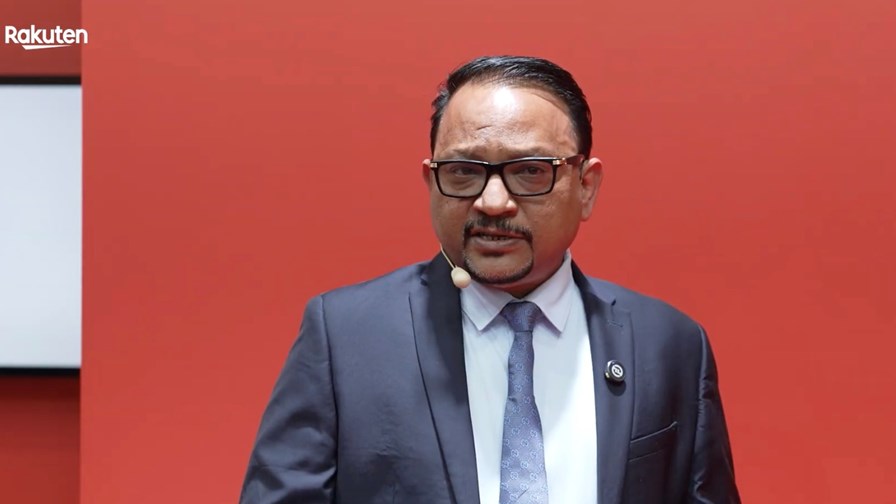
Sharad Sriwastawa, co-CEO of Rakuten Mobile and president at Rakuten Symphony, at MWC26.
- Sharad Sriwastawa has been talking up the market and technical progress being made by Rakuten Mobile and Rakuten Symphony
- Sriwastawa, who is co-CEO of Rakuten Mobile, says there is a direct link between ‘near zero’ churn and multi-service engagement
- He also gave an update on the Japanese mobile operator’s level 4 automation progress and resulting savings
- Rakuten Symphony, meanwhile, now boasts 70 customers worldwide and a $500m annual revenue run rate
Rakuten Mobile, and its parent company Rakuten Group, turned a corner in the first half of this year that, according to Sharad Sriwastawa, co-CEO of Rakuten Mobile and president at Rakuten Symphony, not only validates the company’s strategy but also lays bare the model that communications service providers (CSPs) need to adopt to thrive in the digital service era.
Sriwastawa covered a lot of ground during a relatively short media briefing held on 21 May, but he hammered home some key messages that, to be fair, Rakuten Mobile and its parent company have been sharing ever since the greenfield operator entered the Japanese mobile services market in 2020.
Rakuten Group has been under consistent pressure for its decision to enter the mobile market by building its own network ever since it started the process late last decade, as the cost of building a national infrastructure has weighed heavily on the group’s earnings. But after years of perseverance, in the first quarter of this year, Rakuten Group achieved record revenues of 643.6bn yen ($4.05bn) from its internet services, fintech services and mobile market operations, while its group earnings before interest, taxes, depreciation and amortisation (EBITDA) hit a record 108bn yen ($684.3m) and it reported an operating profit in the first quarter of the year for the first time since it launched its mobile operations.
Rakuten’s Mobile segment (Rakuten Mobile and Rakuten Symphony) is playing its part: It reported first-quarter revenues of 131.2bn yen ($825m), up by 18.5% year on year, though it is still suffering from (albeit smaller) operating losses – 38bn yen ($239m) in the first quarter.
Over the years, the Rakuten management has had to defend its strategy in the face of heavy losses incurred by the Mobile segment, but the plan has always been the same – that adding connectivity to its broad services portfolio was an essential element in attracting and retaining customers who would be loyal and deliver revenue and profit growth. For the bigger picture, see this article from 2022, when the then Rakuten Mobile CEO, Tareq Amin, noted, “What differentiates Rakuten Mobile is that we entered this business largely to drive ecosystem synergy”.
That ecosystem play appears to be paying off.
Sriwastawa noted that Rakuten Group has more than 46 million monthly active users (MAUs) across its 70 services, which range from banking to travel to e-commerce to entertainment and, of course, connectivity, all of which have a common brand. The key aim of Rakuten is to attract customers to one of the services and then entice them to use others within the ecosystem and enhance the potential of customer loyalty.
Rakuten Mobile had almost 10.4 million customers at the end of March and, according to the company, in the years since it launched, the mobile operator has signed up 2.9 million users that previously were not engaged with any of the Rakuten Group ecosystem services.
According to Sriwastawa, churn rates drop dramatically among customers that are signed up to multiple Rakuten services, with the churn rate of those who use four Rakuten services at near zero. So for Rakuten Mobile, having customers that take multiple services from the Rakuten Group ecosystem is absolutely vital to having a low churn rate, which currently stands at just 1.45% (in April). The CEO noted that the target is to reduce that churn rate to just 1.3% by the end of this year, when Rakuten Mobile expects to have 12 million subscribers.
This services ecosystem/customer loyalty approach has captured the attention of other operators too, most notably Veon Group, as we pointed out in this article from March, which is heavily engaged with Rakuten Mobile’s vendor arm, Rakuten Symphony.
Symphony now has 70 active customers and 22 partners around the world and generated revenues of $131m in the first quarter of this year, up more than 40% year on year. It also recently received $50m in funding from the Japanese government to help with “large-scale” Open RAN and RAN intelligent controller (RIC) deployments in seven countries located in the ‘Global South’ (South-east Asia, Latin America and Africa).
Part of Symphony’s role is to take technologies developed for and used by Rakuten Mobile to other markets and, Sriwastawa noted that the mobile operator has made notable progress with its network automation efforts in Japan. According to the CEO, Rakuten Mobile has achieved level 4 automation with its network power-efficiency operations and, as a result, saved 1bn yen ($6.3m) last year and expects to save 1.5bn yen ($9.5m) this year.
(Level 4 automation, as defined by the TM Forum in its autonomous networks six-step taxonomy that ranges from level zero to level 5, involves decision-making based on predictive analysis or active closed-loop management of service-driven and customer experience-driven networks via AI modelling and continuous learning in a cross-domain environment with minimal human involvement.)
Rakuten Mobile’s other automation efforts include steps to achieve level 4 automation in radio access network (RAN) fault management and in mobile core operations.
What does this all mean for the global telecom sector, which is striving for automation and forever seeking ways to increase revenues and retain customers? Sriwastawa summed it up in this blog by noting: “The era of the ‘legacy’ telco model is ending, and the era of the intelligent, autonomous network has arrived.”
We hope to dig deeper into this statement during a video interview with Sriwastawa in the coming weeks.
- Ray Le Maistre, Editorial Director, TelecomTV
Email Newsletters
Sign up to receive TelecomTV's top news and videos, plus exclusive subscriber-only content direct to your inbox.