To embed our video on your website copy and paste the code below:
<iframe src="https://www.youtube.com/embed/pQpEw2WYiGs?modestbranding=1&rel=0" width="970" height="546" frameborder="0" scrolling="auto" allowfullscreen></iframe>
No rest for us. We are going to move straight onto our next session. This is session four and we are looking at cloud native beyond the core. It is fair to say we have covered cloud native probably in every single DSP Leaders event we've done, but this time this year we want to move it and see where telcos are going next — or have to go next — and hence "beyond the core," because as we say, cloud native has kind of become table stakes. But we're finding in the work we're doing that probably only half of the telcos really qualify as truly cloud native organisations. A lot have transformed their core networks, but the rest of the infrastructure — BSS, OSS, edge, access networks and so on — do seem to be trapped behind legacy architectures. So we really want to know how operators can complete this journey and unlock the full promise of cloud native operations, because as we've heard earlier today: without cloud native, are you going to become AI native?
(01:27):
So let's see how far we can get on solving the industry's issues in 45 minutes. Franz here is going to be co-hosting with us, but first of all I'd like to introduce all our guests. If I can start on our far side.
Gary Mackenzie, SUSE (01:45):
Thank you. My name's Gary Mackenzie. I'm the General Manager for the Telco Business Unit at SUSE. I've been doing various things around open source and networks for almost 20 years now. So it's very interesting to see the changes we've seen over the last — even as long as we've been doing these events, which I've sort of been at. So it's going to be an interesting conversation.
Guy Daniels, TelecomTV (02:06):
Oh yeah. Thanks Gary. Warren.
Warren Bayek, Wind River (02:08):
I'm Warren Bayek, a member of the Office of the CTO at Wind River, overseeing the strategy and futures of the intelligent edge. And similar comments — it's amazing how far we've come in just the few years we've been doing this, Guy.
Guy Daniels, TelecomTV (02:21):
Thanks. And Rich.
Rich Stephens, Red Hat (02:23):
Yeah, thanks Guy. So Rich Stephens, VP for Red Hat in EMEA Telco. Been with Red Hat just over a year. From a cloud native perspective, I have 11 years of Microsoft before that. So I have a view from both sides of the cloud native arena. But yeah, really great to be here. Thank you.
Franz Seiser, Deutsche Telekom (02:42):
Hello everyone. I'm Franz Seiser. I'm with Deutsche Telekom Technik, so that's the technology part of the German operations. And I'm running DevOps teams that are building and running cloud native packet core networks — all the parts you need to provide data services to our customers.
Guy Daniels, TelecomTV (03:06):
Great. Thank you. Welcome everyone. Franz, as I said, is our co-host for this session. So Franz, I'm going to ask you to take to the podium and deliver our DSP Leaders address. Thank you.
Franz Seiser, Deutsche Telekom (03:15):
Sure. Thank you. Now, as Guy said, we have had this panel for quite some time and I'm at least sure it's the third time in a row where I have the pleasure to co-host it. So either I'm such a good co-host or you didn't find someone else — I don't know. But in the area where I live in Germany, they say if something happens three times in a row, it's a tradition. So welcome to the traditional cloud native panel. Looking at the previous discussions — this one will not be centred around AI, but it is still extremely relevant for AI, and I will explain why that is the case. As we heard in the morning already, we are all striving for autonomous networks, level four plus, with AI as one of the key enablers. And if you go to any of the events lately, there was one topic and that was AI, and then AI, and then AI.
(04:13):
And somehow that feels a little bit to me like you are discussing a house — you're on the second floor, discussing the rooms and the furniture, and you somehow forget there are still some questions about the basement. That's where we are, by the way. That basement is a cloud native network, at least from my perspective. And we have been discussing this for quite some time. Especially last year after the session, I was approached by some people: "Hey, you're doing so much at DT — why are you not talking more about that?" And we listened. And of course we also concluded a big part of our journey. So we published the white paper around Barcelona. If you haven't seen it, the easiest way to find it is on LinkedIn — you will see a couple of posts where we really describe how we built something we call horizontal telco cloud, which is a cloud native architecture including the cloud layer, where we have plenty of players here, but it also includes the automation layer.
(05:16):
The good thing — and I really do get the feeling that people are somehow missing this — is that luckily you had this panel before. So there are still people thinking about the automation piece, because that's really the secret sauce to get the thing going.
(05:32):
But also keep in mind — and this became clear to me when I was thinking about the concept of cloud native — when that was invented, nobody talked about AI, or only very few people. So this big change started fairly recently. But AI needs two things, as we've learned: data, reliable data, and a software-controlled or programmable network. Guess what? Both come out of a cloud native architecture. This only works if it's fully automated. And to give you a little bit of an impression, we are working toward a vision that's very simple to remember: it's 3-2-1-0. It means a new product idea — from idea and implementation to roll-out in the network — three months. Not six months, not 18 months. Three months. Two days to update a piece of the network.
(06:37):
So when you get software from the supplier, you test it, you deploy it — two days. One day if it's an emergency patch, security stuff and so on. And everything is done with zero night shifts. And the enabler again is full automation of the whole thing. If you fully automate, it's fully software-controlled — that's exactly what you need for AI to happen. That's what we're working toward, and that is also what we see happening. The second thing is that this system provides real-time or near real-time data into our data lakes — which, as was just discussed, is what you need for AI. Keep in mind, in the past you had one data point every five minutes. No AI works on a five-minute data point. And this is why it's so important to scale that out across your whole infrastructure, because otherwise all your vision of a level four autonomous network will never come to work — you won't have the infrastructure and you won't have the data.
(07:26):
So how the hell shall it work? And if you want to do it in an efficient manner, our view is: it only works if you have a proper cloud native architecture in place. Now let's see how we do that.
Guy Daniels, TelecomTV (07:39):
Franz, thank you very much. Third time co-hosting — that's just because you're the best. Thank you.
(07:49):
So we expect a lot of you in the next 45 minutes. Oh my God. And thank you for establishing this new tradition for us — we will continue next year as well, I'm sure. Look, we said at the beginning about moving cloud native beyond the core. Can we establish where telcos are transforming at the moment and which part of their infrastructure stack is being focused on next? Where are they moving beyond the core? Where are we seeing that acceleration of cloud native that we need to see? Where's it happening beyond the core at the moment? Franz, maybe we start with you.
Franz Seiser, Deutsche Telekom (08:28):
Yeah. I mean, I can't tell you what the ecosystem is doing — I can tell you what we are doing. If you would only do 5G core, it would be much too narrow. It's like thinking about an autonomous car that can steer and accelerate but cannot brake. I would not use that car. So you need to have the full set of capabilities, across the full service chain. If you only do parts, you will never get to full autonomy. So what we are doing is, of course, core — and for us core is not only packet core, it's the whole set, including customer database, voice, all the systems you traditionally call core. That's the first step, but in the end, whatever is softwarised needs to go into that architecture as the programme progresses.
(09:19):
And you know the ongoing discussions around Open RAN — I personally have tried pushing that for some time, but it's not progressing as fast as we hoped. But on the core side, we are pretty sure we will be able to bring everything into this horizontal architecture. The vast majority — my gut feeling is less than 18 months. But that's still only the core — it's not the whole end-to-end service chain. So a lot is happening. And in our architecture, there is no OSS anymore. That's all part of the orchestration and automation layer. The secret sauce in our architecture is that it's all horizontalised. There is one cloud layer, there is one automation layer — not one per system, because then you are back in the silo world. We really horizontalised everything. Every application — and 5G core is just an application in that perspective — needs to go into that system, because then you can act and work end-to-end from the very beginning and the whole system starts to scale and to work properly.
(10:19):
So that's exactly where we are going down the route.
Guy Daniels, TelecomTV (10:22):
Great. Very progressive — thanks for sharing that. Our other three guests here between them have probably got a wealth of experience talking to a huge number of telcos. So what do the three of you say? Gary, I'm going to start with you. What are you seeing from telcos as to where they are moving? What percentage of their telco infrastructure has actually been transformed to cloud native?
Gary Mackenzie, SUSE (10:43):
Well, I think first off, what Franz says has a lot of merit — there's a lot of blurring of boundaries between areas. Things we might previously have said were OSS are now being done as part of core projects, and that does move the picture quite a lot. I think this is an area where you could say almost any number and defend it reasonably. For the sake of debate, I think 20 to 30% is probably a reasonable number once we get beyond the core. I think part of the interesting question there though is how you measure it. There are sort of two sets of questions. How cloud native are you as an organisation? Does that mean how much you're adopting containers, how much you're automating your Kubernetes deployments? Or does it mean how are you getting the outcomes that we were effectively promised as part of cloud native?
(11:33):
How are those affecting business outcomes? I think for a lot of operators, there's still a disconnect between the answers to those two questions. At the extreme end, there's a risk that how cloud native you are becomes almost a vanity metric if you're not recognising the business outcomes it should provide. How much more efficient is your network? How much more agile are your operations? How much more quickly can you launch services? All those things are probably the core things we need to measure — rather than just whether we adopted the primitives and the attributes without actually getting the outcomes along the way.
Guy Daniels, TelecomTV (12:08):
That's good. Thanks, Gary. Warren.
Warren Bayek, Wind River (12:11):
Yeah. I'll add to that a little, or frame it slightly differently. I agree. In fact, one thing we need to talk about is even the definition of cloud native.
(12:20):
I think that means a different thing to different people. If you asked everyone in this room, I think you'd get everyone in this room plus one answers. Essentially, telcos had to do cloud native in the core — the move to 5G necessitated that for economic reasons. As we evolve 5G, the desire and requirement to move more cloud native procedures outside the core is what we're seeing now. And I agree — 30% is probably a defensible number. Again, it's a definition problem for me. And frankly, the technology questions are pretty well understood. We know we have to containerise. We know we have to add Kubernetes, things like that. That's really not what cloud native means. It's more about the operational procedures, the business outcome questions. Are we really treating the entire end-to-end — as Franz said, that's a really aspirational look at it — are we treating the entire telco network as one large cloud?
(13:25):
And I think today we're not, frankly. I know that aspirationally, and I know that DT is further along in looking at their network that way. So I think the answer is really operator-dependent. A variety of operators are at very different parts of the journey. But the key is to understand that this goes far beyond just containerising your workloads — that's frankly the easy part. Bringing all the things we've heard in previous panels today, the human part of this, the human part of becoming cloud native — I think that's underrated. And that's another part where I think operators are pretty far behind.
Guy Daniels, TelecomTV (14:00):
Thanks, Warren. Rich, what are your views on this?
Rich Stephens, Red Hat (14:02):
Yeah, I think it's interesting. Spending most of my time travelling, meeting Chief Network Officers and CIOs, horizontal telco cloud — as we prefer to call it, and as Franz is calling it — is prevalent in every operator discussion right now. Either projects that are ongoing, live, underway, and deployments are happening, or the planning is going on in the discussion. I think it's very true that we don't look at the domains in the same way now that we're in a horizontal mode. But it's very much focusing on core first, then looking at things like BSS — which is a challenge, but as an adjunct to core — and that's an effort that's happening as a bolt-on in most of the conversations we're having. And then we're yet to get further into edge and RAN, and that conversation is a lot further behind. But I think fundamentally the energy and the momentum right now around horizontal cloud is huge.
Guy Daniels, TelecomTV (15:02):
Good to hear. I mean, Franz, you are one of the telcos at the forefront of this. When we look at the whole spectrum of telcos from tier one, two, and beyond, not everyone is anywhere near what you're doing. Is this something you'd advocate to others as a best practice approach, or is it dependent on the size of the telco?
Franz Seiser, Deutsche Telekom (15:26):
Well, the intention behind why we did this white paper — and the other things we've been talking about — is of course to encourage people, whether they're still in doubt or haven't started the journey yet. So we've had this cloud native discussion. Yes, of course — if you take cloud native according to the CNCF definition, many network functions are not cloud native. Most likely they never will be fully cloud native because you have standards, point-to-point protocols, stateful functions. Now you can either wait another five years, sit in your silo, and stay inefficient, or say: okay, I'll find workarounds. And what we are saying is: you can find workarounds. Of course, you cannot do rolling upgrades on cloud without talking to the application first, because some applications need special care — but all of that can be done.
(16:16):
It's all about really engaging and saying: guys, from our perspective, the ecosystem is ready, the industry is ready. There are plenty of companies out there — we didn't do this on our own, we did it together with partners, and two of them are actually on this panel right here. So there is enough knowledge out there to get it going, and they can help you get there. Do we need to build it exactly like we did? We built the cloud layer ourselves, we built the automation layer ourselves, all based on open source — but nobody forces you to do it exactly like that. That's an individual discussion: how much do you want to build yourself, and how much do you want to partner? What I can also share is that in doing all of this, we did not increase our workforce by a single person. It was all done with an existing workforce that has actually been going down over time.
(17:05):
So we are also seeing efficiency effects come through and pay off. This is not coming at a higher cost. We are doing this while we have our steady decrease in workforce — so it's all doable. You just need to get it going. There is enough knowledge around the industry — just make it happen. The intention is also that we have consumed a lot from open source, so this is a way to give something back. The blueprint we're sharing is partly intended to help limit fragmentation and get more people saying: if they can do it and there are people who can help us, then we can hopefully start going down that route as well. As I said, from our perspective, this is inevitable if you are serious about autonomous level four networks.
Guy Daniels, TelecomTV (17:52):
So given you said there is enough knowledge out there, Rich, maybe I could start with you on this next point. What are the barriers that are actually preventing telcos from either taking these steps or accelerating and pushing further? Are these barriers organisational? Technical? Relationship-based?
Rich Stephens, Red Hat (18:17):
I think it's been said already, I think in earlier sessions — for us, the telcos that are most effective and most active and moving forward at pace are the ones that are trying to fix their organisational challenges.
(18:32):
You see a lot of conversations about bringing together the different cloud silos into one group and one organisation. I think the technology — between us and the open source community — is tested. It's out there, it's running, it's doing what it needs to do. Yes, we'll find new use cases and we'll build those together with our partner ecosystems. But if you really want to get to a horizontal cloud, the organisational piece is critical. It unlocks the ability to have a single common platform, which is not just a piece of technology or an installation, but an operating model, a lifecycle management capability where you're able to run most effectively. And as Franz was saying, the speed that then starts to generate does cause its own challenges, and it changes things — bringing together an IT mindset or software mindset more effectively into the network world.
(19:29):
And we're seeing it working. So yeah, all power to it and let's keep the acceleration.
Guy Daniels, TelecomTV (19:34):
Yep, absolutely. Warren, is the organisational factor at the top of the barrier list?
Warren Bayek, Wind River (19:41):
Yeah, I think it is at the top for sure. There are other barriers though. I think you hit the main points — organisationally we're seeing, just like in technology, the IT/OT convergence. The ability for the IT mindset to infiltrate the OT parts of your organisation is proving to be pretty challenging. Human beings are involved. They've built these silos culturally for many, many years. A lot of careers are tied to owning a particular piece of the architecture. So breaking those barriers is a big part of what has to happen to go fully cloud native. I will say from the technology side though — I fully agree we understand how to do this and we can do it. But what changes as you move further from the core is that the cloud native requirements fundamentally change. In the core, you're basically in a homogenous environment.
(20:38):
The further you get from that, you're dealing with a very different environment — heterogeneous hardware, where hardware matters again, as some people put it. We have to understand that as you try to cloud-nativise the extreme edge and the RAN world, you have to take into account those changes and requirements. So the things you do operationally in the core become more complicated at the edge. How we solve those problems — I think we know how to do it. It's just that we have to get from A to B and we can't wait five years. We have to do it in pieces, find the right parts and the right ways to operationalise the edge so that we can consider it cloud native and have it ready for everything the earlier panels talked about.
Guy Daniels, TelecomTV (21:27):
Interesting. Gary, we've talked about organisational barriers, about it getting more complex as you go further from the core. What else are you seeing?
Gary Mackenzie, SUSE (21:35):
I think I would echo those two points quite strongly. As both my industry colleagues have said, the technology problems are largely solved at this point. There are still maybe a few hard technical lifts here and there, but not many. Most of it is organisational — I would put that at the top of the stack. I think extending what we are doing in the core to other domains is a key challenge — finding ways to use the same primitives, the same paradigms across the estate. I think in the next few years, focus will also be a challenge. As Franz said at the beginning, everybody's focusing on the second floor, maybe decorating the house, and we're still trying to make sure the plumbing is in place in parts of it. And as we talk a lot about AI, that sucks a lot of air from the room about the underlying infrastructure.
(22:25):
And I think that, both in terms of focus and perhaps in terms of resources, will be one of the things that affects this space in the next few years.
Guy Daniels, TelecomTV (22:36):
Thanks, Gary. Franz, I don't like the fact that cloud native is in the basement — that's a bit rough, isn't it? We need to get out in the light. Where's
Rich Stephens, Red Hat (22:46):
The elevator?
Guy Daniels, TelecomTV (22:46):
Where's the elevator? There we go. We're going to use that one. Thanks very much.
Warren Bayek, Wind River (22:53):
We are there.
Guy Daniels, TelecomTV (22:53):
Franz, we heard there that it gets more difficult and complex as you go away from the core. It's surmountable — you can sort this — but it sucks up more manpower, more thought time, more resource to do that.
Franz Seiser, Deutsche Telekom (23:10):
I'm very much on the core side and I can't comment too deeply on access. Of course, we are looking at transport layers — wherever you have control software, you can talk about bringing it into the cloud and making it part of that architecture, and that will happen step by step. There is also a second well-known activity going on, which is called A4, which is publicly discussed in many areas, where we are trying to do a lot of change on the fixed access side following similar paradigms. But access projects run on completely different timelines. The good thing is that core projects can be done much quicker because you don't have the problem of hundreds of thousands of sites to touch. And if you don't do it right the first time, the most expensive thing is having to go back and fix it.
(24:03):
So it's much easier. And I think the economics for the time being also seem to work much better for more centralised systems. But for whatever is a centralised system, there's hardly any reason not to go down that route. And then it becomes more of a discussion about whether you go on a private cloud, like we built — that's one of the ongoing discussions. What do you put on your private cloud? Where do you co-locate? Because even though we build on our own cloud, that doesn't mean everything goes on that cloud. That cloud is really built for network production. Can it compete with the dynamics and different loads you can get from a hyperscaler? No. And with hardware prices as they are, we cannot afford to have thousands of spare servers just in case. So different parts of the whole network machinery need to be solved differently.
(25:02):
So really what we are looking at is production of connectivity services. Some BSS you can also discuss — does BSS need to go on my private cloud, or can it sit somewhere else, much more cost-efficiently? Because in the end, we are always looking at efficiency as well.
Guy Daniels, TelecomTV (25:18):
Thanks, Franz. Just going to give some advance notice to our guests at the back of the room — start thinking about a question because we're coming to you in about five minutes. So, this is DSP Leaders, this is digital service provision. What new digital services are possible once your network infrastructure is fully cloud native, or as near to fully cloud native as we can get? What becomes possible then? Warren, when you have your conversations, what's being discussed in terms of services? What are we looking at?
Warren Bayek, Wind River (25:55):
So this is the real question, isn't it?
Guy Daniels, TelecomTV (25:57):
This is it.
Warren Bayek, Wind River (25:58):
When I sit with operators, it's the very first question I ask after going through the whole presentation: what do I do with all of this? How do I make money? This is the core question. And in the end, why are we here? Why do telco operators even exist? It's really to provide services to our customers — we can't forget that. So right now, voice and data and connectivity are what we've monetised over the years. I don't know if it was at the last session here or last event, but we heard that for the past 10 or 15 years, telco growth has been capped in the low single digit percentages. The growth of this industry is very low. So in order to change that, we have to get to new services.
(26:47):
So all of that to say — what are those new services? The key thing is to look at what we're building toward: once we build an entirely cloud native infrastructure, to not think of it as a telco environment anymore. It's really a programmable cloud, everywhere. And what I like to say is: telco operators have built the most unbelievable real estate empire. You have hundreds of thousands of sites worldwide, and you uniquely give access to all your consumers in places that no other industry can reach. So what you do with those sites — frankly, there are a lot of smart people in this room and on this stage. We can't possibly begin to imagine all the use cases that are going to be possible once we build this service infrastructure.
(27:45):
One that I like to talk about — and one of my esteemed colleagues is here — is the treating of a car as a mobile data centre. Cars aren't just vehicles anymore. They're rolling data centres. So the ability to monetise things like — we showed something at MWC — through a partnership with an insurance company, we were creating safer driving scenarios. Insurance is the largest industry in the world by a large margin. If you can save a very small amount of money per driver for an insurance company, that's something very valuable to them. And as a consumer — I'm in the US — I'm not going to give Verizon any more money for my cell phone. But if they can get me to save $50, $100 a year on my car insurance, I will gladly put that into a pot and they can divvy it up through partnerships.
(28:39):
And that's one way I see telcos monetising these kinds of environments — finding partnerships with large industries that can use the real estate empire they've built.
Guy Daniels, TelecomTV (28:49):
How much of this though is down to the cloud native transformation programmes of the networks? Because we've been covering this, as you said, since the very beginning — 2019, our first event, we advocated cloud native first, be able to offer these services second. And now we get AI in the mix, and now we're here in the cloud native to AI native services conversation. Is this dynamic changing at all, or is it just the same thing wrapped slightly differently? Gary?
Gary Mackenzie, SUSE (29:19):
I would say AI is in part the missing piece of the puzzle that we've been looking for. As Warren says, telcos have phenomenal real estate, but that goes beyond the locations and into some of the data as well. Being able to monetise that has to some extent always been the dream. And I think AI may be the missing piece of the puzzle that lets us do new things with that. I would very much echo the sentiment that there is so much potential — it would be foolish for anyone to stand up and say they are certain about what the core service offerings that will drive future revenue are. I think that's wishful thinking. But there is a lot of potential out there. I think the core thing right now is we're at a point where we can start doing things that don't scale, to prove the revenue demand in some areas.
(30:16):
In the past, because we lacked agility in some places, we've had to commit to ideas quite wholeheartedly. And perhaps what cloud native gives us is more agility, so that we don't have to commit quite so completely. We can try concepts more easily and not all of them will work, but the cost of doing that is coming down through cloud native — that should be the outcome we're looking for.
Guy Daniels, TelecomTV (30:45):
Sure. Thanks, Gary. And Rich, these new digital services, these new business models we talk about — are they really only fully realisable with a full cloud native transformation? Or what about the hybrid setup? We were talking at the beginning about only half the infrastructure being cloud native and moving forward.
Rich Stephens, Red Hat (31:04):
So common platform is a well-used term. And in reality, in a perfect world, yes — a common platform across everything with one management plane, one automation capability does give you the ability to do things like opening network as a service, being able to open to the development community, the ecosystem, the open source community, which is enormous and full of incredible people and incredible use cases. As Vish was saying earlier, use case driven — we get to a point where you can expose, and we've been talking about opening the network to the world for a while now. The ability to have that development community working and treating the network as an enabler for software development, I think, is a key place where we're going. And in reality, that should be able to work — yes, in an ideal world.
(31:59):
It would be cloud native across the piece. Hybrid can work for some things. I mean, we're working with a few B2B providers where we're basically inside the B2B world, offering a cloud native estate to enable applications from cloud to edge, and that works really well for certain use cases. But does it have the scale and the impact of doing it left to right across the total estate? No. But it still is revenue-generating into new areas. And as Warren was saying, how do we get the industry from single digit to double digit?
Guy Daniels, TelecomTV (32:33):
Thanks, Rich. Look, I did say we'd come to the back of the room. Tony, have you found someone back there?
Neil McRae, CityFibre (32:38):
Neil had his hand up before — oh, it's up again now. Hang on.
Franz Seiser, Deutsche Telekom (32:42):
Middle of the room.
Neil McRae, CityFibre (32:44):
I'm not really at the back of the room, but I'll take it. So it's kind of interesting — I built BT's network cloud many years ago for a 5G rollout, cloud native, and it was hard. So everyone's saying this is easy. Maybe it's got easier, but I think it's brutally hard — especially when you're debugging PCI drivers because someone wrote them one way and someone wrote them another. I would challenge anyone who thinks this is easy to think again. Because I'll use a very well-known line: if it was easy, everybody would have one, and they don't. I do agree with the gentleman from Red Hat that telcos are looking at this. Because what did they do? They went and bought Nokia's full stack or Ericsson's full stack, and then they couldn't run the use cases they wanted to run on them because they were told, "We're not going to support that."
(33:43):
But this is not an easy thing to build. It is super hard. Even the standards from OCP don't actually come out working in the way you think they're going to work. So when you've got a really hard thing like that and then you've got a bunch of leaders saying "I get fired if we screw up," no one's going to go build this. And actually, even if you build the platform, migrating to it — we're going to migrate 30 million SIMs to this platform — it's so difficult to do. So I'd like to understand from those who said it was easy, what has changed over the last few years that makes it easy.
Guy Daniels, TelecomTV (34:27):
Thank you, Neil. So is this still a very difficult undertaking?
Warren Bayek, Wind River (34:35):
Yeah, I want to answer this. I'm shocked that you'd ask a question, Neil. No, I hope no one heard or said this was easy — it's very difficult. As I said, as soon as you go from the core, where you do have more homogenous hardware, to the edge, every site potentially has something different, however small. And things like drift of hardware and drivers — the exponential problem becomes massive when you go to the edge. Frankly, the RAN edge where you have tens or hundreds of thousands of sites — controlling that through AI is part of what has to happen. Can it be done? It is being done. In the US we have a massive rollout with Verizon where they're doing it. They're running into problems all the time, I'll be honest.
(35:33):
It's a very complicated environment. Disaggregating this system is very complicated. Working together as an industry to find solutions to these complex problems is the only way we're going to do it, frankly. It's going to be a consortium of people. Folks like Red Hat and Wind River are working together to find better solutions to infrastructure problems like this — that's the only way we're going to solve it. And I want to add something quickly: we heard that we're going to create a more agile environment. And while I agree with that for a lot of the software services that sit on top of infrastructure, these environments can't be agile at the infrastructure layer. We can't afford to try things. As you say, people get fired if PCI drivers go down, if hardware doesn't run, if network cards don't work. In America, if 911 service fails, people are sitting before Senate subcommittees explaining why their services went down.
(36:32):
So there's a balance to be struck between how quickly we can build the infrastructure and how much agility we give to services that sit on top of it. We have to be very careful and very pragmatic with how we go cloud native in terms of infrastructure.
Guy Daniels, TelecomTV (36:49):
Thanks, Warren. That's really good in reply to Neil's point. Rich, would you want to come in as well?
Rich Stephens, Red Hat (36:55):
I was just going to say — to Neil's point — we spend as long with operators on operating model in a horizontal cloud as we do selling the technology. I think it's critical. We sat recently with a head of network ops at a tier one and he said, "If I go global with this, I'm going to be doing 500, 600 releases a year. How am I now responsible for all of that?" When before it was obviously managed by someone else in a contained environment. So the shift of risk, the shift of ownership — we all talk about this across our industry, the lack of a single throat to choke, because now it's your own throat, in effect. And I think that's the bit that takes an awful lot of time. So it's definitely not easy, Neil. But there are models being built. And as we go operator to operator, the learning increases, the skills increase, and the ability to offer the right fit — I think that's definitely where the progress is.
Guy Daniels, TelecomTV (38:00):
And Gary?
Gary Mackenzie, SUSE (38:01):
I think I was going to say that acknowledging it's a known problem space — which is probably where we've got to in the last few years — is not the same as saying it's easy. You could choose any number of analogies. Rocket science is hard, but we managed to send people into space. I think we are getting to a point where that known problem space is making it not easier, but we know the patterns, we know how to do this a little bit more reliably now, and that's going to improve. It doesn't mean it's easy. It's going to take a village from the ecosystem and the industry to do it. But it is a known problem space — and it remains hard.
Guy Daniels, TelecomTV (38:40):
Thanks, Gary. Franz, to Neil's point there — is it getting easier? Are we doing things collectively as an industry to recognise what's difficult and make it simpler?
Franz Seiser, Deutsche Telekom (38:54):
Yeah. The thing has come a long way. I mean, 2019 — I agree, we had all this discussion about whether you're allowed to use SRv6 or not, and this and that, and faults here and there. But it has developed quite a bit. It has developed on the supply side, so it's much better understood what to take care of. Dependencies are much better understood — application suppliers know what they need to look at on the driver side, so there's much better integration. I measure it by how long it takes to onboard a new application in the environment, and that time has decreased significantly. The number of issues we found, and how long it took to get the whole thing stable and scalable — those numbers have really gone down tremendously.
(39:46):
I mean, if this should not have happened over five years, then I think we would have done something wrong. Is it a piece of cake? No. But we know much better now how to look at it. We have the right test procedures. We know the right staging procedures — what to test first. If that passes, you can be quite sure the next step will also go. So the whole mechanism is much better. And also — and we didn't focus on this enough when discussing challenges — it's not only organisation, it's probably even more the mindset of people. As you just said: you are responsible now, as DT and as a DT employee. You cannot blame a single supplier anymore if things go wrong, because it's your duty to make sure this works. That change in mindset, and this much more collaborative way of working — there's no longer a vendor you can beat all the time who accepts it because they get paid for it.
(40:35):
That was one of the biggest things to drive through. And now people know that only if they work together, if they sit together as a team and figure out what the issue is, can they succeed. Suppliers sit at the same table as our own people, but we know that at the end, we are responsible for integration. There is no third-party company that absorbs that. That is really the biggest thing. And that's what we see every time we bring a new application — we also make sure that the people who were in the old model, going through that process, are coming with us. They learn how to work in the new environment. We make sure the mindset journey is happening, and that's one of the key enablers to making this model successful.
Guy Daniels, TelecomTV (41:12):
Great. Thanks, Franz. Now we only have a couple of minutes left. So I just want to put one final quick question to you all. This is the cloud native beyond the core session. We heard earlier that maybe beyond the core we're about 30% of the way through the cloud native transformation journey — subjective, I know, it's a rough figure. So in order for us to double that, to get to 60, 70, 80%, where should telcos focus? Are there any specific domains that should be tackled next to accelerate this — to find the elevator and get to the penthouse as quickly as possible? And what sort of timeframes? Gary, any specific domains you'd recommend?
Gary Mackenzie, SUSE (41:59):
I mean, what I would say is: a cloud native network is not going to realise its full potential without cloud native orchestration and automation. So if I had to invest a dollar, I would look at the OSS space as the next priority. I'm always reminded that somebody once told me the peak of mainframe install capacity was in the late 2000s — 2008, 2009. And the reason I say that is it takes time for this to reach the edges of the business. So I think the timeline is going to be longer than we perhaps expect, and that's okay. To double where we are now, I think we're probably looking at the 2029, 2030 timeframe.
Guy Daniels, TelecomTV (42:42):
Yeah. Timelines are always longer than we expect, aren't they? Warren?
Warren Bayek, Wind River (42:46):
Yeah, I'd echo that. I think operations — day one and day two operations — has to be the next big win. Until we do that, we really don't have a lot to lean on. So I think we have to get the OSS, then get that operations part into a cloud native environment. I agree. I'd like to say it's going to happen this year, but I think you're talking a three-year project.
Guy Daniels, TelecomTV (43:12):
Yeah. Thanks, Rich.
Rich Stephens, Red Hat (43:13):
Yeah, I echo that. We're expanding our portfolio to deal with day zero and day one operations in order to help and support operators — to give them a bit more support rather than just moving into this somewhat scary world of open source. But I think — maybe because I have a billing background as well — BSS always seems to be the next element after you get the automation and the orchestration working. So yeah, that would be it for us.
Guy Daniels, TelecomTV (43:41):
Thanks, Rich. And a final word to our co-host — any advice for telcos as to where to focus next?
Franz Seiser, Deutsche Telekom (43:49):
Start. Go with it. The most important thing — if you're not already on the journey, start down that route. Start with the most, from an application perspective, easiest to do, which is 5G core, because that's cloud native by design. Of course there's enough complexity there too, but there are sufficient suppliers and a full ecosystem. So start small, start learning, and grow from there. That's what we did some years ago and it worked out, and that's what we are going to continue to do going forward. We started in the core. We have a clear plan. And then step by step we will add additional domains as they are ready — as their timing and development are ready to come. We will provide the whole machine. The good thing is, whatever you bring into this environment, you immediately benefit from all the stuff we've discussed, because it's all part of the architecture.
Guy Daniels, TelecomTV (44:41):
Great. Franz, thank you very much. Well, we must end our session there because lunch is awaiting us and we can't delay lunch. So let's have a round of applause for our guests, please. Thank you.
Please note that video transcripts are provided for reference only – content may vary from the published video or contain inaccuracies.
Panel Discussion
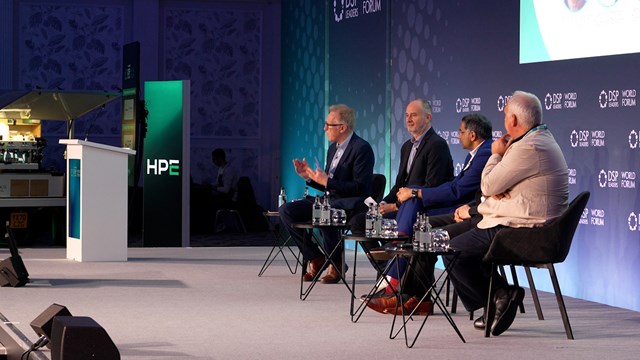
In this panel discussion at DSP Leaders World Forum, Franz Seiser from Deutsche Telekom Technik explains how the operator is extending cloud-native principles across its full service chain, not just the 5G core. Industry experts from SUSE, Wind River and Red Hat join him to explore current cloud-native adoption levels, and examine the operational and business challenges operators face in achieving true cloud-native outcomes rather than just adopting the technology primitives.
Broadcast live 19 May 2026
Participants

CO-HOST
Franz Seiser
VP, Tribe Lead T-DAT, Deutsche Telekom Technik

Gary Mackenzie
Telco General Manager, SUSE

Rich Stephens
Vice President, EMEA Telco, Red Hat

Warren Bayek
VP, Intelligent Edge, Wind River