EC bigs up its tech sovereignty ‘package’

By Ray Le Maistre
Jun 4, 2026
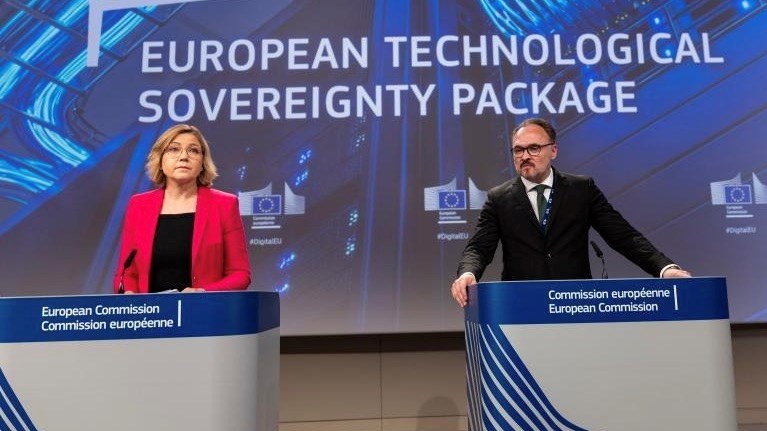
EC commissioners Henna Virkkunen, executive VP for Tech Sovereignty, Security and Democracy and Dan Jørgensen, Commissioner for Energy and Housing, unveil the tech sovereignty package.
- The European Commission has put together a set of measures it believes can result in greater digital sovereignty for the region
- It wants to reduce Europe’s dependency on tech and infrastructure from other regions
- But there’s no sign of any capital commitments
- And little tangible evidence that this really is ‘a major shift’ in the EC’s approach to digital sovereignty
Only hours after the CEO of Telefónica stated that “European sovereignty requires simplifying regulation, building our own technology and accepting the risk of failure”, the European Commission (EC) has unveiled a set of measures, dubbed the European Technological Sovereignty Package, that it hopes will “strengthen Europe’s capacity in semiconductors, artificial intelligence (AI), cloud and open source”.
According to the EC, which noted that “Europe remains heavily dependent on suppliers outside the European Union for core digital technologies”, the move “signals a major shift in the EU’s approach to technology” and is “designed to reduce structural dependencies and make sure Europe can develop, deploy and secure the technologies Europeans rely on.”
The package includes two legislative proposals – the Chips Act 2.0 and the Cloud and AI Development Act – as well as the EC’s ‘Open Source Strategy’ and a ‘Strategic Roadmap for Digitalisation and AI in Energy’.
Combined, the EC believes these measures will “support Europe’s ambition to become an AI continent, strengthen its digital autonomy and help build a more sustainable digital future. They will help widen choice in core technologies for EU businesses, citizens and public administrations,” according to the commission.
EC president Ursula von der Leyen stated: ”We cannot afford to depend on others for the technologies that keep our hospitals running, our energy grids stable and our services secure. This is about protecting our citizens, defending our interests and making our own choices. Europe has the talent, the research excellence, the industrial base and the single market. Together, we must turn these strengths into technological sovereignty.”
What von der Leyen didn’t mention there was the capital/money required to develop the supporting infrastructure needed to make Europe’s dreams of digital sovereignty a reality.
The new EC announcement doesn’t mention any numbers, but does note that the EC will “launch a consultation with the member states, the European Investment Bank Group and other key stakeholders to set up a European equity capacity at scale to finance Europe's tech sovereignty ambitions.”
For reference, a paper issued in February 2025, The EuroStack – Building a European Alternative for Technological Sovereignty, put the cost of developing Europe’s own vertical stack capable of ensuring technological independence from other world regions, while simultaneously increasing its competitiveness, at €300bn over 10 years, of which €150bn would need to be committed and invested by 2030.
That cost estimate seems modest, while the timeline seems reasonable if unachievable, given the snail’s pace at which European decision-making bodies tend to act. (There will be an example of this in a moment…)
So what’s actually happening?
The EC recognises that the European Chips Act, in force since 2023 and developed to try to ramp up Europe’s chip production capacity, hasn’t moved the needle much. The aim of the Act was to double the EU’s share of the advanced semiconductor market to 20% by 2030, and investment incentives were announced, but “Europe still relies heavily on third [-party] countries for advanced production and chip design. AI-related components are expected to drive future growth and make up over 70% of the semiconductor market by 2030,” notes the EC in its new announcement.
So what will change with Chips Act 2.0? Apparently, it will “build on Europe’s strengths, including in mainstream chips, and build capacity in cutting-edge semiconductor technologies that power AI applications. It will speed up permitting, deepen cooperation with like-minded partners and introduce a new excellence label for Europe’s semiconductor regions. Also, by adopting an ecosystem approach, it will bring European chipmakers closer to their customers and build on the demand of growth sectors, such as datacentres, cloud providers and AI gigafactories. Finally, it will support investment and strategic projects, while addressing vulnerabilities that could put supply at risk.”
Ah yes, the AI gigafactories… That’s the kind of initiative that would be a significant step in the right direction, given that Europe accounts for less than 20% of the world’s datacentre capacity and the major investments in AI datacentres announced during the past 12 to 18 months have largely focused on the US, Middle East and South-east Asia.
The EC originally set out the details of its ambition to build a “network” of AI factories and construct AI gigafactories in its AI Continent Action Plan in April 2025, having announced the concept in February last year, when von der Leyen launched InvestAI, an “initiative to mobilise €200bn for investment in AI, including a new European fund of €20bn for AI gigafactories”.
The aim of the initiative is to at least triple the EU’s datacentre capacity by around 2032, with “highly sustainable datacentres” as the priority.
But where is the EC with this initiative? The EC notes that it will “continue its work to make Europe an AI continent and is expected to launch a call for AI gigafactories in July, following the European High Performance Computing Joint Undertaking governing board’s agreement in principle on 1 June.” A call in July…. But when will anything actually happen?
As for the Cloud and AI Development Act, it is “a central part of the commission’s AI Continent Action Plan. It aims to triple datacentre capacity in Europe over the next five to seven years and strengthen the role of the Apply AI strategy to boost adoption. The Act will support research and innovation in cutting-edge and sustainable technologies, while balancing AI ambitions with climate commitments. It will streamline conditions for deploying datacentres across the EU, with a focus on highly sustainable and innovative facilities at the scale needed for the green and digital twin transition. It will also introduce a single EU-wide framework to assess cloud and AI sovereignty, while keeping most of our market open to like-minded partners.”
And there’s more. “This will help protect critical applications and sensitive data, and support the development and roll-out of advanced cloud and AI technologies. It will also support a more coordinated approach to AI uptake across member states, including through the Experience and Acceleration Centres for AI that act as local hubs to support AI integration and scaling.”
With regards to the Open Source Strategy, this aims to leverage the capabilities of the 3 million open-source contributors resident in the European Union to “develop and provide more sovereign solutions. It will scale up open-source alternatives in priority areas, such as cloud, AI, internet technologies, cybersecurity and semiconductors. It will also promote a stronger open-source ecosystem by investing in skills, supporting open-source start-ups, and improving the long-term maintenance and security of Europe's open-source digital infrastructure. The strategy will also support greater use of open source in public administrations through procurement guidelines and practical best practice. It will encourage uptake of European solutions and support standards and interoperability, including through initiatives such as the Open Internet Stack.”
To its credit, the EC is also addressing the thorny topic of power supply – if Europe is to build and run chip fabrication plans and build AI gigafactories, the electricity supply sector will require significant support to ensure environmentally responsible supplies at affordable prices.
According to the EC, the Strategic Roadmap for Digitalisation and AI in the Energy Sector “sets out how AI and other digital solutions can ensure the sustainable integration of digital infrastructure in our energy system, while at the same time help make Europe’s energy system more efficient. This roadmap will ensure that datacentres are integrated into our energy system in a sustainable and transparent manner. The commission will facilitate cooperation between the energy and digital sectors to ensure their efficient integration into the grid as well as the necessary clean energy supply, while safeguarding water and energy resources.”
The EC also pledges to “accelerate the deployment of digital and AI solutions to improve and smarten Europe’s electricity infrastructure while supporting a faster roll-out of smart meters which are key to give European consumers more control over their energy use and ultimately lower energy bills. Furthermore, it will help build sovereign and secure AI models for the energy sector, trained on European data and developed by European companies. By simplifying the exchange of cross-border energy data, it will ensure the uptake of smart energy services and flexibility which can bring about savings for millions across Europe.”
This is all very well, but it smacks of lots of plans and talks and comments, and little in the way of tangible progress and activity. If Europe is going to develop sovereign digital infrastructure and development capabilities that are meaningful, actually make a difference and deliver affordable, timely and relevant end products and services, then it needs a lot more action to back up its optimistic proclamations.
If this really is “a major shift in the EU’s approach to technology”, then the EC will need to show some proof-points, not more documents or announcements, in the next 12 to 18 months, because the rest of the world isn’t sitting on its derrière.
- Ray Le Maistre, Editorial Director, TelecomTV
Email Newsletters
Sign up to receive TelecomTV's top news and videos, plus exclusive subscriber-only content direct to your inbox.