- Synergy Research predicts US datacentre capacity will double in the next three years
- T-Mobile chief fires warning shot at Starlink ahead of satellite JV approval
- Verizon announces record EBITDA in Q2 results
In today’s industry news roundup: US datacentre capacity is set to double over the next three years, according to Synergy Research; T-Mobile CEO Srini Gopalan reveals more about the proposed satellite JV with its rival telcos; Verizon seems bullish after posting the highest EBITDA the company ever reported in its Q2 results; and much more!
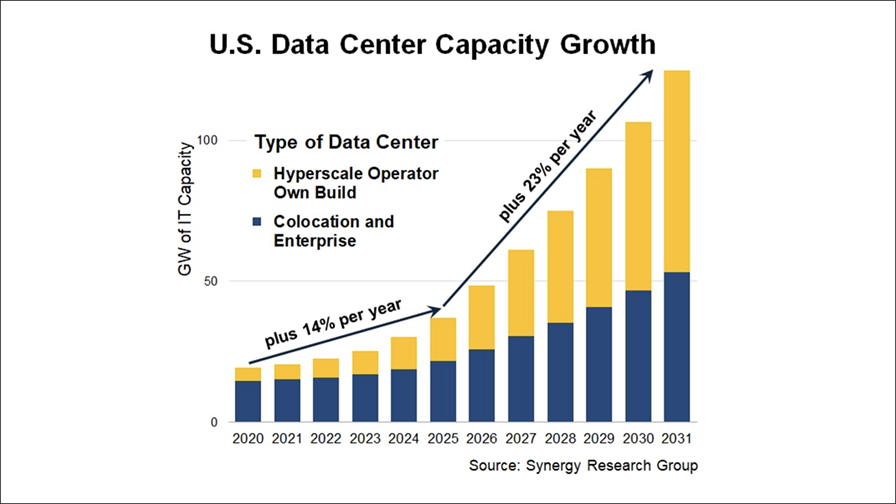
Despite multiple challenges, including power supply constraints, local protests and state government interventions, the total capacity of US datacentres is set to double over the next three years, driven by the aggressive build-out plans of the hyperscale operators, according to Synergy Research Group, a trusted source of datacentre sector analysis. The US is already by far the largest datacentre market in the world by capacity and that isn’t going to change: Synergy Research’s known pipeline of future datacentre deployments includes more than 700 facilities in the US that will support about 45 gigawatts (GWs) of new capacity before the end of the decade, it noted in this press release. John Dinsdale, a chief analyst at Synergy Research Group, noted: “It is indisputable that constrained availability of power and rising local concerns over datacentres are crimping many new plans… But it is also clear that datacentre developers will continue to find ways around those issues and that booming demand will continue to drive aggressive capacity growth. Over the next five years, the US will continue to account for well over half of the world’s operational datacentre capacity. Seven hyperscale companies are driving much of that growth as they build out their US AI campuses, but we also see another 67 companies that are building large datacentres or campuses in the country.”
T-Mobile US CEO Srini Gopalan has issued a very clear reminder to its direct-to-device (D2D) service partner Starlink that soon it won’t be the only game in town, as the US operator closes in on a final agreement to launch a D2D joint venture with rivals AT&T and Verizon. Last year, the carrier partnered with Starlink to launch its T-Satellite service, and it has an exclusivity agreement with the SpaceX subsidiary until at least the end of 2026. But in May, T-Mobile and its rival US operators unveiled plans to launch a joint venture (JV) that will offer D2D services, and according to Gopalan, a final agreement is “progressing rapidly”. This service could be provisioned by Starlink or its potential rivals, which include the likes of Amazon Leo and AST SpaceMobile. Speaking on T-Mobile’s latest financials call, Gopalan said he expects the vast majority of D2D services will be sourced through the joint venture, once it is up and running. “It is a complementary service,” he added. “What is at stake now is to make the customer agnostic of which provider and device you are, and to pool spectrum to make this a much better customer experience. This is what drove the JV. The JV does allow individual operators to have conversations and agreements with other parties, but our expectation is the vast majority (of D2D satellite) will be sourced through the JV,” noted the CEO. During the same call, T-Mobile US chief Gopalan was asked why the carrier isn’t focusing more on low-earth orbit (LEO) satellite-enabled broadband services as opposed to 5G-enabled fixed wireless access (FWA). The CEO said that “as the technology stands today, fixed wireless access is a far superior product, so there is no value for us beyond backup in partnering on this.” He added that any partnership needs to bring differentiation and that’s something T-Mobile US isn’t seeing currently from satellite broadband.
Verizon’s management team is feeling good about itself after the US telco announced record results for the second quarter of this year and raised its full year guidance. The telco reported a 2.8% year-on-year increase in mobile and broadband service revenues to $23.4bn as it gained 184,000 postpaid phone customers and 348,000 fixed broadband customers. Consolidated adjusted EBITDA grew by 7.2% to $13.7bn, “the highest the company ever reported,” it noted. CEO Dan Schulman is bullish about the impact of his recent strategic efforts. “We’re putting customers at the centre of every decision we make,” he boasted. “With recent updates including our new Simplicity plans, Verizon One converged offerings, and an industry-leading loyalty programme, we are gaining subscribers and earning long-term retention based on real value rather than subsidised promotions. Our second-quarter results provide clear, compelling evidence that this transformation is driving a structural inflection point across our entire business. We are accelerating across our key metrics, achieving a step-change in churn reduction while lowering our customer acquisition and retention costs. By compounding lower churn with healthier unit economics, we have generated the strongest operating position we have seen in years. Our core connectivity business is gaining momentum and, with the emergence of AI infrastructure revenue, we are fundamentally reshaping Verizon’s growth trajectory.
It was a tough quarter for Virgin Media O2 (VMO2) as revenue, earnings before interest, taxes, depreciation and amortisation (EBITDA) and customer numbers all fell in the second quarter. The UK operator’s latest quarterly financial results show that total revenue for the three months to the end of June was down 7.9% to £2.042bn (down 3.8% when adjusted for the Daisy B2B merger), while EBITDA fell 2.9% to £975m. Its customer base fell in both fixed, with a net loss of 29,900, and mobile, where it saw a net reduction of 29,200. However, the operator was keen to point out it lost 53,000 fixed customers in the second quarter of last year, so its losses have at least slowed down. Overall, its full year guidance hasn’t changed – it still expects a total service revenue decline of 3% to 5% year on year, and an adjusted EBITDA decline of the same magnitude – both adjusted for the aforementioned Daisy transaction. CEO Lutz Schüler said: “Our performance in Q2 is in line with our full year guidance. It reflects the continued navigation of a highly competitive market backdrop, a focus on execution and transformation in our three operating areas – consumer, B2B and wholesale – and a relentless commitment to improving customer experience and building strong foundations for future growth.” The quarterly report also reveals that VMO2’s fibre footprint (including that of its Nexfibre joint venture) now reaches more than 9 million premises across the UK.
Belgium’s competitions watchdog has given the green light for Proximus and the Telenet Group to collaborate on plans to roll out fibre networks in the Flanders region of Belgium. Proximus, through its affiliate Fiberklaar and Telenet’s Wyre, have committed to more than two million fibre-connectable homes and businesses by 2037 – with the majority to be connected by 2029. The Belgian Competition Authority approved the cooperation, allowing the two companies to divide fibre deployment in designated suburban areas of Flanders rather than building duplicate network infrastructure. As part of the deal, the commitments will be monitored by Belgian telecom regulator BIPT, and other operators will be allowed to use the shared network. According to the partners, the arrangement will allow them to accelerate the rollout of fibre, reduce disruption, and give customers access to speeds up to 10 times faster than those currently available in the region.
Intel reported a 25% year-on-year increase in second-quarter revenues to $16.1bn and an operating profit of almost $1.8bn compared with a loss a year ago, though the chip giant did suffer a massive net loss of $10.85bn due to a non-cash $12.58bn accounting charge. CEO Lip-Bu Tan stated: “AI is driving unprecedented demand for compute, and as we continue to execute, Intel is well positioned to capture sustainable growth across our CPU franchise, ASICs, advanced packaging and vast wafer foundry network. Our Q2 results represent our strongest revenue growth in more than fifteen years, enabled by greater speed, accountability and customer focus.”
British international data network operator RETN has announced a new route linking London to Brussels, with onward connectivity into the rest of mainland Europe. Much of RETN’s UK international traffic is currently routed through its hubs in Paris and Amsterdam, but the operator wanted to add an alternative path through Brussels to boost resiliency. It avoids the network-dense Docklands area of London by taking alternative routes. The route supports a newly built dark fibre network linking Brussels and Rotterdam, which RETN says will support its plans to operate a DWDM network in Belgium.
– The staff, TelecomTV
Email Newsletters
Sign up to receive TelecomTV's top news and videos, plus exclusive subscriber-only content direct to your inbox.