Moving beyond AI pilots to business transformation

By Tony Poulos
Jun 1, 2026
To embed our video on your website copy and paste the code below:
<iframe src="https://www.youtube.com/embed/14xY9sZecB8?modestbranding=1&rel=0" width="970" height="546" frameborder="0" scrolling="auto" allowfullscreen></iframe>
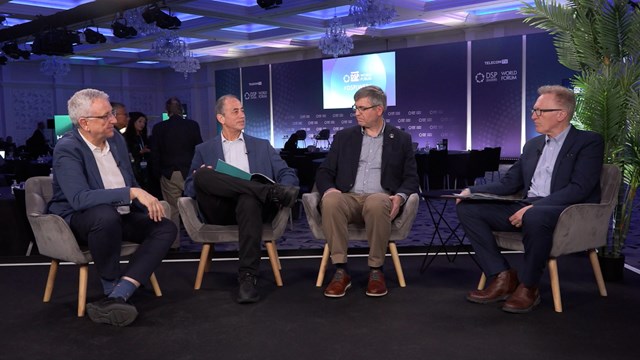
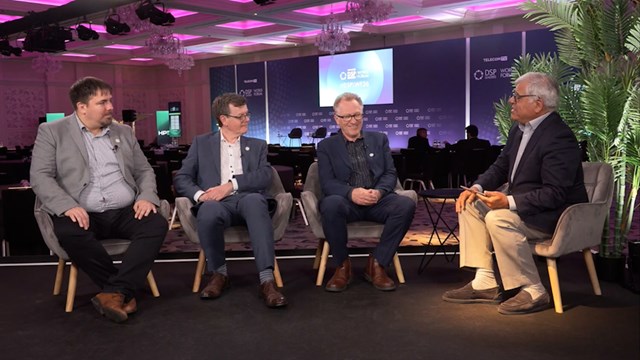
Hi, I'm Tony Poulos and I am at TelecomTV's DSP Leaders Forum in Windsor. We've had a fabulous first session today and this is all about Extra Shot. The Extra Shot is where we cover some of the things that were raised in the earlier sessions and find out a bit of background to them and what other people might think. And helping me today, I have Chris Lewis, who is the managing director of Lewis Insights. Welcome, Chris. Good to see you again. Next to here, we've got Anna Lester, who is account executive at Dell Technologies. Welcome Anna. And last but certainly not least, Prashant Agarwal, who is the head of business development for Telco EMEA at Intel Corporation. Thank you all for coming. Chris, the first session today, I really wanted to talk about AI and scaling AI deployments in particular. What stood out for you this morning?
Chris Lewis, Lewis Insights (01:05):
I think the industry's continued obsession with AI being at the centre of everything always worries me because we seem to be losing sight of the fact that actually delivering the product and service to the customer is where the money gets generated from. We spend way too much time focused inwardly. But the thing that came out that really struck me were Amdocs commenting on the way that actually getting all the people together with an interest in AI and how it might roll out, that came across very strongly to that more cultural change rather than the technology change and the fact that we're still talking so much about proof of concepts, but actually I think it's much more important to have the leadership in the organisation where it's understood how AI fits into the business, not how the business fits into AI. So I think we're almost straightjacketing ourselves as an industry by being obsessed about the building blocks, the components.
(01:57):
And with all due respect to my co-people on the panel, we need those elements. But I think to shape the whole discussion around AI and to scale it for the good of the business, we have to think about that cultural side of it, the business flow side of it, and then we can adapt the technology bit to fit in with that. So I think there's so many moving parts. Everyone has their own interpretation of what AI is and we know it will affect every part of the business, every part of our lives and business lives. But I think we just need to step back and shape it with that cultural view, make sure we get the right tools in the right hands and we don't just get obsessed about what AI is because it's not everything, right? It's a tool we should be using.
Tony Poulos, TelecomTV (02:38):
And Anna, what do you think?
Anna Lester, Dell Technologies (02:41):
I do agree. I think that what came out today is that AI seems to be the goal, but actually the goal of AI is better decisions. And I think we're forgetting that AI is part of creating these better decisions. And I think we are fully drowning in the amount of pilots that we have at the moment. And I think we're doing pilots in siloed areas of the business. And then we've got really big messaging coming down from senior leaders. They need to get their CX scores up. They've got investors coming in, they need to get their money back to them. They need to show transformation, but yet they're not really focused on where are we creating better decisions? How do we do that? Where are the best places to start? And actually that's with your data.
Tony Poulos, TelecomTV (03:29):
I want to come back to that in a minute. Prashant, what are you thinking?
Prashant Agarwal, Intel Corporation (03:32):
To be honest, the one thing I realised it's not about the lack of ideas anymore. To be honest, if anything, operators have a lot of ideas, but it is all about how we take those ideas, those proof of concept, make it to something tangible, which can deliver some benefits.
(03:48):
And in that sense, I think we should not think AI as a destination. AI is just like a tool to help us to get those measurable parts, like how can we achieve better network? How can we have efficiencies? And that was the thing which I realised POCs. And other thing also, to be honest, another part I mentioned, some of the panellists were talking about data. I mean, how the IT and infrastructure guys, they're not willing to share the data. Those were a couple of things which highlighted very nightly. So because they are sitting on a gold mine of data and that's how the operators need to think about how can they use it? How can they share it? Because without data, they can't achieve it.
Tony Poulos, TelecomTV (04:29):
The question comes up then, are they using the data for themselves to improve their own services and their network, or can they use that data to monetise it in the future? And one of the big issues I keep having is should CSPs try and develop AI services or should they leave that to the experts that are doing it outside? Chris, what do you think firstly on that one?
Chris Lewis, Lewis Insights (04:49):
Well, Tony, I'm going to challenge you on what is an AI service because what telcos are selling to customers may well have AI elements in there.
(04:58):
But actually to go back to the point that Anna just made, and I think Neil McCrae raised this during the session, we don't seem to think about processes and flows and business flows. And if we don't think of it in those terms, we will never generate better revenue at the end of it. We'll never generate better customer experience. We'll never be able to embed the communication services into the broader infrastructure and AI elements. And what we just heard in the last panel was actually, yes, connectivity is really important, but linking it with the other infrastructure elements that actually create that underlying AI platform, that's where we're going to really generate much better value and much better relevance for the telco.
Anna Lester, Dell Technologies (05:33):
Exactly.
Tony Poulos, TelecomTV (05:33):
Presuming we can as DSPs and have the capability. And are you being asked to help them out to do that or?
Anna Lester, Dell Technologies (05:40):
We are. I mean, Dell have, we've accomplished our own AI story, right? We've done our own AI journey and we understand more than anyone. You can't do it by yourself. You have to have so many different partners and we're building the ecosystem to support our customers because you can't do it by yourself. And as we've seen, it's siloed pilots across the business. We're not actually getting to the point. And I think Francesca mentioned they need specialists in areas to actually get the outcome that we're looking for, which is giving our customers a far better experience, which is what everyone wants.
Tony Poulos, TelecomTV (06:17):
It's very much about partnerships. I don't think anybody can enter this AI without these massive partnerships. Would you agree?
Prashant Agarwal, Intel Corporation (06:22):
Yeah, totally. We work very closely with Dell and to be honest, that we were talking to get on the point about the infrastructure and that too. So I mean, to be honest, in the future networks on AI, so I totally agree that we talk about how we make the infrastructure and those things. So compute become a very good resource. I mean, is it as important it becomes like connectivity and the spectrum. And in there, what we work with Dell, we work with operators to maybe scale like heterogeneous compute infrastructure because as we know, the problem is not the AI models. It's mainly how to run those AI models, what sort of infrastructure you need. Because again, that one size does not fit all. So we work with partners at Dell to develop the whole infrastructure with the heterogeneous compute infrastructure from the edge to core.
(07:10):
And there, for example, on edge, maybe you don't need, for example, like GPUs, for example, to run, you have a Xeon with the inbuilt AMX acceleration and these are more than enough. So that's the one we work with at Dell and partners to provide the heterogeneous compute. That's the key. You need to have, they will be like a compute, they will be the accelerators, they will be, of course, specific accelerators also. There's space for everything, but you need to be careful what is required to run which model and where.
Tony Poulos, TelecomTV (07:38):
I'm a self-proclaimed AI sceptic. I have to admit in public and because it's all happening so quickly and I think Philippe mentioned earlier from the resources, we don't have the resources. There aren't AI experts sitting around doing nothing at the moment. How are we going to develop these AI services attract those people into the telco? Or does the telco have those people lying in the back room, Chris? And we're just going to pull them out.
Chris Lewis, Lewis Insights (08:01):
Well, it goes back to my opening point, Tony, which is that you've got to have some sort of figurehead within the organisation that has a view of framework within which everyone else can then operate and making sure the cultural changes that everybody becomes educated about how AI tools can help them. But another point, which I think is worth mentioning here, the pieces of the puzzle which are under the control of the telco, so the data, the understanding of both data around both the activity of the actions of the networks along the TMF and automation stack and then the data around the customer, those things are under control of the telco. So let's make sure we do the best around that. The tools that we then use, I think Philippe mentioned this earlier, we may well change the tools that we use. So using some sort of MCP layer, an abstraction layer to make sure we can bring the different tools in different times is absolutely right.
(08:50):
So don't try and control things you don't control
Anna Lester, Dell Technologies (08:54):
Yeah, definitely. I agree. I think that we at the moment are trying to shift mindset and I think actually that's probably one of the hardest things that you have to do in a business. We as Dell, we know that, but now globally we've shifted the mindset and now we are an AI driven company and I think it's important for customers, organisations to reach out to partners that have proof points. They've done it. How did you do it? How can we build and how can we look at these use cases, Dell had 400, we took it to four because you look at feasibility versus business impact. What are the quick things where we can start and you can't do everything and then you can start shifting mindset as you move along. And I truly believe it's a bit like the tractor engine, the analogy that we use, people were ploughing the field, they would never have thought that that would be a good idea.
(09:48):
Where's my job going to go? That's not good. But then they ended up leading. They ended up driving the tractor, which then led to innovation like the railway transportation led to the post office changing how it worked. We will create a cascade of change and a cascade of innovation and that should start changing mindset.
Tony Poulos, TelecomTV (10:09):
Prashant, you've got less than a minute to or half a minute to tell me your ideas.
Prashant Agarwal, Intel Corporation (10:14):
See, one thing I would like to highlight was Amdocs also mentioned in the forum about the flexibility and how it's evolving. So the AI models, which you're talking today, we are not going to deploy them in the four or five years because it's changing very fast paced. So what is the key now how we define architecture? Do we have to be very flexible and if we tie up our architecture with a specific stack or hardware stack, then we will not be able to evolve. So from my perspective, the main thing is now how flexible we make our new infrastructure and it should be like a general purpose compute based where you can bring the new technology and you can evolve further and further. Again, we all agree that currently we are not there. We have all the AI experts and we don't even know what the models will be in four or five years.
(11:01):
So we have to be very flexible. Do not try to tie yourself with a specific hardware layer or a compute stack, have it disaggregation. It's a software disaggregation from the hardware based on the general purpose. Well,
Tony Poulos, TelecomTV (11:14):
I'm not sure if we actually solved any of the issues or problems raised in the panels this morning, but I do thank you for adding another dimension to it. Firstly, Prashant, thank you very much Anna and Chris in the corner. Thanks so much for being with me today. Thank you.
Prashant Agarwal, Intel Corporation (11:27):
Thank you.
Please note that video transcripts are provided for reference only – content may vary from the published video or contain inaccuracies.
Extra Shot with Tony Poulos
In this episode of the Extra Shot, industry experts examine the challenges face by telecom operators when scaling AI deployments. The discussion reveals concerns about the industry’s technology-focused approach, with speakers advocating for cultural change and business-led frameworks. Key themes include moving beyond proof-of-concept pilots, improving data sharing between IT and infrastructure teams, and developing flexible, partnership-based infrastructure strategies. The panel emphasises that AI should be viewed as a tool for better decision-making rather than an end goal, and that operators should focus on business processes and customer outcomes.
Broadcast live 19 May 2026
Featuring:

Anna Lester
Account Executive, Dell Technologies

Prashant Agarwal
Head of Business Development, Telco EMEA, Intel Corporation

Chris Lewis
Managing Director, Lewis Insights