- SKT unveils new AI datacentre company, SK Horizon
- Nvidia linked to major M&A deal as its sales soar
- Qualcomm is gearing up for a 6G launch in 2029
In today’s industry news roundup: SK Telecom is spinning off part of its SK Broadband subsidiary to form a new domestic datacentre company in which external firms will invest; having reported year-on-year sales growth of 106%, Nvidia is reportedly set to announce the acquisition of AI development hub Hugging Face for almost $13bn; Qualcomm is set to launch its first commercial 6G modem in 2029 and is aiming to address the network equipment manufacturers, as well as device vendors, with its 6G portfolio; and much more!
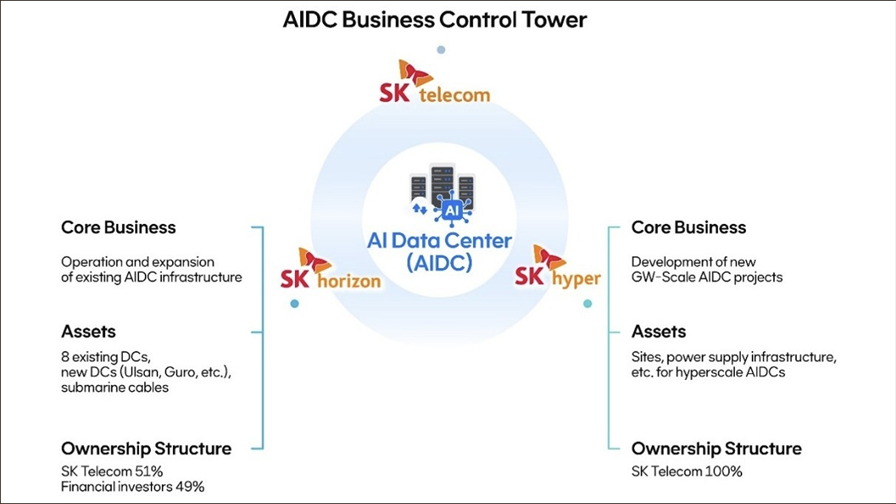
SK Telecom (SKT) is to spin off part of its SK Broadband subsidiary to form a new company, SK Horizon, that will focus on the management and development of AI datacentres in South Korea: As part of the spin-off process, SKT is selling a 49% stake in SK Horizon to external investors for about 3tn won ($2.2bn), with private equity firm KKR taking a 29% stake and a consortium of IMM Investment and Stonebridge Capital acquiring a 20% stake (SKT will retain control of the company with a 51% stake). The split, which will leave SK Broadband to focus on the provision of fixed line, media and enterprise services, is expected to take place in the first quarter of 2027, subject to shareholder and government approval. SK Horizon will oversee eight operating datacentres in Seocho, Ilsan, Bundang, Gasan, Centum, Yangju, and Pangyo, as well as a number of AI infrastructure facilities currently under construction in Ulsan and Guru, with a total capacity of 318MW across all the facilities: It will also manage the group’s subsea cable business. Kim Seong-su, CEO of SK Broadband, is expected to concurrently serve as CEO of SK Horizon. SKT will continue to “oversee the AI datacentre business”, setting business strategy and direction, as well as collaborating with global tech companies. SK Horizon will handle operations and expansion, and SK Hyper, which SKT launched in July to spearhead the construction of AI infrastructure, will develop gigawatt-scale projects, SKT stated in its announcement, adding that with the formation of SK Horizon, SKT has now “completed the establishment of a full-scale AIDC business structure”.
Anyone waiting for the Nvidia bubble to burst will be disappointed today after the AI tech giant reported a 106% year on year increase in fiscal second quarter revenues to $96.2bn and a 124% increase in operating profit to $63.7bn. Unusually, the company, which hasn’t previously provided advance full-year forecasts, told investors during its earnings call that it expects revenues in the financial year that runs from February 2027 to January 2028 to be 70% higher than the total sales it expects to generate in the current year – that’s way higher than the 45% that, on average, financial analysts had been expecting. CEO Jensen Huang told shareholders that demand is running higher but that supply chain constraints will limit how much product it can make. The news sent Nvidia’s share price up by 7.3% in early trading on the Nasdaq exchange on Thursday morning to $224.95, giving the company a market value of $5.44tn (note – that is not a typo!). One of Nvidia’s key customers is hyperscaler Amazon Web Services (AWS), which has just struck a deal to deploy 2 million more Nvidia GPUs.
Nvidia is returning a lot of money to shareholders but it is making the most of its glory years by investing in partners and making acquisitions too. According to The Information (subscription required), its next acquisition is set to be the $12.9bn purchase of popular open source AI and machine learning development platform Hugging Face, which was in the headlines recently when it was hacked by a rogue OpenAI agent.
Qualcomm has reignited the 6G timeline debate at its 6G Leadership Day event in San Diego by stating it is targeting the launch of a commercial 6G modem-RF in the second half of 2029, which industry analyst (and former Qualcomm employee) Prakash Sangam, principal and founder at Tantra Analyst, called “a bold commitment” in this post on X. That’s because the 3GPP’s initial specifications for 6G (in Release 21) are set to be completed only months before, in March 2029, according to a 3GPP announcement made in June this year, and the general industry consensus is that the first 6G deployments will only start to appear in a few advanced markets from 2030. However, as the chip vendor announced earlier this year, Qualcomm and multiple partners have outlined “a clear, milestone-driven roadmap focused on delivering 6G commercial systems starting from 2029 onwards.” And don’t forget that the wireless chip giant is under pressure from the Trump administration, which is very keen to be first with 6G deployments, to deliver pre-standards 6G chipsets in time for the Summer Olympics that will be held in Los Angeles in July 2028. Meanwhile, many network operators are keen to bide their time and not rush into 6G, especially as so many spectrum, licencing and regulatory decisions will need to be made before anything that can be truly called 6G hits the airwaves. Expect this to be a running theme for the next four years…
Qualcomm’s 6G plans don’t stop at the device modem, of course. It is also developing products for next-gen cellular network infrastructure, specifically for radio units that are power-efficient, AI-driven, and based on Giga-MIMO architectures (comprising thousands of antenna elements) that enable wide area sensing capabilities, as well processors for centralised and distributed unit (CU/DU) telco servers are built around “datacentre-grade Qualcomm Oryon CPUs and Hexagon NPU technology”. Giga-MIMO is a term that has been bandied about by Qualcomm and some of the network equipment vendors for a couple of years already but we can expect to see it referenced alongside Massive MIMO a lot more as the 6G marketing budgets get bigger…
One New Zealand has struck a network infrastructure sharing agreement with rival mobile operator 2degrees through a jointly-owned wholesale business, which will be called RANCo. The venture will combine each company’s radio access network (RAN) infrastructure to facilitate a faster rollout of new technologies across New Zealand. The deal builds on a pre-existing commercial RAN sharing arrangement between the companies for a smaller number of sites. Under the proposal, RANCo would own, manage and operate the shared RAN infrastructure, providing network services back to the two operators through separate wholesale agreements. One NZ (formerly Vodafone) is New Zealand’s second largest wireless carrier, with a market share of about 38%, while 2degrees is third, with around 20% of connections. Spark is the largest operator, according to OpenNZ. Any RAN-sharing deal would be subject to regulatory approval and the companies were keen to stress that they “would continue to operate as fully independent retail and wholesale businesses and continue to compete strongly for both consumer and business customers.” Should the partnership be rubber stamped by the NZ Commerce Commission and the Overseas Investment Office, it is expected to complete in the first half of 2027.
Exa Infrastructure has expanded its long-haul terrestrial network to offer a route connecting the Spanish cities of Barcelona and Bilbao. The new route, which also runs past the Spanish city of Zaragosa, creates a more direct corridor linking transatlantic cable systems landing in Bilbao to routes onward into the Mediterranean, Middle East, Africa and Asia. The move is also important for Spain’s growing datacentre sector: With more than 1.6 gigawatts (GWs) of projected capacity by 2030, according to FDI Intelligence, the Aragon region, of which Zaragosa is the capital, is becoming a major European datacentre hub following investment from the likes of Microsoft and AWS. The new path will help meet growing traffic demand between key cities such as Lisbon, Madrid and the rest of Europe, according to Exa Infrastructure. “Barcelona has always been a natural meeting point between East and West,” said Steve Roberts, the operator’s senior VP of strategic investments and product management. “By extending our terrestrial long-haul footprint directly to the Atlantic corridor, we are giving our customers, and the subsea players that already land there, a genuinely shorter and more resilient path to transatlantic systems.”
AT&T, Verizon, T-Mobile US, Ericsson and Nokia have all been cleared of patent infringement by a Texas court, which found in favour of the five companies and dismissed all claims by Taiwanese tech giant ASUS, first levelled in 2023, that the five had infringed the vendor’s wireless technology patents in their 4G and 5G products and subsequent deployments. Law firm McKool Smith, which represented all five telecom firms, noted in this LinkedIn post: “After a seven-day trial before Judge Gilstrap, the jury unanimously rejected all claims brought by ASUS Technology Licensing, Innovative Sonic and Celerity IP, awarding none of the $436m they sought. The jury found no infringement on any of the nine asserted claims and ruled all nine invalid. It also found that McKool Smith's clients had negotiated in good faith, while the plaintiffs breached their own FRAND [Fair, Reasonable, and Non-Discriminatory] licensing obligations.”
Boldyn Networks has partnered with agritech specialist Pneumonitor and West Sussex County Council to use mobile technology to monitor livestock in the English county. The project sees Pneumonitor’s in-pen environmental monitor leveraging Boldyn’s 5G network to offer farmers real-time insight into conditions inside livestock buildings, making it easier for them to identify and respond to issues that may increase the risk of disease or animal stress. It uses Boldyn’s 5G Reduced Capability (RedCap) technology, which is designed for IoT devices that do not require the full capability of 5G, using less power and offering longer device life. The project is part of the Council’s Growing Sussex initiative, which aims to co-develop and showcase practical uses of 5G, IoT and AI, across food, drink and agricultural production in Sussex. As part of this Boldyn is providing four private 5G networks, which all went live by December 2025.
Google has selected 28 AI startups that are focused on the energy sector to join its Google for Startups Accelerator programs across North America and Europe, giving the specialists 10 weeks of mentorship and access to the tech giant’s tools. This blog names all 28 and briefly identifies their areas of focus. If energy efficiency is of interest, and you like to wonder at the inventive names dreamed up by startups, this cohort is worth checking out.
– The staff, TelecomTV
Email Newsletters
Sign up to receive TelecomTV's top news and videos, plus exclusive subscriber-only content direct to your inbox.