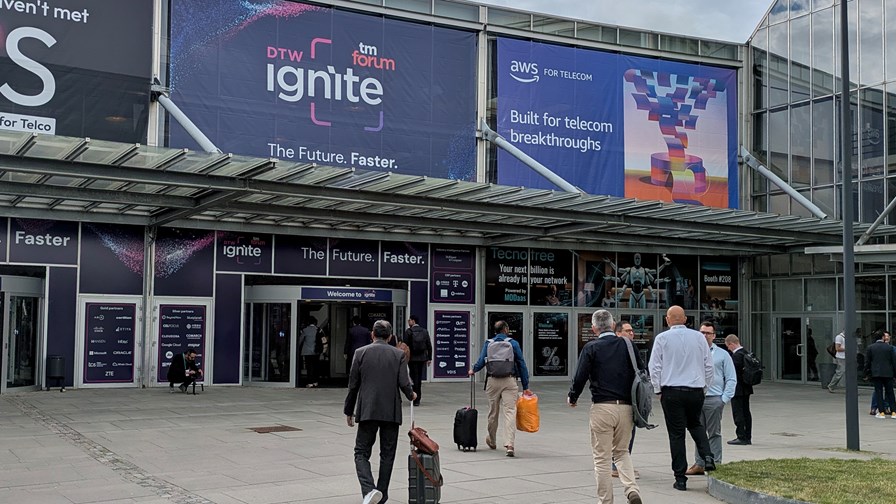
- Automation, AI, data and trust dominate discussions at DTW Ignite
- Ericsson adds cApps to the telecom lexicon
- Nokia integrates Google Gemini into its software
In today’s industry news roundup: As you’d expect, AI is at the heart of pretty much everything at the annual TM Forum event in Copenhagen; Ericsson expands its automation platform to cover the core platform as well as the radio access network by introducing ‘core apps’; Nokia is also busy at DTW, forging closer ties with Google Cloud and expanding its AI and automation portfolio; and much more!
The TM Forum has opened the doors of its annual event, now dubbed DTW Ignite, and it’s no surprise that AI and automation are the dominant themes being discussed, presented and demonstrated at the show in Copenhagen, though it’s worth noting that data management and “trust” are also featuring in a lot of presentations and announcements too. Here’s a snapshot of some of the announcements made to coincide with day one of the event.
Familiar with rApps (RAN applications), the software modules that run on radio access network (RAN) intelligent controller (RIC) platforms and other network orchestration systems? Now Ericsson has added cApps (core applications) to the ever-increasing list of telecom sector terminology, following the expansion of its Intelligent Automation Platform (aka the EIAP) to “support core networks, creating a unified RAN and core network automation solution” for mobile network operators. The Swedish vendor boasts it is the “first to introduce the concept of, and ability to run, new core-specific automation applications (cApps)”, a move that is welcomed by major customers. “AT&T is building the most intelligent and resilient network, and this means embracing automation across every layer of our network and operations,” noted Rob Soni, VP of RAN technology at the US operator. “Ericsson’s expansion of EIAP to include core network automation is a significant step forward for the industry. Having a single platform running cApps and rApps gives operators a critical tool for delivering on the vision of a truly autonomous network, harnessing the power of agentic AI, that can sense, decide and act in real time.” Philipp Bichsel, executive VP of mobile network and services at Swisscom, stated: “Swisscom’s goal is straightforward – provide the best mobile customer experience, driven by data in an automated way. Ericsson has been a valuable partner in this mission, with its EIAP and rApp ecosystem forming a vital element in our constant evolution towards higher levels of autonomy. With this expansion of the platform’s capabilities to include management of core network and providing a platform for cApps, Ericsson has given the market a powerful tool for building on early success with introducing RAN automation, extending those abilities to help deliver an autonomous and programmable network end to end.”
Ericsson also launched its OSS/BSS Business Value Pathways, which the vendor says will help telcos with their autonomous network plans. “Built on Ericsson’s continuous OSS/BSS portfolio evolution and the market-leading AI and automation capabilities from across the whole Ericsson portfolio of products and solutions, the pathways are pre-designed, integrated and proven operational and solution combinations to ensure expected outcomes are delivered,” the company noted in this announcement. They “enable CSPs to move beyond the addition of AI to legacy automation in order to speed up execution. Instead, they represent a more holistic approach resulting in targeted and specified transformation outcomes for intent-based network autonomy where a system plans, designs, validates and runs the change required without human intervention,” the vendor added.
To support its cApps development, Ericsson has also introduced Ericsson Stream Processing and Enrichment (ESPE), which is a new data-streaming capability in Ericsson Network Manager (ENM). “Part of ENM’s overall evolution towards strengthening its capabilities in core network, ESPE acts as a network-wide single source of truth for low-latency network event data, collecting streaming data from Ericsson RAN and core nodes, and ORAN [Open RAN] nodes, in real-time, handling the processing, enrichment, exposure and replication of the data as needed,” noted the vendor. Ericsson’s head of network automation, Anders Vestergren, stated: “By expanding the Ericsson Intelligent Automation Platform to the core, we are providing our customers with a critical central enabler for their autonomous network journey. The expanded EIAP will unify the management and automation of RAN and core networks, provide a single source of truth for network topology and resource data through the central resource layer, and deliver reliable low-latency data from ENM’s streaming capability (ESPE). It gives CSPs a simplified route to deploying complex, high-value differentiated services with real control over cost and complexity.”
Existing tech buddies Google Cloud and Nokia have expanded their partnership to integrate Google’s Gemini AI models into Nokia’s Assurance Center network software suite. Nokia has developed six specialised AI agents built with Gemini that, the telecom vendor believes, will “advance its capacity to help telecommunication providers lower operational costs, rapidly resolve network issues, and move toward fully automated, self-driving operations.” The partners noted: “As modern networks generate increasingly complex volumes of data, telecom providers face significant bottlenecks. Traditional management relies on manual troubleshooting that struggles to keep up with escalating alerts, often resulting in costly downtime. This partnership addresses these challenges by using agents to instantly process raw data, helping telecom providers distinguish critical infrastructure issues from background noise to accelerate repairs and protect revenue.” Vivek Jaiswal, senior VP of autonomous networks at Nokia, stated: “The AI era demands a new kind of network – one that is programmable, AI native and able to operate at machine speed. With Gemini-powered agents integrated into Nokia’s automation portfolio, we’re helping telecom providers move beyond manual operations to maximise performance, ensure reliability and find new efficiencies within their data.”
Still with Nokia…. The Finnish vendor announced multiple upgrades to its autonomous networks portfolio by introducing “a comprehensive set of agentic AI capabilities designed to help telecommunication providers simplify operations, improve network performance, and respond more effectively to increasingly complex and dynamic traffic demands.” It has unveiled a “new Autonomous Networks Agent Library, released the latest version of its Autonomous Networks Suite, enhanced RAN automation, and showcased new AI-driven frameworks for IP, fixed and optical networks,” it noted in this announcement. “Together, these capabilities enable operators to phase in various elements of AI and agentic automation across the stack, while maintaining operational control and trust in live network environments.” Pallavi Mahajan, Nokia’s chief technology and AI officer, stated: “As networks evolve from static infrastructure into programmable, AI-native platforms, there’s growing pressure to manage unpredictable traffic patterns driven by AI-intensive workloads. Our latest advancements are designed to help operators move towards higher levels of network autonomy, resulting in faster decision-making, automated operations and more efficient use of network resources,” all of which you’d expect to be baked into modern telecom platforms these days.
Of course, wherever AI is a focus you’ll find Nvidia, and DTW Ignite is no different. The AI tech giant is in Copenhagen to show how it, and its partners, can help telcos automate their network operations with the help of AI agents that can “proactively watch for problems and coordinate changes across network, IT and business systems. Together, synthetic data, telecom-domain models, secure agent runtimes and simulations form critical pieces of a secure, telecom autonomy platform, where agents understand operator intent, act safely across business and network domains and keep humans in control of policy,” the company noted in this announcement.
– The staff, TelecomTV
Email Newsletters
Sign up to receive TelecomTV's top news and videos, plus exclusive subscriber-only content direct to your inbox.