To embed our video on your website copy and paste the code below:
<iframe src="https://www.youtube.com/embed/ODcaiu0qIJw?modestbranding=1&rel=0" width="970" height="546" frameborder="0" scrolling="auto" allowfullscreen></iframe>
Tony Poulos, TelecomTV (00:08):
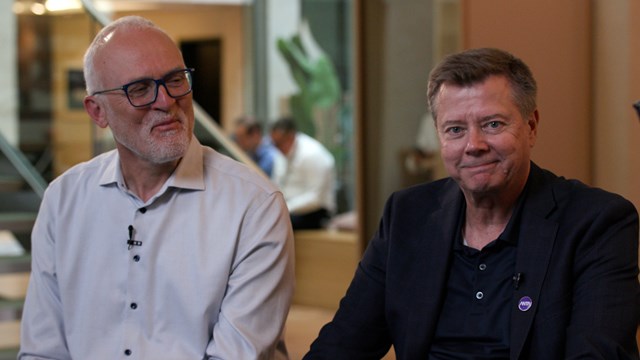
Tony Poulos here at TelecomTV's AI Native Telco Forum in Dusseldorf. Today I have with me Bob Dietrich, who's the director, solutions engineering at Wavelo, and with him, Francis Haysom, who is the principal analyst at Appledore Research. Gentlemen, great to catch up here. Look, what does it mean to actually be an AI-native telco in 2026, and how close is the industry to getting there?
Francis Haysom, Appledore Research (00:34):
Well, Tony, I think that's an interesting question, and of course I used AI to actually answer the question, and it was quite interesting. Copilot came up with three things, one of which was that it's a buzzword. It's the latest buzzword. It's a replacement for cloud native because that's kind of gone off the boil. Second thing it said was we're just using AI with whatever we are doing. And then the third option was it's a complete foundational from the bottom up replacement, AI everywhere, everywhere in the network. I think all of those actually personally I think are wrong. It's not a buzzword, but I think the important thing is we need to focus on not trying to do everything in one go, not just simply just bolting on things, but to think about AI native as being a decision-making process. And that AI native is about enabling machine-time decision making rather than human decision-making time as it were.
(01:29):
So if we take that as the centre of our argument, that's probably the key starting point for AI.
Tony Poulos, TelecomTV (01:34):
Bob, can you add to that, do you think?
Bob Dietrich, Wavelo (01:36):
I think we're moving processes and decision making to the scale, right, where humans can go so far and then AI can go faster. And we also, as an AI-native company, want to be able to enable that. So that requires giving data, you want to make sure your AI has some guidelines and guardrails, and then also you want to govern it on what it does.
Tony Poulos, TelecomTV (01:57):
Is access to AI models still a bottleneck for operators or has access to the right operational data become the bigger issue? Francis?
Francis Haysom, Appledore Research (02:07):
I think the model thing, the reality is telco has been using models, AI models, not the generative ones that we've become used to over the last few years, but we've been using AI a lot in that one. We're used to using models. The challenge has always been data. And one of the speakers this morning neatly put it is like we're moving from a human decision-making framework to a machine data. And that changes the nature of how accurate, but also how timely, et cetera, data needs to be. I'll reiterate an earlier point. I think it becomes also a little bit more, it's not just, I think there's an unnecessary quest for what I would term as perfect data. I think it becomes much more apparent what the quest is, is for relevant data at the right time to make relevant decisions and also learning from making those decisions and how we improve our data or use different data to bring that in.
(03:12):
So I think it's a little bit of everything. The models are there. We now need to work out not just perfect data, but how do we manage data better?
Bob Dietrich, Wavelo (03:22):
Yeah, we're seeing a lot of companies trying to go out and build large data models thinking I can get all the data together in one place and then the AI will pull it together. And I think they're finding issues where siloed data has a lot of conflicts and AI will try to interpret those conflicts adding hallucinations and issues. But also that data they're moving is often batched or latent. So what we're trying to do at Wavelo is we're developing an event-driven architecture that allows us to provide data and the context around the data. So it's not only knowing that a subscriber was provisioned, but I knew how long it took to provision. I knew how many times it took. I knew if this had an issue in the network. Everything is real time, but also with the event-driven architecture, I'm moving away from these siloed point-to-point APIs where data is fragmented.
(04:17):
I can now provide a fabric of data that's streaming and AI can just gulp that up and start making the real-time decisions in the right way.
Tony Poulos, TelecomTV (04:25):
Well, it leads me to my next question. Traditional BSS and OSS were built for transactions and batch processing, as you did mention, but how much is that holding operators back and what has to change architecturally for AI to work in real time? Francis, can you start off on that one.
Francis Haysom, Appledore Research (04:42):
Yeah, I think we need to start thinking in iterative steps to moving there. It's not that we need to move all of our data in one go to real time. I've got far too much history with rip and replace big transformational projects. They fundamentally do not work. Or more importantly, actually they tend to reinforce the way of working that we have today. You want an incremental approach, you want to be learning from the data uses, and you want to, first of all, to leverage the data that you already have, even if it is slow, et cetera, but start to focus on the areas where you understand timeliness is more important or distribution of data is more and more important. Don't try to make that big leap, make little incremental changes and start to bring the data together.
Tony Poulos, TelecomTV (05:42):
Presumably there will be times when AI will need to access old data or processed and historic data as opposed to real time. Is that manageable now?
Bob Dietrich, Wavelo (05:52):
So it can access that today, but we're also trying to, again, get that one to many event broker going where, as I mentioned, the point-to-point interfaces between an ordering and a provisioning system or an ordering and a billing system, there is context in those interactions and we're trying to listen to those and be able to generate those events in almost a digital twin in our event-driven architecture. And then AI can see that as one composite set of streams of data. So instead of point to point in trying to grab that information, we can incrementally move that data without affecting what's going on and AI can then jump in and start adding value.
Tony Poulos, TelecomTV (06:30):
Well, let's get onto AI agents because they're moving from making simple recommendations to actually taking actions, particularly at network level. What does that mean for telecom operators? Do you want to kick off with that one?
Bob Dietrich, Wavelo (06:41):
Sure. I mean, what AI needs is a few things. One is it needs access to the data, have real data. It also needs business logic with guardrails. It needs to be able to do some things and understand what it can do, but with constraints we give it. Also, it needs access to tools, other agents or APIs that also needs to be governed where I don't give AI keys to the kingdom, but I give it plenty of things it can do to solve the intent it's doing. And then finally, like we were talking this morning is I need to have things that are observable. Everything an agent does, I need to be able to track it and log it so I can see that it has been successful or if it's not successful, how I can follow up and make it incrementally better.
Tony Poulos, TelecomTV (07:29):
I think everyone's got the same issue, right? Not just the telecoms industry.
Francis Haysom, Appledore Research (07:32):
No, I think one of the things we don't realise about telco is that part of the reason why we're finding problems with agentic decision making is in fact, we've got a false comparison. We tend to regard human decision making as almost infallible when we're comparing it with agentic AI. It's not. We know that. Telcos make mistakes in networks, that's why—
Tony Poulos, TelecomTV (07:57):
From experience.
Francis Haysom, Appledore Research (07:58):
...certain Australian companies have completely brought down their networks and many others have. I think the important thing is we need to level the playing field between the two. And most importantly, recognise agents will make decision-making mistakes. Humans make decision-making mistakes. The worst thing you can do is not learn by those mistakes. Also, having a view of decision-making criticality as it were. Some decisions can be made wrong and they don't have much of a consequence. They'll deaden down with time. Some decisions like changing your BGP routing tables, for example, will have catastrophic effects.
(08:39):
So we need an understanding of decision-making risk in that one and feeding that back. When do I make good decisions? When did I make bad decisions? How do I learn by whether I made a good or a bad decision?
Tony Poulos, TelecomTV (08:52):
So if an operator wants to be genuinely AI ready in the next 12 to 18 months, what should it prioritise right now?
Francis Haysom, Appledore Research (09:00):
I think the first thing to prioritise is, to Bob's point, how do I bring the data that I already have together? What are the decisions that I can safely make? Probably starting with the decisions that are automatable and I can recover from easily. Don't go for the big decisions. Start to learn by that process. Like a stuck record, it's all about iterative. It's learn by what you experience. Don't seek the perfect end architecture. Don't seek the perfect end state for it and start learning. Start learning about how you're making agentic decision making.
Tony Poulos, TelecomTV (09:47):
Bob, is it realistic that that'll happen in the next 12 to 18 months?
Bob Dietrich, Wavelo (09:49):
I think so where we can. You don't try to solve everything, but you try to hit the key priority business processes. Everything's about process and process needs data. So you want to build your process, you want to understand the flow you need, then you consume the data you need to be able to execute it. And food for thought, bad process causes bad data. So even if I can get good data into a bad process, I get bad data again. So I need to make sure the process is tight, I can iterate, I can see both. We talked about it knowing the baseline of an agent and the end state of an agent after it executed. Did it achieve what it did? And one of that should be don't corrupt my data, let's keep it going. But absolutely can be achieved in 12 to 18 months starting with that data and the process.
Tony Poulos, TelecomTV (10:36):
Well, we still have a lot of challenges to become AI-native telcos. Bob, Francis, thanks for being with me today. Thank you. Appreciate it. Pleasure.
Tony Poulos here at TelecomTV's AI Native Telco Forum in Dusseldorf. Today I have with me Bob Dietrich, who's the director, solutions engineering at Wavelo, and with him, Francis Haysom, who is the principal analyst at Appledore Research. Gentlemen, great to catch up here. Look, what does it mean to actually be an AI-native telco in 2026, and how close is the industry to getting there?
Francis Haysom, Appledore Research (00:34):
Well, Tony, I think that's an interesting question, and of course I used AI to actually answer the question, and it was quite interesting. Copilot came up with three things, one of which was that it's a buzzword. It's the latest buzzword. It's a replacement for cloud native because that's kind of gone off the boil. Second thing it said was we're just using AI with whatever we are doing. And then the third option was it's a complete foundational from the bottom up replacement, AI everywhere, everywhere in the network. I think all of those actually personally I think are wrong. It's not a buzzword, but I think the important thing is we need to focus on not trying to do everything in one go, not just simply just bolting on things, but to think about AI native as being a decision-making process. And that AI native is about enabling machine-time decision making rather than human decision-making time as it were.
(01:29):
So if we take that as the centre of our argument, that's probably the key starting point for AI.
Tony Poulos, TelecomTV (01:34):
Bob, can you add to that, do you think?
Bob Dietrich, Wavelo (01:36):
I think we're moving processes and decision making to the scale, right, where humans can go so far and then AI can go faster. And we also, as an AI-native company, want to be able to enable that. So that requires giving data, you want to make sure your AI has some guidelines and guardrails, and then also you want to govern it on what it does.
Tony Poulos, TelecomTV (01:57):
Is access to AI models still a bottleneck for operators or has access to the right operational data become the bigger issue? Francis?
Francis Haysom, Appledore Research (02:07):
I think the model thing, the reality is telco has been using models, AI models, not the generative ones that we've become used to over the last few years, but we've been using AI a lot in that one. We're used to using models. The challenge has always been data. And one of the speakers this morning neatly put it is like we're moving from a human decision-making framework to a machine data. And that changes the nature of how accurate, but also how timely, et cetera, data needs to be. I'll reiterate an earlier point. I think it becomes also a little bit more, it's not just, I think there's an unnecessary quest for what I would term as perfect data. I think it becomes much more apparent what the quest is, is for relevant data at the right time to make relevant decisions and also learning from making those decisions and how we improve our data or use different data to bring that in.
(03:12):
So I think it's a little bit of everything. The models are there. We now need to work out not just perfect data, but how do we manage data better?
Bob Dietrich, Wavelo (03:22):
Yeah, we're seeing a lot of companies trying to go out and build large data models thinking I can get all the data together in one place and then the AI will pull it together. And I think they're finding issues where siloed data has a lot of conflicts and AI will try to interpret those conflicts adding hallucinations and issues. But also that data they're moving is often batched or latent. So what we're trying to do at Wavelo is we're developing an event-driven architecture that allows us to provide data and the context around the data. So it's not only knowing that a subscriber was provisioned, but I knew how long it took to provision. I knew how many times it took. I knew if this had an issue in the network. Everything is real time, but also with the event-driven architecture, I'm moving away from these siloed point-to-point APIs where data is fragmented.
(04:17):
I can now provide a fabric of data that's streaming and AI can just gulp that up and start making the real-time decisions in the right way.
Tony Poulos, TelecomTV (04:25):
Well, it leads me to my next question. Traditional BSS and OSS were built for transactions and batch processing, as you did mention, but how much is that holding operators back and what has to change architecturally for AI to work in real time? Francis, can you start off on that one.
Francis Haysom, Appledore Research (04:42):
Yeah, I think we need to start thinking in iterative steps to moving there. It's not that we need to move all of our data in one go to real time. I've got far too much history with rip and replace big transformational projects. They fundamentally do not work. Or more importantly, actually they tend to reinforce the way of working that we have today. You want an incremental approach, you want to be learning from the data uses, and you want to, first of all, to leverage the data that you already have, even if it is slow, et cetera, but start to focus on the areas where you understand timeliness is more important or distribution of data is more and more important. Don't try to make that big leap, make little incremental changes and start to bring the data together.
Tony Poulos, TelecomTV (05:42):
Presumably there will be times when AI will need to access old data or processed and historic data as opposed to real time. Is that manageable now?
Bob Dietrich, Wavelo (05:52):
So it can access that today, but we're also trying to, again, get that one to many event broker going where, as I mentioned, the point-to-point interfaces between an ordering and a provisioning system or an ordering and a billing system, there is context in those interactions and we're trying to listen to those and be able to generate those events in almost a digital twin in our event-driven architecture. And then AI can see that as one composite set of streams of data. So instead of point to point in trying to grab that information, we can incrementally move that data without affecting what's going on and AI can then jump in and start adding value.
Tony Poulos, TelecomTV (06:30):
Well, let's get onto AI agents because they're moving from making simple recommendations to actually taking actions, particularly at network level. What does that mean for telecom operators? Do you want to kick off with that one?
Bob Dietrich, Wavelo (06:41):
Sure. I mean, what AI needs is a few things. One is it needs access to the data, have real data. It also needs business logic with guardrails. It needs to be able to do some things and understand what it can do, but with constraints we give it. Also, it needs access to tools, other agents or APIs that also needs to be governed where I don't give AI keys to the kingdom, but I give it plenty of things it can do to solve the intent it's doing. And then finally, like we were talking this morning is I need to have things that are observable. Everything an agent does, I need to be able to track it and log it so I can see that it has been successful or if it's not successful, how I can follow up and make it incrementally better.
Tony Poulos, TelecomTV (07:29):
I think everyone's got the same issue, right? Not just the telecoms industry.
Francis Haysom, Appledore Research (07:32):
No, I think one of the things we don't realise about telco is that part of the reason why we're finding problems with agentic decision making is in fact, we've got a false comparison. We tend to regard human decision making as almost infallible when we're comparing it with agentic AI. It's not. We know that. Telcos make mistakes in networks, that's why—
Tony Poulos, TelecomTV (07:57):
From experience.
Francis Haysom, Appledore Research (07:58):
...certain Australian companies have completely brought down their networks and many others have. I think the important thing is we need to level the playing field between the two. And most importantly, recognise agents will make decision-making mistakes. Humans make decision-making mistakes. The worst thing you can do is not learn by those mistakes. Also, having a view of decision-making criticality as it were. Some decisions can be made wrong and they don't have much of a consequence. They'll deaden down with time. Some decisions like changing your BGP routing tables, for example, will have catastrophic effects.
(08:39):
So we need an understanding of decision-making risk in that one and feeding that back. When do I make good decisions? When did I make bad decisions? How do I learn by whether I made a good or a bad decision?
Tony Poulos, TelecomTV (08:52):
So if an operator wants to be genuinely AI ready in the next 12 to 18 months, what should it prioritise right now?
Francis Haysom, Appledore Research (09:00):
I think the first thing to prioritise is, to Bob's point, how do I bring the data that I already have together? What are the decisions that I can safely make? Probably starting with the decisions that are automatable and I can recover from easily. Don't go for the big decisions. Start to learn by that process. Like a stuck record, it's all about iterative. It's learn by what you experience. Don't seek the perfect end architecture. Don't seek the perfect end state for it and start learning. Start learning about how you're making agentic decision making.
Tony Poulos, TelecomTV (09:47):
Bob, is it realistic that that'll happen in the next 12 to 18 months?
Bob Dietrich, Wavelo (09:49):
I think so where we can. You don't try to solve everything, but you try to hit the key priority business processes. Everything's about process and process needs data. So you want to build your process, you want to understand the flow you need, then you consume the data you need to be able to execute it. And food for thought, bad process causes bad data. So even if I can get good data into a bad process, I get bad data again. So I need to make sure the process is tight, I can iterate, I can see both. We talked about it knowing the baseline of an agent and the end state of an agent after it executed. Did it achieve what it did? And one of that should be don't corrupt my data, let's keep it going. But absolutely can be achieved in 12 to 18 months starting with that data and the process.
Tony Poulos, TelecomTV (10:36):
Well, we still have a lot of challenges to become AI-native telcos. Bob, Francis, thanks for being with me today. Thank you. Appreciate it. Pleasure.
Please note that video transcripts are provided for reference only – content may vary from the published video or contain inaccuracies.
Bob Dietrich, Wavelo & Francis Haysom, Appledore Research
Bob Dietrich, director of solutions engineering at Wavelo, and Francis Haysom, principal analyst at Appledore Research, discuss what it really means to be an AI-native telco in 2026, why AI native is best understood as machine-time decision-making, how the challenge has shifted from AI models to relevant real-time data, and much more.
Featuring:
- Bob Dietrich, Director, Solutions Engineering, Wavelo
- Francis Haysom, Principal Analyst, Appledore Research
Recorded September 2026