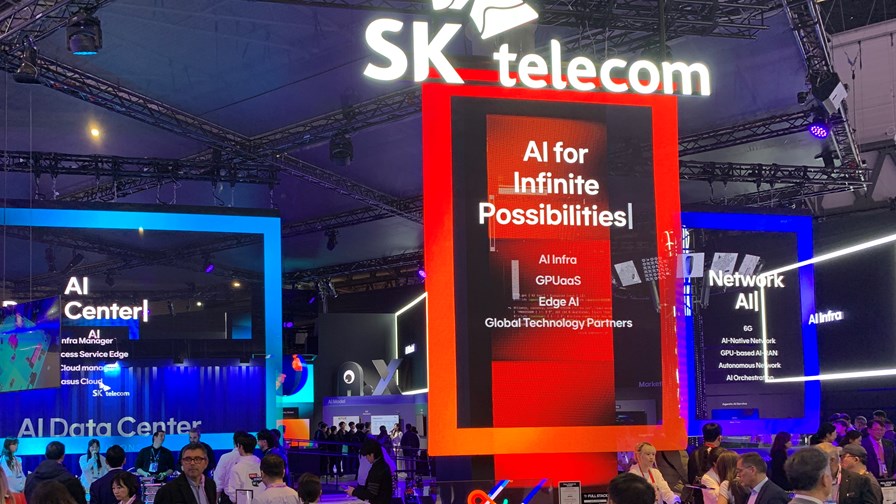
SK Telecom's MWC26 booth is dominated by AI messaging.
- South Korean operator is to treat AI agents as digital employees, with job functions and IDs as part of its new AI transformation strategy
- The agents will interact directly with human employees to speed up processes and improve internal communications and decision-making
- The aim is to achieve ‘groundbreaking’ improvements in productivity and innovation
SK Telecom has been flying the AI flag at full mast for longer than most telcos, having announced itself as an “AI company” as long ago as late 2021 and unveiled its AI Pyramid strategy in September 2023. Now it has unveiled its AX (AI transformation) Innovation 2.0 strategy that will embed AI deep into its day-to-day company-wide operations and treat AI agents as if they are employees.
In announcing the plan, the South Korean operator’s CEO Jae-heon Jeong noted that the company’s existing AX Innovation 1.0 strategy has been focused on improving corporate efficiency, but that the 2.0 initiative aims to “build an environment where employees can become more immersed” in AI transformation, according to this announcement (in Korean).
The approach treats AI not as a tool but as an entity that works alongside human staff, and aims to “fundamentally redesign the way [employees] work so that AX could lead to a groundbreaking improvement in organisational productivity and innovation in the company's business model,” the operator noted.
“AI agents will be managed through procedures similar to those of humans from hiring to termination, including receiving an employee ID and being assigned a department, job function and authority,” the operator noted, adding that it is “establishing a governance system that enables humans and AI agents to work together, including the creation of regulations regarding data and security access rights for AI agents.”
With that in mind, the company is “enhancing its security system to enable employees to use AI tools and agents safely, easily and flexibly.”
It is also trialling an “AI Sandbox” where “one person performs multiple roles, such as planning, development and design alongside multiple agents,” noting that the process is leading to productivity improvements that drastically reduce the time required for planning while improving internal communications and decision-making.
“The goal is to move beyond the existing division of [a] labour-centred work structure and spread a work culture where planning, execution and improvement are carried out more quickly with the help of AI,” noted SKT.
It’s hard to imagine such an initiative won’t capture the attention of network operators worldwide, as we hear so often that the main challenges associated with the introduction and use of new technologies or processes, whether it is cloud-native, AI or others, are to do with working culture and human factors.
- Ray Le Maistre, Editorial Director, TelecomTV
Email Newsletters
Sign up to receive TelecomTV's top news and videos, plus exclusive subscriber-only content direct to your inbox.